

|
|
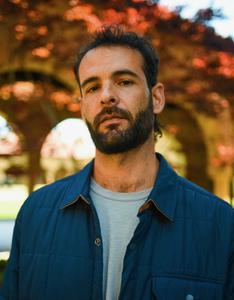
| photo: Jemimah Wei | |
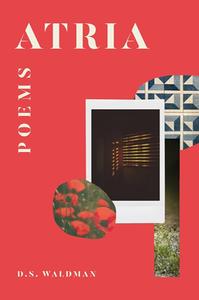
D.S. Waldman is the author of the poetry collection Atria (Liveright, February 17, 2026), his debut that explores presence and absence, proximity and distance with formally experimental poems. His writing has appeared in the New Yorker, the Atlantic, the Los Angeles Review of Books, ZYZZYVA, and many other publications. A former Wallace Stegner Fellow at Stanford University and recipient of the Poetry Society of America's Lucille Medwick Memorial Award, Waldman lives and teaches creative writing in New York City.
Handsell readers your book in 30 words or less:
Atria is a formally restless text interested in grief and love and art and how they affect the way we see and interact with the world.
On your nightstand now:
Helen Vendler's Invisible Listeners: Lyric Intimacy in Herbert, Whitman, and Ashbery. I'm a bit of a dork in that I enjoy reading criticism, and I like to have at least one book of criticism going in the background while I read something else, fiction or poems or whatever. I'm not aware of a better reader of poems than Helen Vendler was--I love this book.
Favorite book when you were a child:
Bud, Not Buddy by Christopher Paul Curtis. I'm not sure if it was my favorite, but it's the first to come to mind. There's this outrageous and memorable scene in which a cockroach or some other bug crawls into someone's ear and begins speaking to them, or makes sounds that sort of evolve into speech. In truth, I don't even remember the plot. I need to revisit it.
Your top five authors:
In no particular order, and with the caveat that my top five is probably pretty fluid:
Anne Carson
Julio Cortázar
Garth Greenwell
Maggie Nelson
Ben Lerner
Book you've faked reading:
Leaves of Grass by Walt Whitman. I've just never been able to get into Whitman the way it seems like I'm supposed to; I prefer reading Helen Vendler and Ben Lerner and Robert Bly and others who write about him. Maybe if I had lived a hundred or more years ago his verse would've resonated with me.
 Book you're an evangelist for:
I'm not so evangelical, but a book I recommend to a lot of people, and which I teach often when working with nonfiction students, is Figure It Out by Wayne Koestenbaum. He is a writer who has definitely cycled in and out of my top five, depending on the day or the moment, and this collection of essays in particular has so much to offer my students. I think it helps reimagine what an essay is and how it operates and what its aims or non-aims can be.
Book you've bought for the cover:
Time and Materials by Robert Hass--I bought it for the cover, but it turned out to be one of my all-time favorites, a tremendous poetry collection. I also used its cover as inspiration for the design of my own book jacket.
Book you hid from your parents:
I remember my first time flying into LAX--I'm not sure how I got separated from my parents--I was approached by a guy handing out these self-realization books, and I took one. In truth, I never even read it; it was more a talisman of the West Coast progressivism and looseness and free-spiritedness that, having grown up in rural Kentucky, I'd never really encountered. I think my mom found it eventually and was pretty concerned. She thought it was some cult thing.
Book that changed your life:
I think every book I read changes my life, to a degree. I don't remember when I first encountered Anne Carson's Nox--sometime after my own brother died, but before I'd really started writing poetry with any seriousness. I read it and knew I wanted to make something to both work through and memorialize that loss, something formally defiant and distinctly my own, like Nox.
Favorite line from a book:
"At the end of my suffering/ there was a door."
Probably the bravest first line of any poetry collection I'm aware of (Louise Glück, The Wild Iris).
Five books you'll never part with:
Nox by Anne Carson
Ways of Seeing by John Berger
Go Tell It on the Mountain by James Baldwin
Proofs & Theories by Louise Glück
What the Living Do by Marie Howe
Book you most want to read again for the first time:
The Topeka School by Ben Lerner--mostly for its penultimate chapter, and in particular the final several paragraphs of that chapter, which the entire novel builds toward. Spectacular.
If you could never read or write again, what would you do instead:
Watch and direct films. I've lately been obsessed with Joachim Trier's recent film Sentimental Value; I think it has made me want to work (when, I don't know) on some sort of film project.