

 In the nine interlinked sections of her thought-provoking, poignant debut graphic memoir, Names and Faces, Leise Hook grapples with "what it means to have a mixed identity in a world that insists on its impossibility."
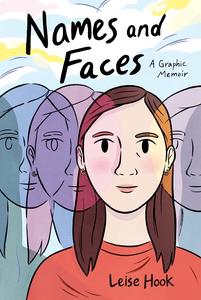
Hook beautifully marries the verbal and visual representation of her internal struggle, using predominant shadings of blue and salmon pink, with full-color renderings reserved for flashbacks or moments of clarity. In the introduction, haunting questions appear in thought balloons that nearly crowd her out of one panel, in which she sits at her desk while a rendering of herself splinters into three ghost-like figures. She sets the stage for the tug-of-war within, a U.S.-born woman caught between her mother's Chinese heritage and her father's German roots. Her parents, both linguists, each gave her a name: Liang Li Dun in Chinese; Leise Sara Hook in English. A striking panel image in "Names" shows her portrait in triplicate, a red outline sketch and a blue outline sketch flanking a full-color rendering ("Leise and Lidun/ live alongside/ each other").
In "Faces," Hook breaks her blue- and pink-dominated palette for full-color memories of elementary classmates in Michigan, and of sixth grade at an international school in Tokyo, where she finds herself among mixed-race students ("I was blissfully unremarkable--allowed to exist in a way I'd never experienced before"). "The Vine and the Fish" mines the phrase "invasive species" in a green palette as Hook considers the many Asian species originally brought to the U.S. to address ecological problems ("Can we fully understand our ecosystems as long as xenophobia is part of how we see and name?").
Hook's first language was Mandarin Chinese. In "Fluency," she again uses a triple portrait image, this time in gray half-tones, to show a left profile speaking in English, the central image looking out at readers, and the right profile speaking in Chinese. She uses full color judiciously, for moments of epiphany. The final section, "The Portrait," balletically synthesizes the themes of the preceding sections. Hook begins in a blue-tinted color scheme with a memory of sitting for a painter at age six, and ends with her own creation of a full-color self-portrait. "Part of what gives me trouble is I think I feel more Chinese than I look," she writes. Hook generously lays out the moving specifics of her journey, and thus allows readers to experience the universal, ongoing struggle to form a self. Her interrogation offers a template to readers of the questions that make for a meaningful life. --Jennifer M. Brown
Shelf Talker: In her moving debut graphic memoir, Leise Hook shares the process of her evolving sense of self with readers.