

When the news broke last December that ReaderLink would be ending its distribution of mass market paperback books because of a dramatic decrease in sales over the past couple of decades (131 million units in 2004 to 21 million in 2024), I had a curious double response.
|
|
| (credit: Escondido Public Library) | |
First, I realized that I couldn't remember the last time I'd purchased an MMPB, nor what that book might possibly have been. And second, I recalled two moments when MMPBs played a formative role in my reading life.
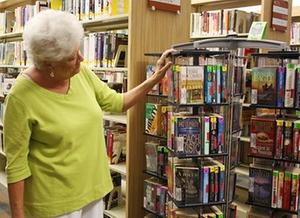
That initial reaction came back to me a couple of days ago, when the Guardian featured a piece headlined "America says goodbye to the mass-market paperback," noting that "for generations of readers, the gateway to literature was not a hushed library or a polished hardback but a wire spinner rack in a supermarket, pharmacy or railway station. There, amid chewing gum and cigarettes, sat the mass-market paperback: squat, roughly 4" by 7" and cheap enough to be bought on a whim." ReaderLink's decision "marks the end of a format that once democratized reading for the working class."
Paula Rabinowitz, a professor emerita of English at the University of Minnesota and the author of American Pulp, observed that the format "generated a new technological explosion of this form of mass reading. The whole idea was to make the books no more expensive than a package of cigarettes at 25 cents and they were often sold outside of bookstores."
Shelly Romero, a literary agent in New York City, told the Guardian she has early memories of going to her local supermarket and buying pulp fiction: "We were very working class; my mom was working two jobs sometimes. The appeal of books being cheaper and smaller and able to be carried around was definitely a thing....
"They had that democratic aspect to them where you can just find them anywhere and it always felt like it was the pick 'n' mix candy-type store where there is something here for everyone, whether it's the Harlequin romance novel or something very pulpy like a sci-fi or horror novel that you could quickly get."
I get it. I also grew up in a small working-class town, where my only book-buying options were Colville's news stand (also a great destination for comics) and Calvi's Dairy Bar.
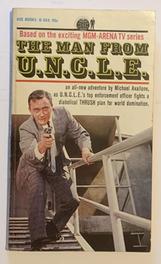 My first personal library was courtesy of the news stand. In addition to watching every episode of The Man from U.N.C.L.E. (IYKYK), I read, re-read, and collected the tie-in novel series, with subtitles like The Doomsday Affair, The Copenhagen Affair, and The Dagger Affair. I bought new editions as soon as they were released and carefully shelved the numbered MMPBs (1-23) on top of my dresser, between wooden bookends my father had made for me.
Those novels were an early bridge to the world I would choose to live in as an adult--the world of books where I became a reader, a writer, a bookseller, and an editor.
Six decades later, a quick inspection of the bookcases in our home (and there are a lot of bookshelves) shows that my MMPB collection has been reduced to just two titles, Aleksandr Solzhenitsyn's The First Circle, translated by Thomas P. Whitney (Bantam, 1969, $4.95); and The Making of One Day in the Life of Ivan Denisovich (Ballantine, 1971, $1.25), translated by Gillon Aitken, with an introduction and screenplay by Ronald Harwood.
Although I saw the Denisovich film adaptation in 1973, two or three years earlier I'd made my first great reading "find" on an MMPB spinner rack at Calvi's Dairy Bar, which was owned by Delfina, a first-generation Italian immigrant. Calvi's was one of those miraculous establishments that managed, in limited space, to fit a lunch counter with stools, a few booths (discretely tucked in the back), a line of glass-enclosed display fixtures offering myriad curios, and, most importantly, the shrine to reading that was the MMPB spinner rack.
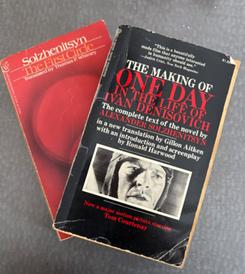 Incredibly, The First Circle was wedged among the romance, thriller, mystery, self-help, and diet books. It would inspire me to read Solzhenitsyn's One Day in the Life of Ivan Denisovich and Cancer Ward. The chance discovery had a profound effect on my reading life. Thanks, Delfina.
In December, after ReaderLink announced its decision, Esther Margolis, publisher of Newmarket Books, told NPR's Daniel Estrin: "I'm very sad about it. I've been sad about it for a while. Even during the '80s, when it started to really shift, I was sad because it really--like you asked before, that you could actually establish a total unknown.
"Today, thank God, you have TikTok and BookTok. They could take somebody unknown and somebody can just get on a camera and say, I love this book, and next thing you know, you have Colleen Hoover or somebody. But that's what you could have done in the past paperback that you can't do really today. To me, Stephen King is a great example. I mean, his whole career, I don't know what--how that might have been built otherwise, if not for the mass-market paperback."
MMPBs still live, of course, but I guess this is my quiet, pre-RIP paying of respects to the format. Or maybe it's just my old eyes acknowledging the fact that I probably couldn't read the small type now anyway.