

 "You do not wait for times to get better," said Keaun Michael Brown of Ujamaa Community Bookstore, Indianapolis, Ind., during Winter Institute 2026 in Pittsburgh, Pa., last week.
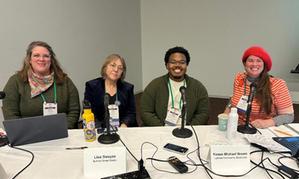
Brown was one of four booksellers on a panel convened to discuss bookselling in times of fascism, and with him were Kimberly Daniels, manager of the Country Bookshop, Southern Pines, N.C.; Lisa Swayze, general manager of Buffalo Street Books, Ithaca, N.Y.; and Jackie Davison, operations manager at the Lynx, Gainesville, Fla. Daniels served as moderator for the discussion.
"You do not wait for an administration to end," Brown continued. "You wait for nobody but yourself."
When it comes to activism and resistance, Brown emphasized the importance of starting small, starting locally, and starting "with what you can do." Booksellers should think about what they can do "right now" with the resources at hand, and if something isn't sustainable, it's a "waste of time." Places to start might include asking customers to round up to the nearest dollar to benefit a local mutual aid fund, or donate a percentage of sales to help local families. And speaking from his experience as an activist, he noted that booksellers already have an extremely valuable asset--a venue, which can sometimes be the "hardest thing" to find.
 |
|
| Left to right: Jackie Davison, Lisa Swayze, Keaun Michael Brown, Kimberly Daniels | |
He cautioned booksellers against neglecting the "small things" because they're thinking about larger systemic and structural problems. "Sometimes what your community, what your people, what your neighbors need is the small stuff," Brown said.
One of the key things to remember, he said, was that "none of this is new." Mass deportations, attacks on queer and trans people, and book bans, to name just a few examples, did not begin with the Trump administration and will not suddenly end when he is out of office. People have been resisting for a long time, and they've "never once given up," said Brown. Those people are out there in communities across the country, and the people "who came before us have all the answers that we need."
Swayze agreed that "a lot of what we can do is in our own communities and in our own stores," while stressing the need for managers and owners to communicate with and care for their staff. Whatever the store ends up doing, staff members "need to be comfortable with it, and they need to be able to own it." At the same time, owners and managers need to "treat them well, and feed them, and do all the things that help them do whatever it is you're going to keep doing."
Much of what Buffalo Street Books does, Swayze added, comes from their community. It has become a space where community members bring resources to be shared and disseminated, whether that be face masks or material about free expression. Starting with something as simple as a community information board could be a good way to start forming those relationships, she said. And whatever tactic a bookstore is looking to pursue, there are almost certainly other organizations in the area doing the same work.
Over the past few years, Swayze continued, Buffalo Street Books has gotten a lot of experience dealing with content and curation challenges, ranging from the events the store hosts to the books it carries. The bookstore has learned to not engage on an emotional level with the people making these challenges, as they are often only interested in provoking booksellers and recording a "soundbite" to be shared online. It is much better to engage based on the "rules and values that you established in your store," such as a curation policy. Swayze urged booksellers to make use of the content challenge resources available from ABFE on Bookweb.org.
Davison remarked that while Florida is "last in a lot of things," it is "number one in book bans." In the 2023-2024 academic year, when there were some 9,000 books banned in the entire country, Florida was responsible for about 4,500 of those, and in the '24-'25 school year, there were more than 2,000 in the state. The store was founded with the goal of fighting back against book bans, Davison said, and the plan was always "we're going to be loud about it."
As such, there is a banned books display right at the front of the store that spans two bays and is there year-round. The upper left corner of the display features the top 10 most banned books, per PEN America, and that is updated each year when a new top 10 list appears. The display also features shelf talkers for the books with information about how many times the title has been banned and the reasons why. Davison called those shelf talkers "invaluable" for starting conversations about book bans, and for these and other conversations about potentially contentious issues, she advised booksellers to prepare "specific language" that staff members can cite.
On the subject of staff training, Davison pointed out that "you don't have to be the expert." She, for example, is not an expert in de-escalation, but she found someone who is, and that expert comes to the Lynx once a year to teach staff about it. Similarly, booksellers should remember that "you can't do everything" and "you shouldn't do everything." It is enough to "pick something and go for it."
Touching on community partnerships, Daniels recommended booksellers use "structures that are already in place" as well as pre-existing relationships as starting points. A lot of bookstores already have plenty of experience partnering with schools to get books to children, she said, and they can use those school partnerships as models for working with other organizations in the community. As an example, the Country Bookshelf has partnered with a nonprofit to buy copies of Jon Meachem's American Struggle and is getting those books into people's hands via community organizations with which the store already has relationships.
When it comes to the "intentionality of language," Daniels said people are coming to the bookstore to have conversations "because they are looking for the language" to be able to talk about these issues at cocktail parties, PTA meetings, basketball games, or wherever else. She encouraged booksellers to have bullet points prepared for staff on various topics so they never have to scramble when customers ask questions. "Say it, practice it," and serve as a model for talking about these things in places where doing so may not be normalized, she said.
Daniels urged booksellers to remember that "every interaction that you have matters" and to take "confidence in every relationship that you have." Just the act of being "can be an act of resistance in every moment." --Alex Mutter