


|
|
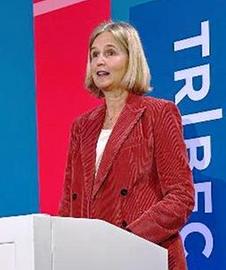
"The decline of reading is a greater challenge to our industry than AI could ever be," said Joanna Prior, CEO of Pan Macmillan, at the London Book Fair Wednesday morning.
Prior took the stage to discuss the reading crisis, which she characterized as an existential threat to the publishing industry, one far greater than generative AI. She noted that in the U.K., only 1 in 3 children enjoy reading in their free time, and half of all adults have stopped reading. Daily reading to children ages 0-5 has dropped 25% since 2019, and even Oxford students, who once read three books per week, are now struggling "to finish one book in three weeks." Prior quoted journalist James Marriott, who said the country is "witnessing the birth of the first post-literate generation."
She emphasized that this not about a lack of intellect. Rather, it is a sign of a "neurological shift" caused by children being raised on short-form algorithms "designed to dismantle the capacity for sustained attention." A generation has been "rewired for the scroll over the page," and with that loss of literacy and inability to pay attention, Prior asserted, "critical thinking is the first casualty." It becomes especially dire given the "global surge of book bans" and other efforts to "narrow the mind."
 |
|
| Joanna Prior | |
"And the uncomfortable truth is that while we obsess over the machine's ability to write, we're ignoring the audience's fading ability to read," Prior said. "We've spent too much time fearing the artificial author, but we've overlooked the disappearing reader."
Prior stressed that although too much emphasis has been placed on whether "a machine might one day write a Booker Prize winner," the industry's commitment to "protecting our authors and illustrators is non-negotiable." She applauded the lobbying efforts of the Publishers Association, but pointed out that "protecting our IP won't matter if we lose the readers we're protecting it for."
Publishers can no longer expect today's readers to "meet us on our terms," she said. Publishers must make the book "as accessible, as urgent, and as socially relevant as the notification."
Prior highlighted a few recent releases, such as Gisèle Pelicot's A Hymn to Life and Sarah Wynn-Williams's Careless People, as evidence that books still have the power to be the "ultimate driver of conversation." And the boom in the romantasy genre shows that books can still capture the popular imagination as well as any "high-budget streaming series."
Much more work needs to be done on the accessibility front. Publishers can leverage technology, including AI, to lower barriers to entry for readers and, Prior said, the industry should press the government to treat books as "essential infrastructure." And like essential infrastructure, books have to reach everyone, across every age group and socioeconomic category.
"Imagine if we were in the business of supplying clean water, but our pipes only reached the most affluent postcodes in London," Prior said. "We wouldn't call that a successful utility. We'd call it a public health crisis."
There have been some positive signs, Prior noted, such as the U.K. government committing last fall to putting a library in every primary school. That, however, is not an end goal but a "non-negotiable first step." The industry needs to hold the government to that promise while also considering what can be done for secondary schools and early childhood.
Touching on the ongoing National Year of Reading, Prior said a single year's effort won't solve a "generation of systemic decline," but it can prove to be a "meaningful and high impact" start for long-term efforts. She encouraged publishers to work to a "10-year horizon" and aim to create a "sustained, inclusive reading culture by 2035."
Prior also advised the industry to publish "with wide arms and without judgment." Children and adults should be encouraged to read wherever their interests take them.
"Our job isn't to curate their tastes to match our own," Prior said. It is to "fuel the engine of their curiosity" with "whatever they happen to choose." --Alex Mutter