


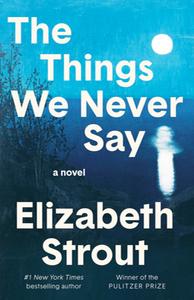
 Readers will likely fall in love with 57-year-old high school history teacher Artie Dam, the hero of The Things We Never Say by Elizabeth Strout (Tell Me Everything; Oh William!), just as readily as his students. Artie won Teacher of the Year five years ago from the state of Massachusetts and keeps his students' letters to him in his mother's jewelry box in the attic. Ten years ago, a tragedy occurred: Artie's son, Rob, was in a car accident that killed his girlfriend. After the accident, Artie's wife, Evie, seemed less warm; a distance also developed between Artie and Rob, which has grown "more acute" in the past year. Artie feels lonely. He becomes preoccupied with whether human beings have free will. And he considers suicide. He believes drowning is "the most plausible," so no one will suspect it was suicide.
Sailing off the coast of Massachusetts is Artie's greatest joy. Then one day, he slips while stepping from his dinghy to his boat; Artie falls in the water and nearly dies in the strong current. A new neighbor, a stranger, saves Artie's life. Suddenly Artie has a new friend and a will to live: "Artie--having almost died--no longer wanted to." Soon after, Rob shares a secret with Artie that Rob does not tell his mother, and this brings Rob and Artie closer. But the secret also poses other complications: Artie finds himself reexamining what he thought he knew in light of what his son confided to him.
Strout skillfully fashions a web of the interlocking lives in a small Massachusetts coastal town. She explores the roles of class structure (Evie is from an "old Brahmin family"; Artie, working class), politics, and education, with subtlety and finesse as a presidential election approaches. A gifted teacher, Artie champions each of his students--bully and bullied, athlete and outcast, no matter their politics--and urges them to fulfill their potential.
While Strout anchors the proceedings in the specific, her themes cross eternity. Artie's students are learning history from him, Shakespeare from his dear colleague, and life lessons in the halls. Soccer star Danny Marino and misfit Rhonda Lazarre couldn't be more different, but Artie loves them both, and each later say he changed their lives. It's a story of quiet heroes, like Artie, like Kenneth Moynihan, who saved Artie's life. Strout's genius is that her words work on readers between the lines, implicitly asking, What if you said what you really think? And if you don't, what are you giving up? And sometimes, is the heroic act not to say it? Strout's masterful novel poses searching questions, yet ultimately gives readers hope. --Jennifer M. Brown
Shelf Talker: Elizabeth Strout's masterful novel stars a hero who grapples with what it means to say what one thinks, and what if the better course is to keep it to oneself.