

|
|
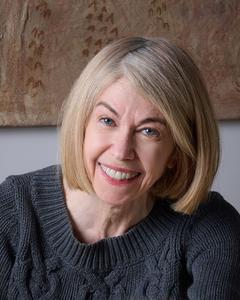
| photo: Winky Lewis | |
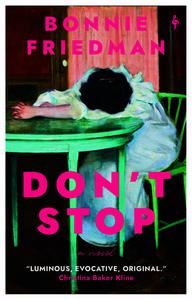
Bonnie Friedman is the author of Writing Past Dark: Envy, Fear, Distraction, and Other Dilemmas in the Writer’s Life, named one of the Essential Books for Writers by the Center for Fiction and Poets & Writers. She is also the author of the memoirs The Thief of Happiness and Surrendering Oz, a finalist for the PEN Award in the Art of the Essay. Her work has appeared in the New York Times, Ploughshares, and numerous other literary journals, and she has been named a notable essayist four times in The Best American Essays. She has taught writing at the University of Iowa, Dartmouth, New York University, and the University of North Texas. Don't Stop (Europa, April 21, 2026), her first novel, is an erotically charged story about ambition, desire, and the dangerous pursuit of self-knowledge.
Handsell readers your book in 25 words or less:
Don't Stop is about a brilliant 41-year-old scholar whose sexual obsession threatens to unravel her carefully built life.
On your nightstand now:
My nightstand is for books I've read and want to keep close, like inspiring friends. All the following are openhearted, original, and constructed of sentences strong as granite: Fellowship Point by Alice Elliott Dark; Giving Up the Ghost by Hilary Mantel; Stones for Ibarra by Harriet Doerr; The Diaries of Franz Kafka (translated by Ross Benjamin). This last, chock-full of Kafka's surprisingly bon vivant Prague evenings and nights, lets you see Kafka training himself to describe how people actually look and behave in life and also how to make use in his stories of the logic of dreams.
Favorite book when you were a child:
Hilaire Belloc's Cautionary Tales for Children, originally published in 1907, made my sister and me howl with joy. We used to borrow the book constantly from the Francis Martin Library. My mother had the idea that each of her four children should memorize one of the long and comically horrific poems, which had titles such as "Henry King, Who chewed bits of String and was early cut off in Dreadful Agonies." My sister memorized "Rebecca, who slammed doors for fun and perished miserably." I can still chant my way through "Jim, Who ran away from His Nurse and Was Eaten by a Lion." About once a year, given enough wine at a dinner party, I will stand up and declaim.
Your top five authors:
E.M. Forster, who grew on me over time. Such well-constructed plots and humane charm! I still read A Room with a View every summer. I know it is July when Lucy Honeychurch is plunging into the field of violets.
Hilde Bruch, who pioneered the understanding of anorexic girls, and had herself escaped a repressive regime. She was one of the first psychological writers I read, and she opened up a world of significance.
Ottessa Moshfegh. I didn't want to like her. I revere her. Brilliant, funny, perverse, with an extraordinarily sharp eye for the details of contemporary life. Fearless.
Edna O'Brien for the Country Girls trilogy and A Fanatic Heart. Details from "The Love Object" still return to me decades after I read it. A pin from a man's new shirt left on a windowsill and the ashes from his cigar collected in an empty lozenge box and helplessly, ludicrously cherished; the beloved's wife glimpsed at a party. The writing is precise and piercing as that shirt pin, if that pin were a knife.
The James Joyce of Dubliners, even if he completed the collection at the age of only 25. I love the way he decenters the stories, the way he takes Anton Chekhov a step further. Also, he makes you feel like you're allowed to acknowledge what you see in peripheral vision.
 Book you've faked reading:
David Copperfield by Charles Dickens. I did a junior high book report on it, cribbing from the back of a crummy encyclopedia my mother bought at the A&P, which had novel summaries at the end. I was worried that I wouldn't fool the teacher and worried that I would. Whenever I read the first paragraph of David Copperfield, it mixes with the cheap glue scent from that encyclopedia and fills me with despair that I will ever make a decent job of anything in my life.
Book you're an evangelist for:
Looking for Mr. Goodbar. Judith Rossner is a shockingly good novelist and has constructed a book with great psychological insight about shame and the desire for oblivion. Rossner was a literary novelist, divorced, who needed to support her children and herself. She used all her gifts to write this critically underrated if extravagantly well-selling book.
Book you've bought for the cover:
None. I just don't! (Or, at least I think I don't!) That said, who could resist the cover of Just Kids by Patti Smith? Those two photo-booth faces, she glamorously sullen as a Sex Pistols performer, he looking angelic and stewed.
Book you hid from your parents:
Valley of the Dolls by Jacqueline Susann. My mother was given this glorious trashy read while she was in the hospital, and I rendezvoused with it every afternoon when I was about 13, fascinated and plagued by the sensations it aroused. At some point it disappeared from our bookshelves and was never ever mentioned by my mother or me.
Book that changed your life:
Pilgrim at Tinker Creek by Annie Dillard. It made me an essayist for two decades, before I returned to my first love, fiction.
Favorite line from a book:
"People who have shelved their feelings, or their capacity for trust, always feel not quite real." --Marie-Louise von Franz, The Feminine in Fairy Tales.
Five books you'll never part with:
Gustave Flaubert's Madame Bovary. Leo Tolstoy's Anna Karenina. Colette's The Shackle. Impossible to part from them because they half-live inside me and also because they half-invented me. Virginia Woolf's Mrs Dalloway, with its brilliant evocation of the internal life. I recall reading it at college while drinking cups of French vanilla-flavored instant coffee from a tin, and feeling that I made more and more sense. Others had thoughts that moved the erratic ways mine did. Woolf was my religion for many, many years. Philip Roth's Goodbye, Columbus: The Great Gatsby comes to Newark, N.J.
Book you most want to read again for the first time:
Reading Turgenev by William Trevor. Set in a rural town in Ireland, it concerns a shy young woman who is bullied and scanted--and then encounters a man from her past who cherishes her for who she is. Trevor writes crisply disciplined prose whose scenes linger in the mind. He is an ultimate master.