

Australian author David Malouf, who "successfully merged his passion for literature, language and imagination with his connection to home to become one of Australia's most celebrated writers," died April 22, the Guardian reported. He was 92. Malouf "wrote of characters who transcended time and place. His novels explored ideas of identity and post-colonialism, but also broader themes--life and death, liberty and conflict, virtue and vice--and the interaction of these opposing forces in creating tension and temptation."
 |
|
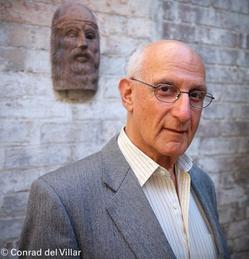
| David Malouf | |
"In most of my books and stories, the central character suffers some sort of disruption--loss of innocence if you like, or of the self--and has to work through to wholeness, or healing," he told Colm Tóibín in 2007.
As a poet, Malouf's debut collection was Bicycle and Other Poems (1970), followed by Neighbours in a Thicket (1974), which won the Australian Literature Society gold medal. He published his final novel, Ransom, in 2009, but continued writing poetry, with his last collection, An Open Book, coming out in 2018.
Malouf's first novel was Johnno (1975), "which many believe to be partly autobiographical, [and] tells the story of two boyhood friends living in steamy, sultry wartime Brisbane," where the author was born, the Guardian noted. His novella An Imaginary Life (1978) was a fictionalized reimagining of the exiled Roman poet Ovid. In 1990, The Great World won the Commonwealth prize and Miles Franklin literary award.
Remembering Babylon (1993), which was shortlisted for the Booker prize in 1993, "tells the story of a shipwrecked cabin boy, who comes to represent the tension between two worlds--that of the local Indigenous people with whom he has lived for 16 years, and the Scottish settlers whom he joins," the Guardian wrote.
Malouf was always a voracious reader, beginning with classic English children's books, then reading Shakespeare aged eight, and at 12 reading Wuthering Heights, Pride and Prejudice, Vanity Fair, and Moby-Dick, his favorite novel. He said these books "kept telling me the most extraordinary things about the world, and I couldn't wait to grow up and get into it."
Addressing the fact that none of his books were adapted into films, Malouf said, "they're all interior; you can't translate that to the screen. Almost nothing happens."
Among his many honors, Malouf was made an Officer of the Order of Australia in 1987 for his service to literature and in 2016 received the Australia Council award for lifetime achievement in literature.
In the Age, literary journalist Jason Steger wrote: "My reaction to the news that David Malouf had died on Wednesday was one of great sadness because he was lovely, kind man--a gentleman. And also one of great gratitude because over the years he gave us so many wonderful works--novels, short stories, essays, libretti and poetry--that will remain essential to any understanding of Australian literature.... Malouf was a modest giant in Australian literature. He had a long life and his work will last for a very long time."
The Conversation noted that Malouf "was in every sense a man of letters. He was a great reader and profoundly erudite. He was a sociable, assured and generous contributor to literary and public conversation. These same qualities imbue his writerly voice, his regular invocation of a communal 'us' or 'we.' His intimacy of address marks his poetry and prose, inviting trust and drawing in readers."
Colm Tóibín posted on Facebook that he had last spent time with Malouf in May 2025, "and what he had at that last meeting was what he had always--a sort of grace, a lightness in his tone, a way of being amused.... More than a decade ago, when he won an award in Athens, I met him there. How lightly he wore his deep knowledge of the city. He took me through the archaeological museum item by item. He was private. He treasured his time alone as he did his family and a few close friends. If there is one piece of fiction by him that I love most and read often, it is a long story called 'The Valley of Lagoons.' I cannot imagine what will happen now when Carmen Callil and Patrick White both discover that he has arrived in heaven."