

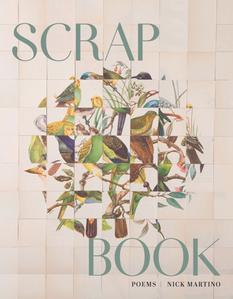
 Scrap Book, the lustrous debut collection by Nick Martino, arose from a Midwestern upbringing in a broken family. In particular, his father's incarceration--from before the poet was born--casts a long shadow.
These 40 poems draw inspiration from Martino's mother's journal and family photographs. The imagery spotlights the surrounding Midwest farm country. "I was raised inside the meadow of my parents'/ broken marriage. Even as a child, I understood. How often I was called to mend/ their love." The poet felt, by turns, protected or abandoned. "From her, I inherit the soft armor/ absence makes"--an oxymoron that contrasts with the realism of the paternal legacy: "From my father, I inherit silence/ and bad timing." Closer to the present, the speaker escapes loneliness through recreational drug use and fondly watching a lover sleeping. Love and meaning are salvaged from family wreckage in the same way one might "look/ for fugitive beauty in the bulldozed" orchard.
One series of poems brilliantly transforms photographs into hidden-message text. Eight are titled "Polaroid: Prison Visit," followed by a 1989 date stamp. A prose description of his mother's visit to his incarcerated father on that day appears within a photo-sized frame. Selective use of bold type creates, across several pages, one or two erasure poems that reveal the emotional reality beneath appearances (such as four sentences being reduced to "My mother turning to the/ prison/ He/ lied."). Partial scenes assemble, just like on the book's collage cover. Handwritten passages from his mother's journal are interspersed with the text and sometimes complete lines of poetry. Meanwhile, her observations of the colors of Lake Michigan provide a calm counterpoint to traumatic memories.
Free verse alternates with forms: an unrhymed sonnet, an aubade, and a "duplex"--invented by Jericho Brown. "QVC" presents a grid of words and phrases (e.g. "basketball tickets," "dementia," and "set of copper pans") and instructs the reader to "cut along the dotted line" to fill in the blanks of a Mad Libs-type story on the facing page. Alliteration and assonance ("the plummet/ and the tumult/ of an earth-bound body") sparkle, and two poems employ anaphora. Throughout, the metaphorical language impresses with its originality and precision: "moonlight/ waterfalls the plastic blinds"; "stoned as the gargoyles in heaven"; and "I slide back/ into the knife block of silence."
Pairing novelty of form and expression with psychological insight, Scrap Book is a triumph. --Rebecca Foster, freelance reviewer, proofreader, and blogger at Bookish Beck
Shelf Talker: Nick Martino's formally inventive debut poetry collection draws on his mother's journals and 1980s Polaroids to capture a family dynamic overshadowed by divorce and incarceration.