

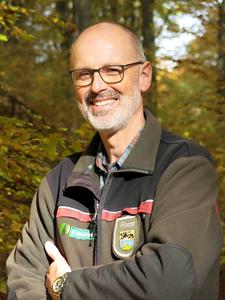
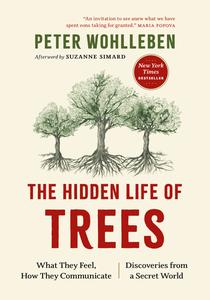
 Peter Wohlleben is one of the world's most notable foresters and a passionate advocate for tree conservation. Wohlleben lives in Germany, where he founded the Forest Academy for education and advocacy, and teaches forest owners to manage ecologically conscious forests. His books are bestsellers around the world. The Hidden Life of Trees (Greystone Books, May 5, 2026) is an anniversary edition celebrating the original from 10 years ago, an illuminating account of the forest, and the science that shows us how trees communicate, feel, and live in social networks.
Handsell readers your book in 25 words or less:
If even trees help one another and use their intelligence to cooperate, the world can't be all bad. The book is a dose of optimism.
On your nightstand now:
Children of Time by Adrian Tchaikovsky. After the end of humanity on Earth, survivors try to re-create the same thing on another planet. This goes completely wrong and reminds us that we had better protect our current planet. Also, it's fantastic to see the world through the eyes of ants and spiders. And I've been meaning to read Octavia Butler's Parable of the Sower. That's up next!
Favorite book when you were a child:
Robinson Crusoe by Daniel Defoe. When I was young, reading was the only way to dream of distant worlds. But at the time, I wasn't aware of the colonial mindset and racist stereotypes present in the novel. Historical texts like these, and even contemporary children's books, can be important educational tools to help young readers better understand and contextualize issues like racism, representation, colonialism, and point of view.
Your favorite book now:
Watership Down by Richard Adams. It's a novel that warms my heart. It depicts a hero's journey (with a happy ending!). Hazel and the rabbit gang make me sympathize, hope, and rejoice with them--that's what a good book should do. I loved it so much that we named our pet rabbits after the heroes in the book, and in 2010, I visited the actual locations with my family in the English hills of Watership Down--where, of course, you can't really find anything from the book.
Your top five authors:
Ray Bradbury, especially The Martian Chronicles, in which human society flees to Mars and takes its problems along with it--I can read this book over and over again; Bernard Cornwell and his historical novels, which are light and easy to read and provide the best relaxation; Margaret Atwood, who anticipated some current developments with The Handmaid's Tale that I never would have thought possible; David Suzuki, the author of many books including The Sacred Balance, whom I admire for his fight to protect the ancient forests of the West Coast, and Alexander von Humboldt, who discovered the interconnections in nature over 200 years ago and at the same time championed human rights.
Book you've faked reading:
The Adventures of Simplicius Simplicissimus by Hans Jakob Christoffel von Grimmelshausen. The book is about the Thirty Years' War that ravaged Europe. Von Grimmelshausen wrote it in 1668, and the "modern" version is very similar to the original, so it is difficult to read. As a schoolboy, I didn't enjoy it, but my German teacher promised me a good grade if I read it and gave a presentation on it. I gave the presentation and got the good grade, but I never read the book.
 Book you've bought for the cover:
I'd like to turn that question around: I'm often interested in the smell of a book. What do the pages smell like, what does the glue smell like? I love books that have that special, almost indescribable scent and feel good to the touch. These are usually paperbacks, and I always smell them before I read them. That's why I also like to be the first to read a new book--it smells particularly intense. Why on earth doesn't book printing take this into account? I'd love to know how many readers do the same--I estimate 50%.
Book you hid from your parents:
My books came from the school library--there weren't any books there that I wasn't allowed to read. And for Christmas and my birthday, I always asked for nonfiction books about animals and plants, so I didn't have to hide those either. Oh, no, there is one more that I've forgotten the title of. It was about puberty for teenagers, and I used to secretly take it from my older sister's room from time to time.
Book that changed your life:
A school atlas. As a child, I liked to leaf through it in the evenings, looking at the thematic maps to see what was happening where and how the world was changing. I was particularly interested in where there were still large, undestroyed forests (at the age of 10, I know, that's a bit nerdy). In my mind, I traveled around the world, and I realized how small our planet is and that I absolutely want to protect it. Later on, I put that into practice consistently.
Oh, and just for the sake of completeness, of course The Hidden Life of Trees changed my life. With its help, I was able not only to reach millions of readers but also do a great deal to protect forests.
Favorite line from a book:
"I will not give you the mule whose step is the easiest, but the one that reasons best, la mas racional," from Personal Narrative of Travels to the Equinoctial Regions of America. Unlike many of his contemporaries, Alexander von Humboldt believed that animals were intelligent, which made him far ahead of his time. He didn't care that he was swimming against the tide.
Five books you'll never part with:
The Lord of the Rings by J.R.R. Tolkien, because it's incredible how someone could imagine a fantasy world, including its language and prehistory, in such detail; The Egyptian by Mika Waltari, because it shows the complexity of the lives of Egyptians 3,000 years ago; The Terror by Dan Simmons, because it brings home the incredible hardships of polar exploration; an 1870 encyclopedia, because it shows how valuable it is to spread and preserve knowledge through books and paper; and last but not least, The Book of Hope by Jane Goodall--my friend, who signed it for me personally.
Book you most want to read again for the first time:
The Frozen River by Ariel Lawhon. She is incredibly good at describing moods without becoming long-winded. While reading it, I told my wife several times that she absolutely had to read it too. That rarely happens because our tastes are different. Because the solution to this authentic historical crime case is very exciting, reading it a second time doesn't evoke the same thrill.