

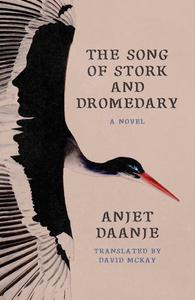
 In Anjet Daanje's expansive historical novel The Song of Stork and Dromedary, readers are treated to a rare literary phenomenon, a work that captures the haunting soul of the 19th and early 20th centuries while maintaining a sharp, contemporary metaphysical edge. Expertly translated from the Dutch by David McKay (whose translation of Daanje's The Remembered Soldier was a finalist for a National Book Award), the novel is a triumph of linguistic versatility. McKay renders Daanje's distinct, rhythmic prose and character tones adroitly, alongside the atmospheric dread and luminous beauty that epitomizes her writing.
The Song of Stork and Dromedary is an intricately structured epic, told through 11 interconnected stories that spiral outward from the life and death of Eliza May Drayden, a character inspired by Emily Brontë. Eliza May and her sister, Millicent, ultimately form an impoverished literary duo after the loss of their mother, their sisters, and eventually their parson father. The sisters each pseudonymously write what will become canonical texts of English literature, Millicent's Widow revered initially and Eliza May's Haegar Mass considered offensive and potentially dangerous.
Set largely on the rugged moors of Yorkshire, Daanje's novel follows Eliza May's impact after her death, tracing how her enigmatic poems, difficult novel, and the ghostly aura of her brief life infuse the lives of those who knew her. Her influence further spreads to those who come after, people affected by her work and whose own lives parallel aspects of hers. The few included excerpts of Eliza May's writing shed light into many of the stories that will follow--"Haegar Mass's hate was the disguise her love wore, love she scorned in herself and yet could not shake off, love like a curse."
This is a portrayal of hauntings, not solely the gothic, spectral variety, but of the way art can cast shadows across centuries, shaping biographers, gravediggers, and distant relatives who all struggle to grasp the essence of a woman who seemed to exist half-tethered to another world. At the heart of this exploration is the searing, existential curiosity and grief of its central figure. Daanje masterfully balances on the thin line between the physical and the infinite, most poignantly through the devastating question, "Is God hungry?" This inquiry reframes the divine not as a distant, benevolent provider, but as a consuming force, an entity that perhaps thrives on the lived experiences, the sufferings, and the creative outpourings of humanity.
Daanje has crafted an unforgettable meditation on the permanence of art, grief, and the passage of time. The prose is lush, the emotional stakes are visceral, and the intellectual depth is impressive. The Song of Stork and Dromedary is a work that demands to be read slowly and savored over the course of its 736 pages. --Elizabeth DeNoma, executive editor, DeNoma Literary Services, Seattle, Wash.
Shelf Talker: The Song of Stork and Dromedary is a significant and moving literary achievement, an unforgettable story of a historical mystery.