


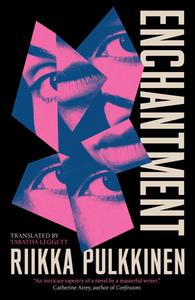
 Riikka Pulkkinen (True) challenges readers to form their own impressions with Enchantment, a striking novel about girlhood, perception, and death.
"The sun is setting and they're at the beach. The sky is soft mallow and bronze. It's the last summer of their youth." Pulkkinen, in an atmospheric translation from the Finnish by Tabatha Leggett, emphasizes this cinematic view. The next scene, almost a year later, is a forensic autopsy. Philippa Laakso, age 17, has been found dead in the courtyard of her apartment complex.
Philippa is the center of this novel; all gazes are directed toward her. Observations come in various formats: interview notes by police investigators, flashbacks, and descriptions of videos recorded by Philippa on her treasured Olympus PEN camera, a gift from her mother on her 13th birthday. Chapters take the close-third-person perspective of various characters, rarely including Philippa herself. She adopted several personae, beginning with "little experiments in selfhood; facial expressions, gestures, hair flicks, kisses blown to the lens, the camera, whose naive but fearless eye devoured stories without judgement." Sometimes she co-created her online aliases with her longtime best friend, Saga, dark hair to Philippa's fair, the other side of Philippa's coin: "Two girls. Girl and girl. Me and me."
Philippa is a perfect enigma to those left behind. These include a compassionate, poetic forensic pathologist, who "has always believed that the deceased have a right to carry the truth with them"; an elderly neighbor, a widower, whom Philippa befriended; a woman who appears in Philippa's videos, screaming in rage; the older men she met via dating apps; the boy she dated seriously and recently broke up with; Saga, her friend and double; and Philippa's mother, from whom "the girl had learned the art of being a matryoshka. Beneath one layer was always another layer--happy, funny, strange."
Philippa has given the world many versions. She is a fantasy, a friend, a tormentor, an innocent, a vixen, a hero, a villain. "This girl is rarely considered wise, more rarely still intelligent. She can't possibly be profound because she's laughing in her pictures, pointing her chin downwards, like a child. She can't possibly be reflective, not while she still treats these affects of hers as accessories."
One of Enchantment's central concerns is the question of perspective, of what is possible to know about a person. Pulkkinen's dreamy novel delves into the line between truth and fiction, storytelling and self-creation. Philippa invented herself, and in the aftermath of her life, police investigate the question of her death, as everyone investigates how to view her and how to remember her. She has "become a dream, gossip, stories," and readers are left to parse the enchantment that remains. --Julia Kastner, blogger at pagesofjulia
Shelf Talker: A singular girl stars in this unusual novel of identity and mysterious death.