


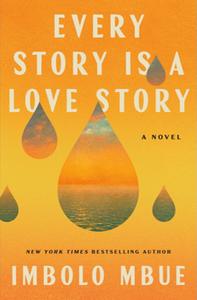
 Imbolo Mbue's immersive Every Story Is a Love Story begins with a letter from Victoria Snow, the white woman who was driving the car that killed Wolo Lifafa's wife, Yoma, who was pregnant with twins.
It has been three years since Wolo lost his entire family when his wife went out for a jog one morning and never returned. He is convinced an "African immigrant getting justice meant nothing to the police; protecting white people was their priority." And he is still angry. Wolo's mother, Keka, is adamant that Wolo not open Victoria's letter. But there are things Wolo wants "to say to her face."
The chapters alternate between Wolo's present in New York City and the past--from his courtship of Yoma up to the morning of her death. Through these juxtapositions, Mbue makes clear the opportunities available in the U.S. to the Lifafas, but also the trade-offs in leaving their homeland and support system in Cameroon. Keka's recognition of the freedoms for women especially, and for the education of her two sons, compel her to remain in the U.S. when her husband returns to Cameroon for a position as a professor at the University of Yaoundé. Wolo even suspects Keka may have orchestrated the duration of her stay--to complete her own education--by nudging her husband into the arms of another woman; he impregnates a student, whom he marries and with whom he has additional children. Mama Jokeh, as Wolo calls his father's second wife, is both from an "eminent family" and "[knows] she could never be equals with the sophisticated, American-educated senior wife"; she and Keka become close, keeping the family together.
Years later, when Osi, son of Jokeh, sexually assaults Mary Lambi, a young woman from a lower class, Keka and Jokeh ask Wolo, as the eldest son, to help them. Wolo is moved by the way Mary's father handles Osi's transgression. This stays with him, so that when Victoria sends him the letter, he finds himself thinking of the elder's ability to forgive. Wolo's father-in-law, too, models for Wolo the capacity to forgive; he tells Wolo: "Some people want your grief to look the way they think it should look, the way they would do it if they were you...."
Mbue (How Beautiful We Were; Behold the Dreamers) explores with grace and nuance in the numerous ways people experience loss, anger, and sorrow. Through the examples of Victoria and Osi, she demonstrates that the perpetrators of harm also need to heal. Her tender novel allows readers to see they are not alone in their desire to move through grief and assures them that they will. --Jennifer M. Brown
Shelf Talker: In Imbolo Mbue's profound exploration of how different people move through grief, she affirms that there is indeed life after loss.