

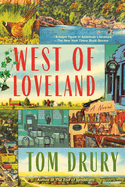
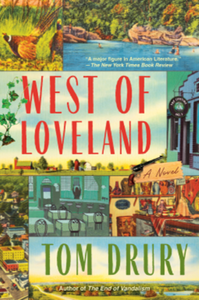
 Infidelity, missing persons, drugs, mental health conditions, and murder: these are just a few of the hallmarks of small-town, rural America. That's what one might conclude, at any rate, based on works such as David Lynch's cinema classic Blue Velvet and West of Loveland, the fourth installment in the series of Grouse County novels by Tom Drury (The Driftless Area; Pacific). The underbelly of the town in Drury's story may not be as seedy as the one in Lynch's film, but in its quiet way, this work exposes tensions in a Midwestern community where anonymity is impossible, secrets are common knowledge, and resentments are barely concealed beneath the diaphanous surface of neighborliness.
It all starts with a gun. Rocky is 15. His parents abandoned him to become watchmakers in Europe, leaving his aunt Helen as his guardian. The locals consider Rocky odd, in part because of his "runaway parents and a lisp," and for other supposedly effeminate traits such as crossing his legs "like a girl." As the novel opens, Rocky and Helen are driving home from an unsuccessful pheasant hunt. Helen asks Rocky to pull over when she sees a revolver by the side of the road. She brings it home "so that [they] can dispose of it in a way that nobody gets hurt."
Readers can find out for themselves whether, in true Chekhovian fashion, the gun introduced at the start of the novel eventually goes off. But West of Loveland is much more than that. The gun's discovery is only the first of many incidents involving the narrative's enormous cast, among them the town sheriff; his wife, an amateur photographer who has an affair with a club owner; her ex-husband, a 70-year-old man who has been "a thief, a plumber, a carpenter, a hauler of heavy things, a thief again"; a lounge hostess who did television ads long ago and one day disappeared; a pastor who feels helpless over her inability to comfort the townsfolk; and a man who knows something about the gun but must spend time in a facility for psychiatric evaluation.
West of Loveland is the type of gentle novel that is a series of quiet confrontations rather than dramatic clashes. To Drury's credit, the book is not bucolic but rather a perceptive, unsentimental portrait of middle American life. That's the hallmark of an empathetic writer with a lot to say. --Michael Magras, freelance book reviewer
Shelf Talker: Tom Drury's West of Loveland, the fourth in his series of Grouse County novels, is a quiet story of infidelity, surface tensions, and even murder among the residents of a small Midwestern town.