

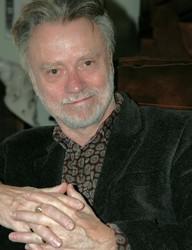
John Crowley, an author of "sweeping fantastical narratives whose ability to blend such disparate material as American history, dreams of lost utopias and Alice in Wonderland-tinged occult allowed him to transcend the fantasy genre in novels like Little, Big," died August 8, the New York Times reported. He was 83.
 |
|
| John Crowley (photo: Mikhaylo Nazarenko) |
|
Crowley's 14 novels and 10 volumes of essays and short fiction "explored a considerable range of subjects and genres," the Times noted. His first novel, The Deep (1975), "was set on a disc-shaped world and involved a war between two factions, the Reds and the Blacks, loosely based on the 15th-century War of the Roses in England.... Even his most straightforward, realistic novel, Four Freedoms (2009), about the workers at an airplane factory in Oklahoma during World War II, is an alternative history of the home front."
In 2000, in the Washington Post, critic Michael Dirda described Crowley as "arguably the most original and accomplished American fantasy writer ever."
Crowley was "consistently interested in the way that narrative shapes perception; in the sometimes murky line between fantasy and reality," as well as "the possibility, as he wrote in his 1987 novel, Aegypt (eventually republished as The Solitudes), that 'there is more than one history of the world,' " the Times observed.
His fourth novel, Little, Big, was his best known work. Poet James Merrill, a fan of the novel, arranged for Crowley to receive a grant from the Ingram Merrill Foundation, which Merrill directed. Ursula K. Le Guin said that the book "calls for a redefinition of fantasy," while Harold Bloom observed that it was "literally the most enchanting 20th-century book I know." It was named the best novel at the 1982 World Fantasy Awards.
In 2009, Crowley told the Believer magazine: "The kind of fiction that always interested me is stuff that somehow manages to be convincingly actual--in the sense that you believe that truths are being told about the world you live in--and are also somehow connected to the imaginary in some way."
His film scripts include The World of Tomorrow (1984), about the 1939 World's Fair, and, with his wife, Laurie Block, Fit: Episodes in the History of the Body (1991), about American fitness culture.
As a lecturer at Yale, the Times wrote, he "insisted to his students and readers that fantasy was, at its heart, no different from any other genre, and could achieve greatness if it followed the rules of literature."
He told Locus magazine in 2010: "To actually articulate a way of being in a literary world without boundaries between reality and fantasy--it can't just be a bunch of craziness and surreal carrying on.... Fantasy fiction at bottom, or at its best, is about making true fictions by the rules, in worlds you make up out of whole cloth, or out of your heart."