

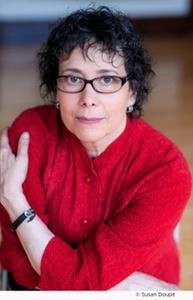
Stephanie Kallos was born in Idaho, grew up in Nebraska and lives in Washington State. Before coming out of the closet as a writer, she had a varied work history, including many years as a musician--she is a pianist and sultry vocalist for the Seattle7Writers' band The Rejections (and Trailing Spouses)--and a long career in theater as an actress and teacher of voice, speech and dialects. Her short fiction has received a Raymond Carver Award and a Pushcart Prize nomination. Her first novel, Broken for You, received Washington State and PNBA Book Awards. Her second novel, Sing Them Home, was a Pacific Northwest Independent Booksellers bestseller, and selected as an IndieNext title. Her new novel is Language Arts (Houghton Mifflin).
Let's start with the Palmer Method of penmanship--an unusual scheme for connecting so many characters.
Like a lot of people of my generation, I mourn the demise of handwriting--it's becoming lost to us. There are powerful connections made between our hands and our brains. My kids are some of the last that were taught cursive in grade school but their handwriting is awful, it's illegible. I love to write by hand; I'm a journal keeper, a diary keeper from the time I was a little girl. To me there's nothing like it. When I don't do it for a long period of time, I get grumpy. As for the Palmer Method, because of its physical practice, its repetitiveness has a meditative quality. Hopefully readers will make this leap--at times the behaviors of a person with autism are repetitive (it's called stimming), and because of that, they are behaviors that people want to limit. And yet do we not all have our versions of that? For me it's knitting. It's repetitive action, it's not fancy, it's simple. Or yoga practice: some of the movements are comforting in their repetition. Within that repetition there's a place for the mind to go, there's a different kind of opening in the brain. One of my favorite quotes about writing comes from one of my favorite books by Brenda Ueland, If You Want to Write. She says the quality of attention we want to cultivate about writing is the quality of attention a child has about stringing beads. This outward physical action can allow the brain to work in a different way.
Did you come up with Palmer as a unifying device after the book idea?
No. Handwriting, as it relates to expression, was always a piece of what I wanted to do in this story. It's a very personal form of expression and communication, which is what the book is a lot about.
Is Mrs. Braxton, Charles's and Dana's grade school teacher, based on a former teacher of yours?
Kind of. My second-grade language arts teacher could be daunting. I never learned how to diagram a sentence, but we did sit in a circle and read. That was my introduction to writing. She could induce fear, but there was something very soft about her and she was the person I wrote my first story for [at this point Kallos pulls out the original story, written in pencil]. She read my story to the entire class.
In your Anne Lamott epigraph about prayer, she writes, "Let's say it is communication from one's heart to God." It made me wonder if for Dana and Cody practicing the Palmer circles--looping--was praying.
That's what I wonder, too. And all the other rituals--grinding ramen noodles and tearing magazines--laden with meaning. That's Charles's argument: why should we deny Cody access to these activities? We don't know what's going on in his mind, we have no way of knowing. We don't want him to spend 24 hours a day grinding noodles, but do we need to be afraid of these kinds of behaviors?
Anne Lamott had a powerful effect on the writing of Language Arts. I hope I get to tell her that some day. I went to see her in Seattle when I was in a really dark place with the book. I'd been working on it for a couple of years at that point. In most of my work, the issue of God is a thorn in my side, a pebble in my shoe, and I just wanted to be more overt about that in this book. Listening to Anne talk made me think I really needed to put this on the page. Stop shying away from it.
You say that Giorgia focuses on her students' divinity and mystery, not on their obsessive, repetitive gestures. She knows they are capable of more than "competency and compliance. The key lies somewhere in penmanship practice."
She thinks it comforts the families too--to see them trying to write. It's all about the effort. Families with special kids do so often feel disconnected. There's no bridge, there are mysteries, so to see them trying to engage in something that is familiar can be a great solace. It's the miracle Charles is expecting to never have--sharing in an activity with a connection; it's a communion. It's like so many stories I've read about families with autistic children--you get a miracle, but it's not linear. You aren't going to build on that miracle. So you develop a Buddhist attitude; you come to be so grateful for those little drop-ins of connection.
Giorgia is a wonderful creation.
Yes! She's somebody that just occurred. It happens in all my books. This person shows up, and you say, wait a minute--I didn't plan on you! And then you just have to trust that there's a reason. I would have liked to include more of Giorgia--my secondary characters never want to be secondary!
You take something pedestrian, to get back to penmanship, and turn it into exceptional. It reminded me of the teacups in Broken for You and Bonnie in Sing Them Home, looking for clues on the roadside.
It's the stuff that surrounds us. That's where I notice things. Small things tend to spiral out for me.
You can walk into a church and feel a sense of the Divine, but for me the Divine resides in the things that we handle. You know--before ecstasy, chop wood, carry water....
If you want to see the Divine, you have to pay attention.
That's where it hits. Paying a different level of attention to cooking, making coffee.... It's mindfulness. And Cody is nothing in his repetitive behaviors if not mindful. He's in his work in a way I remember my sons being when they were playing with Thomas the Tank Engine toys. Completely absorbed. No barriers between them and their work.
Does autism have a personal significance for you?
Only as much as Dana is based on a child whom I remember from primary school. His name was Dana, we were never friends, but there is a very strong visual connection with the fictional Dana. He wore white suits, and some of his behaviors I remember like it was yesterday. I've been trying to write about him since 1986; I have early notes on the story. That was a really powerful time in my life--seven or eight to 10. In terms of starting to look out and notice the world, that's when it all happened. So this child dropped into my life and I was mesmerized by him. I've been trying to write about him forever.
And I feel like the narrator in A Prayer for Owen Meany: "I am doomed to remember a boy with a wrecked voice...." I go back to that book a lot. I don't feel doomed to remember Dana, but I've always felt compelled to remember him and somehow bring him out into the light. He's always been--I'm going to cry--the emotional heart of this book. He is the white center of the book, and still I don't know why. I don't know what it means. But at least I brought him into the world. I hope people love him.
There are lovely passages in the book, like, "The rain had stopped and started several times in the past hour; sudden downpours followed by sudden cessations, as if there were a poorly sutured incision in the sky that kept opening up, being restitched by the same incompetent surgeon, and then tearing open again, a perpetual malpractice suit."
One thing I've learned that I've come to really trust is that when you have a metaphor--of course, living in the Northwest, I was trying to figure out one more way to write about rain!--the further you can go with a metaphor, the more rich it becomes. The further you burrow in, you wonder, can we go any deeper? Really? Can we go just a little bit more? That's fun. And this came to me in a moment of grace. --Marilyn Dahl