

 |
|
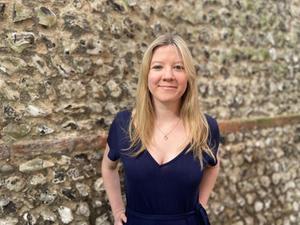
| Sara Barnard (photo: Tom Phillips) |
|
Sara Barnard is the author of seven YA novels. In her adult debut, Here We Are at the End (Berkley, March 16, 2027), guests gather on a beautiful Italian island for a destination wedding, then hear the news that a comet is going to destroy Europe in just over 38 hours. Barnard studied American Literature and Creative Writing at the University of East Anglia and lives in Brighton, England.
Your previous novels were for young adults. What was different about imagining and composing this one, knowing there was a different target audience?
It was a much easier shift from one to the other than I thought it might be--I think the fact that the story itself is so inherently adult rather than YA helped a lot. So it wasn't just that the characters happened to be older than teenagers, it was also that their preoccupations and relationships were older--marriage, illness, commitment issues, etc. That made it much easier to be in an adult mindset rather than shifting into the familiar teenage voice. The fact that it's told in third person rather than first probably helped with that as well!
The bride's brother was obsessed with the comet and, like many prophets of doom, scorned until events proved him right. Would it be correct to read an environmentalist parallel into this?
For sure. I think, in a way, it was easy to dismiss the comet as another silly conspiracy theory because people assumed that, if something so catastrophic was going to happen, governments would be doing something about it--loudly!--or at the very least be talking about it seriously. I find it difficult to get my head around the fact that we know climate change is happening, and how catastrophic it's going to be, and yet it barely makes headlines, let alone government policy. At least in this fictional world they have the excuse that they couldn't do anything to stop the comet. We can't say that about the environment.
At one point Grace announces, "World's ending. Different rules." Was it freeing (or a useful constraint), plot-wise, to put your characters in an unprecedented situation and have a clock ticking down?
Yes, it was both, in different ways! It was freeing in the sense that it freed up the characters to think, speak and behave in a way people usually wouldn't. That was fun to explore. There are so many things, every single day, that we don't say because of the possible repercussions for our personal, social and professional lives. Imagine if all that just went away? Pretty much everything we do is predicated on the assumption that we've got time. Taking that away made for a really interesting dynamic, especially when they were (almost) all stuck on a small island. But it did also throw up a number of logistical issues that were a headache to try and fix in a way that felt both emotionally resonant and realistic, like Tatty's phone call.
Were responses to other disasters from recent history, such as 9/11 and the Covid-19 pandemic, instructive for deciding on your cast's varying reactions?
They were, in the sense that I felt like they informed those reactions. Anyone in their 30s, like most of the characters, has grown up seeing these sorts of disasters play out on 24-hour news as much as they have in films and TV shows. We probably all have a sense of how we think we'd feel and behave if something like that was happening to us, including the things we'd say to people we loved. So you have someone like Peter, who wants to be the shepherd, the source of comfort for all the people he imagines will be panicking, but actually he needs that comfort from other people as well. And then there's Grace, who has understood herself throughout her adult life to be quite a selfish person, spending her last hours trying to help other people in a way that surprises everyone.
You quote from "Closing Time" by Semisonic and mention the last few songs that Sophie plays on her phone. What else would make it onto your end-of-the-world playlist?
I think "Little Wonders" from the Meet the Robinsons soundtrack would be a pretty great one to see out the end of the world. And then the Matchbox Twenty track "How Far We've Come" is also about the end of the world.
But really, if I was making an end of the world playlist for myself, I'd just put all the songs I've loved on it. So it would be very long! I chose Sophie's songs because they were three songs I happened to be listening to at around the time I was writing that scene, so it would have changed after a week! For example, if I was going to write it now, I'd choose "Here You Come Again" by Dolly Parton, "The Whole of the Moon" by the Waterboys, and "Passing Afternoon" by Iron & Wine.
Avoiding spoilers, can you say why it was important to you to give a quick peek into what comes after "The End"?
I knew that, for a book like this, the tone of the ending is almost more important than anything else. As tempting as it was to end in a certain way that may have been expected (really trying to avoid spoilers here!), it felt right for the themes and emotional journey of the story as a whole to add that little something at the end.
What are you working on now? Can we expect more adult fiction from you?
I hope so! I'm working on a new book right now. It's less apocalyptic, but just as human! --Rebecca Foster