

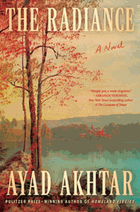
Set amid the cultural wildfires and fraught sexual politics of the #MeToo era, The Radiance by Pulitzer Prize-winning playwright Ayad Akhtar (Homeland Elegies) elegantly merges intellectual inquiry, cultural critique, and high drama to spectacular, often satirical effect as its narrator navigates a trifecta of tumultuous changes in his life.
A fictional New Yorker bearing the author's name temporarily relocates to the Hudson River Valley to complete his novel and is hit by a truck while bicycling on a remote country road. The crash, a possible hate crime, unleashes neurogenic changes marked by a "sublime burning calm" and an intensely pleasurable "radiance." The practical impact of this aural shift emerges when the narrator agrees to teach an autofiction class at the local university. Whereas once he would have scoffed at how many of his students consider themselves "disabled in some way," the post-crash Ayad views their "shared agreement in frailty" through a pleasing "brain fog" of nonjudgment.
Ayad's campus colleague Lucie features prominently in his thoughts as a "harmless infatuation," their bond platonic yet erotically cerebral. When Susan, a troubled student, teeters over the edge of self-destruction, it triggers a campus-wide reckoning over her inappropriately close relationship with Lucie that also implicates Ayad. What finally snaps his crash-induced "beguiling inner repose" is a family revelation that sheds heartbreaking light on his late father's troubled life.
A formidable storyteller, Akhtar frames his darkly entertaining third novel as a fictional memoir of a "non-Muslim Muslim-American" still processing the aftermath of his recent adventures in the "Christian-inflect[ed]" rural United States. --Shahina Piyarali