


|
|
| Amor Towles (photo: Leo Jacob) |
|
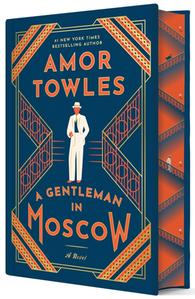
Born and raised in the Boston area, Amor Towles graduated from Yale and received an MA in English from Stanford. After working as an investment professional for more than 20 years, he devoted himself full time to writing. He lives in Manhattan with his family. He is the author of three novels, including Rules of Civility and The Lincoln Highway, as well as a collection of shorter fiction, Table for Two. A gorgeously rendered deluxe, hardcover edition celebrating the 10th anniversary of A Gentleman in Moscow promises to enchant readers once again with its evocative voice, strong characters, and lush setting in 1920s-'50s Moscow.
When you were writing the book, were you worried that the American reader would find the world of Russia during the Soviet era a bridge too far?
Honestly, I didn't think very much about how the book would be received. But I was confident that readers who knew little of Russia would recognize the world of the hotel. The grand hotels that were built around 1900 in cities throughout Europe, Latin America, and the U.S. shared many attributes. So a grand hotel is something of an international space regardless of where it is located. I knew that if I could get the reader across Red Square and through the door of the hotel, they would quickly settle in.
How closely does this novel stick to the historical record?
Rather than pursuing research driven projects, I like to write from areas of existing fascination. Like many Americans, my interest in Russia began when I was a young man from reading the 19th-century greats such as Tolstoy, Dostoevsky, Gogol, and Turgenev. That led me to an interest in the Russian avant-garde that flourished before the Revolution, which led me to the writers eventually oppressed by the Soviet regime. Most of the texture of A Gentleman in Moscow springs from the marriage of my imagination with this 30-year interest in Russian culture. In fact, when I began writing the book, I had only been to Russia for a total of 10 days and had never spent a night in the Metropol Hotel.
The book is not based on a historical character. That said, house arrest existed in Russia for hundreds of years. Pushkin, for instance, the Russian Shakespeare, was forced to live in an apartment across the street from the Winter Palace where the tsar could keep an eye on him.
What might surprise many Americans to discover is the fact that a significant portion of the Russian nobility stayed in Russia after the revolution and were allowed to persist under humbled circumstances. So, Count Rostov's life in the Metropol is a fusion of these two historical realities.
 What makes the count an ideal protagonist?
One of the advantages I had in writing from the count's perspective is that he is an erudite person. He is a lover of the great 19th-century novels, of classical music, of fine food. This gave me permission to celebrate these wonderful aspects of our shared cultural heritage. But importantly, the count is not a snob. He is a person who is genuinely curious. He is ready to befriend people regardless of their station. And he has the benefit of having joined the Confederacy of the Humbled, a fact that makes him celebrate the smallest gifts that life has to offer.
What was the experience of the television adaptation like?
As an executive producer, I was involved in the choosing of writer Ben Vanstone, director Sam Miller, and lead actor Ewan McGregor. As the author, I spent time with all three of them--before production began--discussing the history of the Metropol Hotel, the themes of the novel, and the backgrounds, personalities and motivations of the principal characters. But at that point, I left the project in their hands.
There is no shortage of adaptations that have failed to capture the spirit of a novel, even when produced by talented teams. So, when I visited the set in Manchester, England, for the first time, I was a little anxious. I was met in the parking lot by Sam, Ben, and the production designer, Victor Molero, who wanted to personally introduce me to the set. Entering the vast sound stage, we passed by lumber and lights and technicians until we turned a corner and found ourselves before the façade of the Metropol. When we passed through the revolving doors, I looked around at the beautifully realized lobby, and my first thought was: Everything is going to be just fine.
Has Covid updated your thinking about small, indoor, isolated living?
I don't think Covid would have changed any aspect of how I conceived or wrote A Gentleman in Moscow. But it had a meaningful impact on how many people read the book during the era of quarantine. At the time, I received e-mails from around the world from readers who were trapped in their homes and who found solace from the count's experience and attitude. As a novelist, I'm not interested in writing timely work. What I hope to write is timeless work. To have an historical event like Covid give readers a new and meaningful way in which to consider the life of the count was very moving for me.
What's your favorite thing about the new deluxe edition?
One of my favorite "characters" in the book is the one-eyed cat whom the count befriends during the first days of his internment, and whom he calls Kutozov, after the canny, one-eyed Russian general who faced Napoleon during the War of 1812. On the edge of the pages of the new edition is an illustration of the hotel's staircase going back and forth. I love that the one-eyed cat is in three different places on the staircase.
What does it feel like to look back at a novel you wrote more than 10 years ago?
I remember hearing Elvis Costello talk about his evolving relationship to his classic song "Alison." In the early years of his success, he would be irked by audience's insistence that he play that song again, since he had moved on, artistically. But he came to realize that the song had been a gift to him in that it kept bringing new listeners to his music. I feel that way about A Gentleman in Moscow. The count has given more to me than I ever gave to him.
What are you working on now?
I'm currently working on a novel that takes place in New York City in 1942. It will come out in September of 2027. --Julia Kastner, blogger at pagesofjulia