

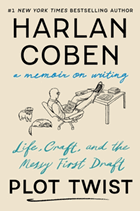
Harlan Coben's hybrid memoir and book on craft, Plot Twist, rivals Stephen King's On Writing in that even if readers don't write in his genre, Coben's succinct insights apply to every sort of writing--and even daily life.
Coben's organizing principle is to adopt "the writer's mind frame." Using this lens, "everything in life is material." He doesn't mind the question that makes most writers cringe: "Where do you get your ideas?" He breezily responds with an answer about keeping a curious mind. Coben repeatedly asks "What if?" and offers readers examples of how it led to several of his works. He also details which real-life situations became fodder for his fiction.
Coben walks the talk. He shares what he calls "our life axiom": "If it helps me produce pages, good. If it doesn't, bad." He never leaves home without equipping his backpack with laptop, legal pad, small notebook, writing instruments, and snacks. Throughout Plot Twist, he includes instances of writing "this sentence" on United Flight 17, or writing "this paragraph" on a boat while his kids snorkel. Writing is a job, and he takes it seriously, but he also finds humor everywhere and shares poignant moments, such as the early deaths of his parents and how that shaped his writing.
Coben explores point of view, plot versus character, the importance of dialogue, and "incremental ambition," achievable challenges he gives himself. Most of all, he lays out a blueprint for a creative, empathetic life: "Everyone has hopes and dreams," he writes--a great thing to remember as a writer, a heroic thing to remember as a human. --Jennifer M. Brown