

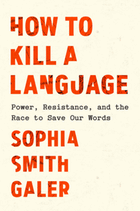
Journalist Sophia Smith Galer provides a fascinating peek into the possible future of many languages in How to Kill a Language: Power, Resistance, and the Race to Save Our Words. Languages are disappearing at an alarming rate: up to half of the world's languages are expected to die out in the next century.
Smith Galer highlights several reasons for this loss; one of these is expulsion. Ladino, a Sephardic Jewish language, survived in Greece for hundreds of years after the Ottoman Empire welcomed the Jews expelled from the Iberian peninsula. However, it largely disappeared when the Ladino-speaking population was again expelled, this time from Greece to Nazi concentration camps. Another cause is exploitation, which devastated Karuk and other Indigenous North American languages as settlers ravaged tribal lands and boarding schools punished children for speaking their native tongues. A final cause is criminalization: the Kurdish language is violently suppressed by the Turkish government, even though Kurds make up almost a fifth of Turkey's population.
Eminently readable and well-researched, How to Kill a Language presents complex linguistic ideas and colonial history in an approachable, journalistic style. Smith Galer frames this study with her own story--her grandmother and mother spoke a dialect of Italian that has almost disappeared, inspiring her to investigate vanishing tongues. Smith Galer takes readers on an armchair journey of exploration, showcasing 10 languages across several continents. Perfect for fans of Mark Abley or David Crystal, How to Kill a Language may inspire readers to seek out and celebrate the linguistic diversity around them. --Jessica Howard, former bookseller, freelance book reviewer