I won't lie; my first Black Friday as a bookseller scared the hell out of me for a month before it arrived. In 1992, I was just a 42-year-old kid with a crazy dream. I'd been a bookseller for six months and believed nirvana had been attained. Like most rookies, I wanted nothing more from life at that point than to be in the stacks all day, talking with other book lovers about our mutual addiction. Who knew there was a catch?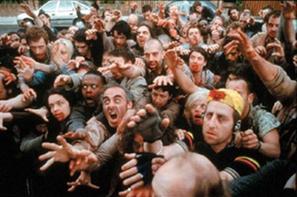 Shortly after Halloween, however, as if inspired by the ghoulish holiday itself, my colleagues began to spin cautionary tales about the post-Thanksgiving blitz--the crowds, the noise, the complaints, the screaming kids and, sometimes, adults; the crush of bodies, the scattered heaps of browsed and discarded books. Zombies were still a couple of decades away from becoming fashionable, so I imagined an episode of The Twilight Zone as conceived by Stephen King.
"It's bad?" I asked.
"You don’t want to know," the veterans replied, exchanging mirrored glances of suppressed terror.
Prior to my incarnation as a bookseller, in those innocent days before YouTube and mobile phone cameras, BF had been nothing more than a vague concept to me, a headline I saw in the paper or a brief news report of lines outside department stores. I wasn't a shopper, so I had no reason to care--or be afraid--until then.
To allay my fears, I immersed myself in the intensive BF preparations, as walls of new books and key backlist titles piled higher in the backstock area (for those were the ancient times of backstock, a concept we can only imagine now).
I don't recall Thanksgiving Day 1992 because, no doubt, I was paralyzed with trepidation. The next morning, I arrived at the store early and we went through last-minute battle plans: register and lunch schedules, sales floor assignments, pep talks. Then it was time. We opened the doors and unleashed retail demons. As I recall it now, "overwhelming" is a fair description of what happened, but panic somehow blended nicely with adrenaline-laced professionalism to turn the day into an efficient, exhausting and profitable blur. Not scary, as it turned out, but... not quite un-scary either.
In subsequent years, BF would lose much of its anticipatory terror for me. As my responsibilities at the bookstore grew, I worried less about surviving the stampede and more about finding ways to increase the potential for even larger stampedes. I focused on the practical aspects like inventory and weather, and let human nature take its course.
Big-box stores and online options increasingly dominated the scene during the late 1990s and early 21st century, so BF gradually seemed to become less monumental--at best the second busiest day of the year after Christmas Eve, and sometimes not even the busiest day of Thanksgiving weekend.
I'm not a bookseller anymore, and still not much of a shopper, but I do harbor remnants of an odd, nightmarish nostalgia for my first BF. This time of year, I often wonder if the big day has lost its edge for other booksellers. There are so many alternatives now; the concept has been spun and twisted into all sorts of new shapes, sizes and goals. Here's a sampling: Independent bookstores have Plaid Friday and Small Business Saturday.
Online sellers have Cyber Monday, but are also "offering an arsenal of mobile-only deals intended to pick off shoppers as they wait in line," the New York Times reported. There are, not surprisingly, apps for that.
The Occupy movement is weighing in this year with Occupy Black Friday and Reoccupy Main Street.
I've read about several smaller BF options, too. For example, knowing there would "be no Black Friday sales at Uptown's Borders this year," the Chicago Writers House Project created a pop-up bookstore in the empty building last week and hosted Chicago Book Expo, which featured the works of "more than 40 fiction and poetry presses," as well as readings, live performances and architectural walking tours. I like that.
In spite of the general demystification of bookseller BF, however, I'm sure when Friday morning arrives, I will recall, if only for a moment, that nervous frontline bookseller in 1992 who watched those doors creak open and the book-loving masses attack. Maybe I'll even hear the distant whisper of Rod Serling's voice: "Picture, if you will, an ordinary bookshop...."--Robert Gray (column archives available at Fresh Eyes Now)

