

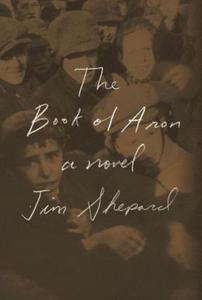
 Following two distinctive and critically praised short story collections, Like You'd Understand, Anyway and You Think That's Bad, Jim Shepard has written a novel for the first time in a decade. In The Book of Aron, he imagines the early years of the Warsaw Ghetto through the eyes of an adolescent whose life intersects with that of Janusz Korczak, the real-life doctor whose struggle to preserve the lives of some 200 children in his orphanage was one of World War II's great tales of heroism. Perfectly channeling the artless voice of his young narrator, and with impressive restraint, Shepard gives readers a glimpse of the nightmare world of Warsaw's Jews.
Aron Różycki has just celebrated his 10th birthday when the Germans invade Poland, and it's only a few months before the Nazis construct the walled quarter into which they herd the city's Jews. At first, Aron and his friends take on the challenge of scavenging and petty theft almost with a sense of playfulness. But as the ghetto's barely livable space shrinks, their games turn deadly. Aron finds himself reluctantly serving one of the representatives of the Jewish police force, and he plays a role, if only an indirect one, in the deaths of two of his band. After his father and brother are transported to a labor camp and his mother dies, Aron lands on Korczak's doorstep.
Shepard makes no attempt to exaggerate the terror and bewilderment of the children under Korczak's care. "Death by famine lacked drama," he tells one of his nurses. "It was slow and dispiriting. At least until the crows or the rats or the dogs came along." The ones who don't starve succumb to typhus, spread by the lice that infest everyone. Aron accompanies an ailing Korczak on daily trips through the ghetto's streets, begging and bartering for scraps of food. "I exist not to be loved but to act," Korczak says in a summary of his creed. But through all this, as Shepard shows with profound compassion, the doctor's love nourished his charges as much as any physical sustenance.
From the historical record, Shepard suggests, Korczak and his children died in Treblinka in 1942. The novel's moving final pages, when Korczak rejects even the hope of an escape that would involve abandoning the orphans, are almost too intense to bear. And the sentence that concludes the novel, one that grants absolution to Aron, has the power to break your heart. The Book of Aron ennobles unimaginable suffering through the gift of art. --Harvey Freedenberg, attorney and freelance reviewer
Shelf Talker: With compassion and restraint, Jim Shepard's new novel views the suffering of the Warsaw Ghetto through the eyes of a child.