

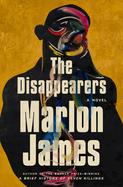
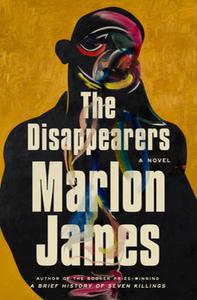
 Can someone vanish if their existence isn't acknowledged as valid to begin with? That is the question driving Booker Prize winner Marlon James's The Disappearers, a massive, unsparing reckoning of a novel, spanning more than 600 pages.
The story opens in Kingston, Jamaica, in May 1988. Eight gay men, all strangers, gather to rehearse John Herbert's Fortune and Men's Eyes, a play set inside a prison. "This is a gay play about men loving and sexing and rule over other men in a prison. All the roles are gay. If is 'Christmas Carol' you looking for you in the wrong place." The choice of a cage for a set reflects exactly how these men already experience the outside world. The cast includes Havelock Titus, the director; 18-year-old Eddy Porteous; and Jordan Brown, who describes himself with sharp, defensive bluntness as a "full-time battyman.... Occasional thorn in somebody's backside." Rounding out the group are Omar Joseph, Rainford Ellis, Orrin Turner, Matt Chin, and Clive Lim.
Their world shatters when a violent mob attacks their rehearsal space. By sunrise, Omar is dead, Rainford is blinded, and Orrin and Matt, the titular "disappearers," have vanished into the Kingston heat. The narrative maps the ensuing wreckage over several years through a fragmented structure of diary entries, interviews, letters, and even the perspectives of the attackers themselves. This formal choice forces readers directly into the mob's mindset, refusing to offer the safety of a detached vantage point.
In 1988 Jamaica, the Offences Against the Person Act, a colonial-era relic, mandated up to 10 years of hard labor for sex between men, but more often the penalty was enforced culturally. Pastors preached damnation, dance-hall tracks competed in violent homophobia, and neighbors turned informant. The global AIDS crisis was considered proof of divine judgment. In The Disappearers, James refuses to turn perpetrators into caricatures; he presents the homophobia of ordinary citizens as casual and omnipresent.
Survival requires different tactics from each character. Jordan's voice crackles with a protective wit and a refusal to seek respectability, making him the novel's anchor. Meanwhile, the younger Eddy tries to untangle his trauma by obsessively replaying the year before everything broke. Even the missing men, Orrin and Matt, define the narrative through an absence that carries its own weight.
James (Black Leopard, Red Wolf; A Brief History of Seven Killings) has spent his career examining Jamaica's historical fractures, but The Disappearers possesses a raw, unmediated fury. As a gay Jamaican writer, James brings profound personal stakes to this register. The result is a more intimate and less mythologized prose than in his previous work with a gravity that is felt on every page. --Elizabeth DeNoma, executive editor, DeNoma Literary Services, Seattle, Wash.
Shelf Talker: A sprawling, furious, necessary work, Marlon James's The Disappearers maps the wreckage of a violent act in 1988 Jamaica.