

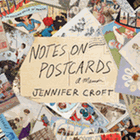
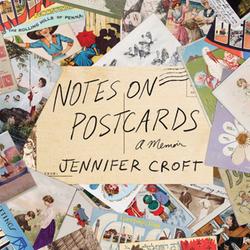
 Jennifer Croft is an author (Homesick; The Extinction of Irena Rey) and translator (Pedro Mairal's The Woman from Uruguay from the Spanish; and, from the Polish, Olga Tokarczuk's The Books of Jacob and Flights, for which she shared the Booker International Prize). Her illustrated second memoir, Notes on Postcards, is an earnest, elegant meditation on place and purpose. Postcards, which she "sent... home religiously" from her travels, are literal display pieces in this attractive art book; at the same time, they offer the template for a structure uniting the advantages of brevity and (self-)exposure.
"From an early age," Croft divulges, "I needed to travel, to be in the world." Chronological sections headed with location stamps span 2010 to 2022. Every year or two, she moved, always looking for "the One," geographically and romantically: Buenos Aires or Los Angeles, Juan or Jules? It wasn't until she met fellow translator Boris Dralyuk that she contemplated giving up the nomadic lifestyle and putting down roots. The focus is on 2021-22 when, following two miscarriages, she gave birth to twins not long after her father's death. In a satisfying full circle, the book opens in her hometown of Tulsa, Okla., and leaves her there at the end, settled with her family and working as a professor.
Interspersed with this personal narrative--which is cleverly captured via fragments of text of postcard dimensions--is the history of the postcard. Although the definitive precursor is disputed, one early example stands out. At the 1865 Austro-German Postal Conference, Heinrich von Stephan proposed an "open post-sheet" as a quick and inexpensive missive. The technology has advanced little since, adding only a box for the stamp and a line dividing address from letter. The postcard has filled various roles: conveying news, commemorating vacations, telling jokes, or encapsulating places. The image on the reverse might outweigh, match, or underline the importance of the handwritten message. Specimens from Croft's collection highlight this variety of functions and tones. Some are mundane, others (reporting a death, for instance) momentous yet offhand. When exchanges are reduced to such "bare communication," she wonders, "is what you ultimately get to feeling? Need?"
"Postcards make me feel less lonely, less lost," Croft says. In an era of constant digital messaging, they retain value as tangible tokens of place and incident. The book presents life, appealingly, as a concatenation of everywhere one has been, all that has happened--and positions the translator as linguistic and cultural go-between. In paring her story back to the basics, Croft has produced something that, much like a postcard, is simultaneously "telltale and intimate... ephemeral and lasting." --Rebecca Foster, freelance reviewer, proofreader, and blogger at Bookish Beck
Shelf Talker: A charming illustrated history of the postcard, alongside postcard-sized fragments of ruminative prose tracing how places and events shaped Croft's life as a daughter, translator, and mother.