

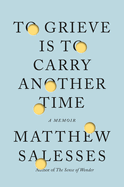
 Novelist and academic Matthew Salesses's eighth book, To Grieve Is to Carry Another Time, is a potent philosophical memoir exploring the nature of loss: not just the death of Salesses's wife but also the foundational wound of his adoption from Korea.
The narrative opens with a jolt. The setting: a psychiatric ward after one of Salesses's suicide attempts. His keen observations shift from his fellow patients to himself. In 2018, Salesses's first wife, Cathreen, who was Korean, had died of metastatic stomach cancer, leaving him a single father of two. He quickly discovered "grief makes time... uncanny. To grieve is to feel that you are in the wrong time. The same is true of love."
It wasn't the first time Salesses (The Sense of Wonder; Craft in the Real World) felt he was living in the wrong time and despaired of reclaiming a fixed identity. He grew up in Connecticut with white parents and no exposure to Korean culture. His adoptive father was physically abusive. "As an adoptee, I grew up with grief as another time. I lived simultaneously in one reality in which I was American and another in which I was still Korean." At 23, he went to Korea to teach kindergarten and felt like an outsider, ignorant of the Korean language and culture. However, it was on that trip that he met Cathreen.
The 136 numbered fragments zigzag through time and incorporate science (Carlo Rovelli), philosophy (Roland Barthes), and psychoanalysis (Adam Phillips). Liberal quotations from Asian and Asian American authors, including Han Kang, Chang-Rae Lee, Ruth Ozeki, and Michelle Zauner, offer perspective. Throughout, Salesses interrogates accepted notions such as "time heals" and the "model minority stereotype" that expects Asian Americans to be quiet and assiduous. Instead, Salesses argues, he experiences "racial melancholy" because, although white people profess to be postracial, they actually wish to annihilate color. Perhaps aptly, he notes, white is the color of mourning in Korea.
The memoir's aphoristic style can feel detached, but there is dignity to its wrestling with paradoxes. Salesses never resorts to easy answers, because there are none; grief doesn't end. Yet through his writing he creates space for the ghosts of extinguished people and unlived lives. And by giving his child-self permission to let go of the burden of the past, he bypasses suicide and keeps going. Trenchant and cathartic, this work will captivate readers of Nicole Chung and Denise Riley. --Rebecca Foster, freelance reviewer, proofreader, and blogger at Bookish Beck
Shelf Talker: A Korean American adoptee reflects on racism and bereavement in the wake of his first wife's death and his time in a mental hospital.