

The Swedish Academy has awarded the 2026 Nobel Prize in Literature to Canadian author Anne Carson "for her bold and inventive oeuvre that, in playful dialogue with the classical tradition, has created new forms for contemporary literature."
 |
|
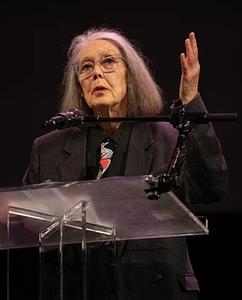
| Anne Carson at the 2024 National Book Awards finalists reading (photo: Jay Dixit) | |
Carson was born in 1950 in Toronto. In 1981, she published her doctoral thesis in classics, Odi et Amo Ergo Sum, "and has, throughout her entire career, combined poetry writing with translation work and teaching at various universities," the Academy wrote in a bio-bibliography, adding that "almost all her literary production has centered upon the intersection between the philologist's obsession with words and the poet's desire for new meaning. She has herself identified the etymology of words as the starting point for all her work. Her translations from Classical Greek may be regarded as independent works in their own right."
The Academy cited as examples her interpretation of Sappho's poem fragments, If Not, Winter (2002), along with tragedies such as Sophocles's Electra (2001) and Antigone (2015) and Euripides's Bakkhai (2015). (Carson's books are published in the U.S. by Penguin Random House and New Directions)
Among her most heralded and popular works is Autobiography of Red: A Novel in Verse (1998), which "demonstrates her eminent ability to actualize the classical literary tradition," the Academy observed. "With a precise feel for contemporary idioms and experiences, she takes as her starting point poem fragments by the sixth century BC Greek poet Stesichoros concerning the winged red monster Geryon. While the myth describes how Heracles, in fulfilling one of his labors, kills Geryon and steals his cattle, Carson recasts the terrifying giant as a tender 'hero' devoted to his mother, in what becomes a modern Bildungsroman."
Carson's long essay Eros the Bittersweet (1986) laid the foundation for her subsequent authorship, the Academy noted. "With its brilliantly rendered meditation on Eros being the essence and driving force of the poem, the book draws heavily on a compound adjective from Sappho that defines Eros as pain and sweetness combined."
Her other works include Glass, Irony, and God (1995), "which demonstrates the potential of the long poem where genre boundaries are seen to blur"; The Beauty of the Husband: A Fictional Essay in 29 Tangos (2001), which "tells of a cutting and sardonic row with a deceitful husband, its 29 episodes each opening with lines of verse by the romantic poet John Keats"; Nox (2010), written in memory of her brother Michael, "who was mysteriously absent prior to his death in Denmark in 2000"; Float (2016), a work consisting of 22 chapbooks on different subjects, capable of being read in any order; and Wrong Norma from 2024, "a diverse combination of texts with a strongly performative aspect in which Carson crosses over into various artistic and academic fields."