

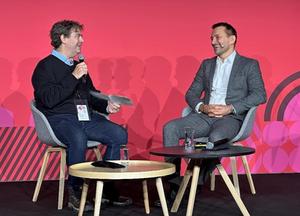
"The most important target is to stay relevant," said Joachim Kaufmann, the new director and CEO of the Frankfurt Book Fair, in a conversation with Publishing Perspectives editor-in-chief Andrew Albanese Friday morning.
Appointed in September, Kaufmann will officially take over from longtime director Juergen Boos on November 1. He discussed his background in publishing and his vision for the Frankfurt Book Fair.
 |
|
| Andrew Albanese in conversation with Joachim Kaufmann. | |
The biggest risk he sees for the book fair, Kaufmann continued, is the growing tendency of "people from the professional side" to "shorten their visit" and spend fewer days at the fair. Kaufmann said the "DNA of the Frankfurt Book Fair" is the B2B fair, and he called it "by far" the most important part of the book fair. He sees the fair's role as being the central platform for the publishing industry and a hub for matchmaking and networking; going forward, the fair needs new offerings and new formats to make it worth "traveling all the way" to Frankfurt.
Prior to joining the Frankfurt Book Fair, Kaufmann had a long career in publishing. He spent 20 years as the CEO of German publisher Carlsen, and in that role, he was one of the fair's "biggest exhibitors." As such, he has "certain ideas" about "what must be changed" from an exhibitor's standpoint, though he did not address specifics.
Kaufmann said he also wants to shine a "much bigger, much stronger" spotlight on the publishing industry during the week of the fair. He wants "even more attention" from media both in Germany and abroad, and he wants to draw politicians and other important figures to discuss big topics like AI and copyright and literacy and reading promotion. He would also like to elevate the status of the publishing industry in Germany, saying it left him "speechless sometimes" that the German film and gaming industries enjoy more attention and greater government subsidies.
When it comes to the fair's public days, he wants "to create the big festival for books." He emphasized, however, that "there will always be that pure professional fair," and he will "never accept" public attendance before Friday. But from Friday through Sunday, he wants "to have a huge crowd out there," drawn by "huge stars" and "huge stages."
Asked about the current challenges facing the industry, Kaufmann called himself a "terribly optimistic guy" and described the publishing industry as being in "permanent change." He said he believes strongly in book publishing and the future of the book industry, asserting that publishing is in a "more robust" place than other legacy media, as publishers are not dependent on advertising.
Kaufmann also noted that over the course of his roughly 30-year career in book publishing, there was "always a challenge," and though the industry "loves complaining" about losing readers or bookstores dying out, "nevertheless we still exist."
He recalled that around 2010 while he was at Carlsen, in the midst of a huge increase in e-book sales following the launch of the Kindle, the company did a "scenario day" examining what would happen if the book market became mostly digital and Carlsen's revenue became more than 50% digital. Though in the end that never came to pass, it was "good to think about it," he said.
However, Kaufmann did acknowledge risks facing the industry, including how AI companies "steal our content," the decline in reading, and competing with social media for consumers' attention. He stressed, however, that challenges also afford opportunities. AI, for example, can be a useful tool for publishers, and social media can be a great environment for promoting books.
Kaufmann said he was grateful to be taking over a fair in a "healthy economic condition," and he praised Boos's 20-year tenure as director and CEO. One of his major achievements, Kaufmann said, was that Boos "always lived with the change." He remarked: "Change will always be part of our job." --Alex Mutter