

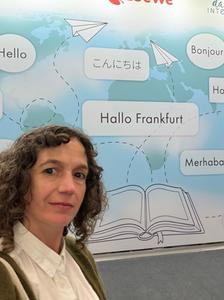
Hannah Harlow is the co-owner and day-to-day operator of the Book Shop of Beverly Farms, Beverly Farms, Mass., which she and her brother bought in 2020. Before that, she worked in publishing for many years, most recently at Houghton Mifflin Harcourt. She attended the Frankfurt Book Fair earlier this month thanks to a fellowship from Books Across Borders, the nonprofit organization that aims to connect booksellers to the international world of publishing. This is her report:
|
|
| Hannah Harlow | |
Working in a bookstore, I love the everyday conversations I have with the people who walk into our store. When I'm selecting books for our shelves, I think about the people who shop with us and the sense of self we've cultivated through the contributions of booksellers and patrons and historical data. And this is what makes indie bookstores so great: We each have our own personalities that reflect the identities of our communities.
This October, I received the Books Across Borders fellowship to travel to the Frankfurt Book Fair. Suddenly, I had the whole publishing world at my fingertips. And what a large world it is. I spent my first few hours there simply wandering from hall to hall, in an attempt to grasp the massive scale of the fair (4,000 exhibitors! 65,000 trade visitors from 130 countries!). Then I started talking to people--where did they come from, what did they publish, what did they hope to achieve at the show? I also attended programming--with 3,800 events across dozens of stages, I barely scratched the surface.
At a panel about the activities of the European Network for Literary Translation, an international nonprofit network of organizations that invests in literary translation support programs, one panelist said that, when selling a work of translation, they always ask: "How is this book extremely local and extremely universal?"
Later that afternoon, at a panel called "Saving the World Without a Budget," an editor at the Brazilian publishing house Pallas Editora, which produces internationally award-winning children's books, said their initial goal had been to serve the people of Brazil. Those books just happened to go on to find wider success.
These similar ideas stuck with me: What makes a story both local and universal? While meeting with a rights director at Europa Editions, I brought this up. "Well, of course," she said. "The human story transcends. Those are the stories that work locally first. In the end, we're all the same. So which are the stories that best get at the human experience?"
 The next day, I stumbled upon a panel sponsored by the Literature Translation Institute of Korea. Two translators were talking about the challenge of translating larger languages (Chinese, Korean) into smaller languages (Danish, in this specific case). They talked about how translating is community building and community building is activism. "Why do we translate poetry? Not because it's going to sell in big numbers, but because it's important. It conveys one culture to another."
From the personal to the universal and from the big to the small, I was starting to see a circular flow. Serving your own community must come first. Serving your own community also means bringing the world to your neighborhood because it's vital for us to understand other cultures. And to do so, we must occasionally step outside of our communities.
Elisabeth Jacquette, executive director of Words Without Borders, said while accepting an award for innovation for her organization, "Literature in translation is not a genre in and of itself. It encompasses all genres. Let's just read good stories."
No matter where we are in the world, isn't that all any of us are trying to do?
I'm extremely grateful to Books Across Borders for offering the fellowship that allowed me to connect with publishers and booksellers from all over the world. It reminded me of the scale this industry is operating on and the important role each small community plays in its success.