

|
|
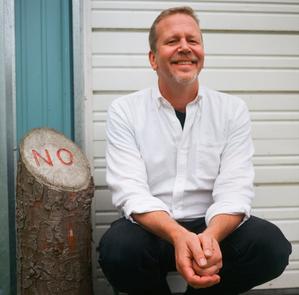
| Samuel Ligon (photo: Heather Malcolm) |
|
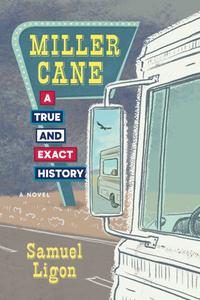
Samuel Ligon's novel Miller Cane: A True and Exact History (Slant Books, September 15, 2026) was serialized for a year in Spokane, Wash.'s weekly newspaper, the Inlander, as well as on Spokane Public Radio, before being published in revised and expanded form. Ligon is the author of four previous books of fiction, including Safe in Heaven Dead and Wonderland, and is co-editor, with Kate Lebo, of Pie & Whiskey: Writers Under the Influence of Butter & Booze. His stories and essays have appeared in the Georgia Review, New England Review, the Gettysburg Review, Prairie Schooner, and elsewhere. He teaches at Eastern Washington University in Spokane.
Handsell readers your book:
Miller Cane: A True & Exact History is about a fraudulent grief counselor who makes his living conning and comforting survivors of mass shootings while also working as a fraudulent historian, writing twisted biographies of notable Americans for an 11th-grade history textbook. When the woman he loves asks him to rescue her daughter from a bad situation, he takes the child on the road, his life as a conman imperiled by his evolving role as a father. How long can Miller keep Carleen safe? And how's he supposed to explain this gorgeous, broken country to her--or to anyone?
On your nightstand now:
Life's Work by David Milch. He tells us in the prologue he's suffering from Alzheimer's, "losing my faculties," he says, and must rely on his wife and children to help write the book we're reading. There's a thrill shortly thereafter, as we fall into this wild, beautiful narrative, when we wonder, Is this possibly true? Is this possibly accurate? And then we remember what he told us at the beginning, that he's losing his memory, and it doesn't matter if what we're reading is true or not, because it is so clearly the David Milch who wrote so much of the best-written TV show of all time, Deadwood.
Favorite book when you were a child:
I loved Robin Hood, my dad's copy from 1923, and the Dr. Seuss books, for the music, and Laura Ingalls Wilder's Little House on the Prairie series, which played such a significant role in Miller Cane. There are so many children's books I read to my kids that I love, especially, at the moment, While You Were Napping by Jenny Offill, illustrated by Barry Blitt, one of the funniest books I've ever read.
Your top five authors:
William Faulkner, for the music; Alice Munro for the character complexity; William Shakespeare (I realize how pretentious this sounds, but I've been in a Shakespeare group for 15 years with five other writers, and I've come to realize that, Oh, yeah, this work is just jammed with the most complex, contradictory characters, the plots have a beautiful elegance, and he distorts history over and over again, something I find particularly appealing); Anton Chekhov, because he can write a major novel in 15,000 words, and because he reveals so many facets of human complexity in his stories; and Toni Morrison, because she covers so much American experience and history from so many perspectives in one body of beautiful work.
Book you've faked reading:
Edmund Spenser's The Faerie Queene, a 16th-century, thousand-page epic poem that I was supposed to read in a college seminar, the only class I could take to graduate with honors, something I still have nightmares about, the poem threatening to kill me by its third line. Back in college, I might have made it through 20 pages before I realized I was never going to finish and would somehow have to fake any knowledge or understanding of the work--and this was long before the Internet or AI, though CliffsNotes did exist. I'm not sure I ever did get those notes. Not sure how I passed the class. I'll need some deep therapy to fully recover this memory.
 Book you're an evangelist for:
Fools Crow by James Welch, a novel examining the 19th-century wave of white encroachment that would change the Blackfeet people's way of life forever. Welch establishes the characters and how they live before that tidal wave arrives. And while history records, however narrowly, much of what will happen next, Welch's novel is much larger than other, simpler narratives of doom. The book itself is a document of ongoing life and resilience in the face of what seems like insurmountable forces of destruction. And the prose, the story, and the characters are fantastic.
Book that changed your life:
As a fiction writer I'm interested in time, since plot can't exist without a clock, one event shaping the next. Because of that interest (or obsession), I'm often seduced by narratives that play with time, work around time, try to subvert the clock, refusing to be imprisoned by it. Many of Alice Munro's stories start at one point and go back in time, without ever returning to the present, which feels transgressive. Her collection Runaway in particular changed me as a writer, not just because of how she plays with time but because of how she respects the reader, leaving some of the action mysterious, unclear--"What just happened?" we think. Stuart Dybek also plays with the clock, a master of digression, especially in The Coast of Chicago and I Sailed with Magellan.
Absence is also an obsession of mine, what we leave out, as exemplified by Amy Hempel's use of negative space in her stories and Ernest Hemingway's iceberg principle, the idea that most of a story should be under the surface, exerting tremendous gravity, but not visible. Another good example of absence and bending time is found in The Known World by Edward P. Jones, wherein the American Civil War hangs like an anvil over the action but is never directly addressed, time weaving forward around it, like a planet orbiting the sun. There are so many more. Tim O'Brien's The Things They Carried, because of its lists. Juan Rulfo's Pedro Páramo, because of its distortion. And on and on and on.
Favorite line from a book:
I don't know which line from which book could be considered my favorite--I love so many lines in so many books--but the beginning of Tropic of Cancer by Henry Miller comes into my head at the oddest moments: waiting in line at the grocery store; when I'm stuck in horrific traffic; or whenever I'm held hostage in a particularly boring meeting. (And it's really three lines): "I am living at the Villa Borghese. There is not a crumb of dirt anywhere, not a chair misplaced. We are all alone here and we are dead."
Five books you'll never part with:
Jesus' Son by Denis Johnson, Reasons to Live by Amy Hempel, The Sound and the Fury by William Faulkner, Fools Crow by James Welch, Pedro Páramo by Juan Rulfo.
Book you most want to read again for the first time:
David Mitchell's Cloud Atlas. Mitchell's play with form and genre was such a pleasure to participate in, especially because each new section/genre is an invitation for the reader to leave. New voice. New character. New story. New point of view. But each new section brought me in deeper. And seeing a writer at play like this is almost always a pleasure.