

The winners of the 77th National Book Awards were announced and honored last night at a gala event in New York City, hosted by actor Kyle MacLachlan, whose memoir Fictional Selves was published in September, and featuring musician Michelle Zauner, whose first book was Crying in H Mart and whose next book, Thank You for Your Suffering, will be published in April. The event was a mix of the usual celebration of reading and books and authors and the industry, as well as criticism of book bannings, U.S. Administration policies, and U.S. support for Israel. Watch the full awards program here.
Two nominees were not in attendance after the U.S. government withheld visas: Samar Yazbek of Syria, a finalist for books in translation, and Abdelrahman ElGendy, who won the nonfiction award.
The winners:
|
|
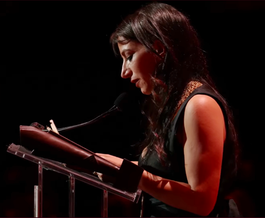
| Hannah Lillith Assadi | |
Fiction: Paradiso 17 by Hannah Lillith Assadi (Knopf)
Assadi said in part about the tale of a man born in Palestine who had to leave in 1948, "You know how beautiful stories go. There is always so much pain, and what a beautiful story this has been.... In the course of its writing, I've experienced deep personal grief and unimaginable collective grief. I watched cancer ravage my father's body and genocide ravage his people and their children. Perhaps this is the Palestinian story on this earth, so beautiful, so painful."
|
|
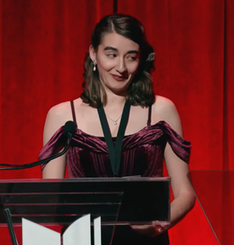
| Helen Thomaides | |
Nonfiction: Huna: A Memoir of Revolution, Prison, and Becoming by Abdelrahman ElGendy (Hogarth)
His editor at Hogarth, Helen Thomaides, accepted the award for ElGendy, who had been denied a visa by the U.S. government to come to New York for the awards. She noted that after spending six years in prison in Egypt, ElGendy had found refuge in the U.S., where "this book took shape, where he built a community of writers, a life, a home." But he was "once again forced to flee, from a cruel deportation machine... and now he's not able to return even as a celebrated visitor."
|
|
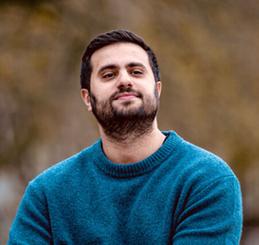
| Abdelrahman ElGendy (photo: Fadel Dawod) |
|
Thomaides then read remarks from ElGendy, who said in part, "If you're listening to this, then a years-long dream of mine has come true.... Years ago, in my prison cell in Egypt, I used to fantasize about writing a memoir." He began writing there, "concerned only about rendering on the page the torture my body was enduring. The scribbles on a smuggled page became a potential essay, the essay a potential published article, the article a book."
He decried the "more than 60,000 political prisoners still behind the bars of Egypt's military dictatorship, bankrolled by the U.S. government, the tens of thousands of souls disappeared into ICE concentration camps," and "the Palestinians still being massacred by U.S.-funded Israeli bombs."
|
|
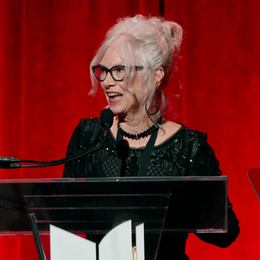
| Brenda Hillman | |
Poetry: Still House in the Desert: An Eco-Contemplation by Brenda Hillman (Wesleyan University Press)
Hillman thanked "everybody in the room who's ever written a poem because you've all written poems, I bet.... Thank you for keeping poetry in your lives. If you would keep it there all the time, not just at weddings and funerals--because poetry is a life's blood for you." Saying that poetry "sometimes gets short shrift," she suggested people "keep reading poetry, not just occasionally, and try to read a poem every day."
She also noted, with a laugh, that now she and her husband, Robert Hass, who won an NBA in 2007, have "a matching set" of NBA trophies.
|
|
|
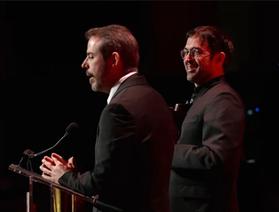
Vicente Luis Mora (l.) and Rahul Bery |
|
Translated Literature: Centroeuropa by Vicente Luis Mora, translated from the Spanish by Rahul Bery (Bellevue Literary Press)
Mora spoke a moment about the novel, which features a man trying to bury his wife but who can't do it "because the earth is full of frozen corpses of soldier from a lot of wars." He observed, "I think there is something in history that we cannot learn about," but hoped that countries where people love other people who are different and where people are peaceful and decent someday "will be something more than fiction in a book."
Bery noted the challenges of translating some difficult passages and said, "In a year where everyone's talking about AI and the threat to all kinds of human creativity and endeavor, I like to think that for now, this is the kind of thing a computer probably couldn't do." And when re-reading one's own work, one sees "all the mistakes you've made, but at the same time, I recognize the humanity in it, and that's something worth celebrating."
 |
|
|
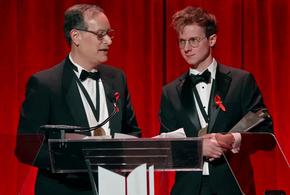
David Levithan (l.) and Gabriel Duckels |
|
Young People's Literature: The Fight of Our Lives: AIDS in America by David Levithan and Gabriel Duckels (Knopf Books for Young Readers).
Duckels said in part, "This book's about the AIDS crisis, and that's not a simple story to tell. It's not an easy one to hear. It's not a story that's finished. It's never been just one story. It's hundred and thousands, millions of stories, scattered across borders, oceans, decades, generations.... People living with AIDS matter. The past, present, and future of HIV and AIDS can't be disappeared or marginalized. It has to be talked about, understood, respected."
Levithan said in part, "We are so proud to be in the company of so many extraordinary queer storytellers in all categories this evening.... We have this to say: Yes, there are people who want to erase our stories from the shelves. But, no, there are far, far, far more people who want our voices to be heard, who want the truth of our lives shared, and who want the queer generations that come after us to have an easier time, not a harder time. We will not allow our youth, particularly our trans and nonbinary youth, to go unsupported. We will not let the noise of others drown out the music of who we are."
Also at the gala, Salman Rushdie was presented with the Medal for Distinguished Contribution to American Letters, and Perri Klass received the Literarian Award for Outstanding Service to the American Literary Community. Both awards were announced in September.
(photos courtesy National Book Awards)