






Lending Ending: Penguin Cuts Ties with OverDrive
 Penguin is ending its relationship with digital library distributor OverDrive effective today and will "stop offering e-books and digital audiobooks to libraries--at least until it finds a new partner," paidContent reported, adding that Random House is now the sole of the six major U.S. publishers "to allow unrestricted access to its e-books in libraries--though it will raise prices beginning in March."
The American Library Association, which met with big-six publishers regarding the issue of digital book borrowing cutting into paid sales, noted that a "key issue that arose in each meeting is the degree to which 'friction' may decline in the e-book lending transaction as compared to lending print books. From the publisher viewpoint, this friction provides some measure of security. Borrowing a print book from a library involves a nontrivial amount of personal work that often involves two trips--one to pick up the book and one to return it. The online availability of e-books alters this friction calculation, and publishers are concerned that the ready download-ability of library e-books could have an adverse effect on sales."
Penguin is "continuing to talk about our future plans for e-book and digital audiobook availability for library lending with a number of partners providing these services," the publisher said in a statement.
OverDrive CEO Steve Potash told the Associated Press (via the Wall Street Journal) that he is still "actively working" with Penguin on the issue.




 In the third quarter ending December 31, revenue at Indigo Books & Music rose 0.5%, to C$352.9 million (the Canadian dollar is equal to the U.S. dollar), and net profit slipped 12.2%, to $23.7 million. Sales at superstores open at least a year rose 1.8%, and IndigoSpirit small-format stores were up 2.5%. Sales from Indigo's online channel, chapters.indigo.ca, rose 9.3% compared to the same period in 2010.
 Retail e-commerce spending hit the
  On March 11, Switzerland votes on a referendum that would guarantee fixed prices on books and e-books for at least 18 months after publication, making it the first country to put book pricing issues to a public vote, Carlo Bernasconi, editor-in-chief of Schweizer Buchhandel reported. A fixed price law passed the parliament last March, but a group of young liberals, the right-wing party Schweizer Volkspartei and the country's largest retailer, Migros, collected more than 50,000 signatures for the referendum. The Swiss Bookseller and Publishers Association is running a campaign in favor of fixed book prices and borrowed Heidi from the eponymous Johanna Spyri novel to yodel for a yes vote. (See a billboard featuring Heidi on the wall of wholesaler Schweizer Buchzentrum.) Polls predict a narrow victory for the measure.
 Pulitzer Prize-winning author Michael Chabon, Norwegian novelist Jo




 Here's a question you don't see every day: "
 Universal has released its first trailer for
 Your top five authors:
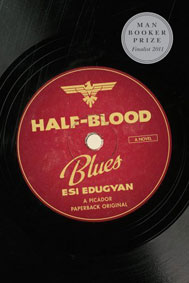 One of the risks of historical fiction is that the history can get in the way of the fiction; the author's imagination is often crammed into a box of flat characters and plodding narrative in the name of accuracy. Such is not the case with Esi Edugyan's atmospheric second novel. Although set mainly in late 1930s Germany, as Hitler's "jackboots" march toward war, and later in Paris, Half-Blood Blues merely uses politically unstable Europe as a backdrop for a dialogue-rich story about a multi-ethnic jazz band and its prodigy trumpet player.
 The recent publication of Jessica Keener's fine debut novel Night Swim prompted me to pay closer attention to the enthusiastic support she received online from authors whose work I admire, including Patry Francis (The Liar's Diary), Susan Henderson (Up from the Blue) and Leora Skolkin-Smith (Hystera), among many others.
  Francis noted that when she started submitting her work to agents, "I was suffering from an extreme case of writerly isolation. I viewed loneliness and fierce rivalry as occupational hazards." Gradually she discovered online alternatives, "and eventually the tangled, marvelous, distracting, infinitely fascinating world that is social media. There, counter to stereotype, I found an incredibly large-hearted and generous community. No one embodies that spirit more than Jessica Keener. Her willingness to give of herself, to offer encouragement, nurture, constructive criticism when requested, and enthusiastic support to others is truly unique."