Tuesday January 13, 2026: Maximum Shelf: A Killer in the Family
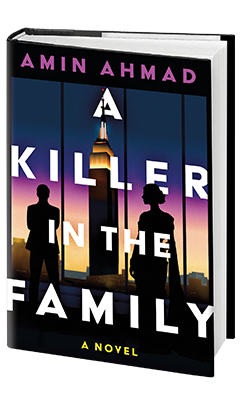
A Killer in the Family
by Amin Ahmad
Amin Ahmad thrills readers with an intoxicating blend of dark crime story and complex family drama in his tightly plotted and suspenseful novel A Killer in the Family, set in the rarefied, hidden world of the billionaire class where power dynamics, secrets, and the lure of extreme wealth create a perilous moral landscape.
The story begins in Mumbai, 2014, as Ali Azeem, an aspiring photographer, prepares to meet his potential bride, Maryam Khan, the daughter of the megarich real-estate magnate Abbas Khan. In his late 20s, Ali is an amenable but unmotivated party boy whose moderately wealthy family is, unbeknownst to him, on the verge of bankruptcy, making the arranged marriage an urgent business decision. Ali is attracted to the beautiful and demure Maryam but even more excited by her volatile elder sister, Farhan. When Farhan compliments Ali's photographs, he feels "a rush of buoyant joy: The shock of being seen, of mutual recognition--I had been craving this feeling all my adult life." At Farhan's urging, the two begin a torrid affair. None of this stops Ali from marrying Maryam; the allure of the Khans' enormous wealth and all the opportunities it will bring are as seductive as his new sister-in-law. But as soon as the newlyweds move to New York City, installed by Abbas in a sumptuous luxury apartment, Ali's dream of escape into a coddled life of private jets, servants, and exclusivity begins to sour.
Ali quickly realizes that the Khan family is teeming with rivalries, secrets, and abuses of power, and he is little more than a cog in the machinery of his father-in-law's empire: "Less than a month into our marriage, I began to feel like I was not just married to Maryam but part of a larger plan... Abbas projected an air of benevolent ownership when he spoke to me." That plan, Ali realizes, will include joining Tiger Corp, the family business, giving up his dreams of becoming a professional photographer, and immediately producing heirs. Maryam, though conciliatory, is emotionally distant and tight-lipped. Feeling homesick and dislocated, Ali reignites his affair with black sheep Farhan, and she hints that not only is Abbas responsible for horrific acts in her own childhood, he may have ties to a spate of murders more than a decade in the past. Farhan also implies that Maryam is not the good daughter she claims to be. For her part, Maryam tells Ali that Farhan is an addict and a liar. Nevertheless, the two sisters are strangely close and Ali suspects that neither is telling him the whole truth. Despite needing to protect his own secret affair and terrified that the unstable Farhan will let the cat out of the bag, Ali starts an investigation into the Khans, even while becoming more comfortable with and accustomed to his opulent lifestyle.
Ahmad is expert at creating the world of the super-rich Khans and illustrating how privilege and entitlement can warp one's sense of morality in ways both small and large. When Maryam and Ali are invited to a family lunch at Abbas's estate, a helicopter arrives to take them there. When Ali wonders what Central Park would look like from the air, Maryam tells him she could have told the pilot to "swing over." When Ali mentions that they would need to submit a flight plan, Maryam dismisses it with, "There's always wiggle room, isn't there?" With enough money, he learns, "wiggle room" can encompass anything from escaping traffic to neutralizing inconvenient truths and those who tell them. And while Ali is initially taken aback by Maryam's sense of entitlement and shocked that the South Asian servants Abbas has hired for them "followed a feudal model and seemed terrified in my presence," it doesn't take long for his adopted privilege and money to shift Ali's moral compass. He finds himself yelling at the housekeeper for failing to serve him gelato, then proclaiming that "I began to enjoy adultery," and, later, covering up much darker transgressions.
The question of compromise, of how much one is willing to give up of oneself in order to belong, whether to a family or to a new country, is at the beating heart of A Killer in the Family and is what keeps the tension high throughout the novel. For Abbas, attaining wealth and protecting his dynasty is paramount and yet, even at the pinnacle of his achievement, he still sees himself as an outsider. "You do not understand the American psyche," he tells Ali, "optimistic on the outside, but underneath, it is weak, hollow. Americans are bred to think they are special--so when adversity hits, they cannot bounce back." For Ali, who has had a much softer landing in the United States than his father-in-law, it is much easier to erase his outsider status by simply becoming a Khan, even if that means inheriting the rot underneath the American dream.
Ahmad's writing is propulsive and cinematic, expertly blending family intrigue and murder with an examination of the immigrant experience and the lives of the ultra-wealthy in a novel that is unsettling, provocative, and enthralling. --Debra Ginsberg
Holt,
$28.99,
hardcover, 320p., 9781250394897,
April 7, 2026
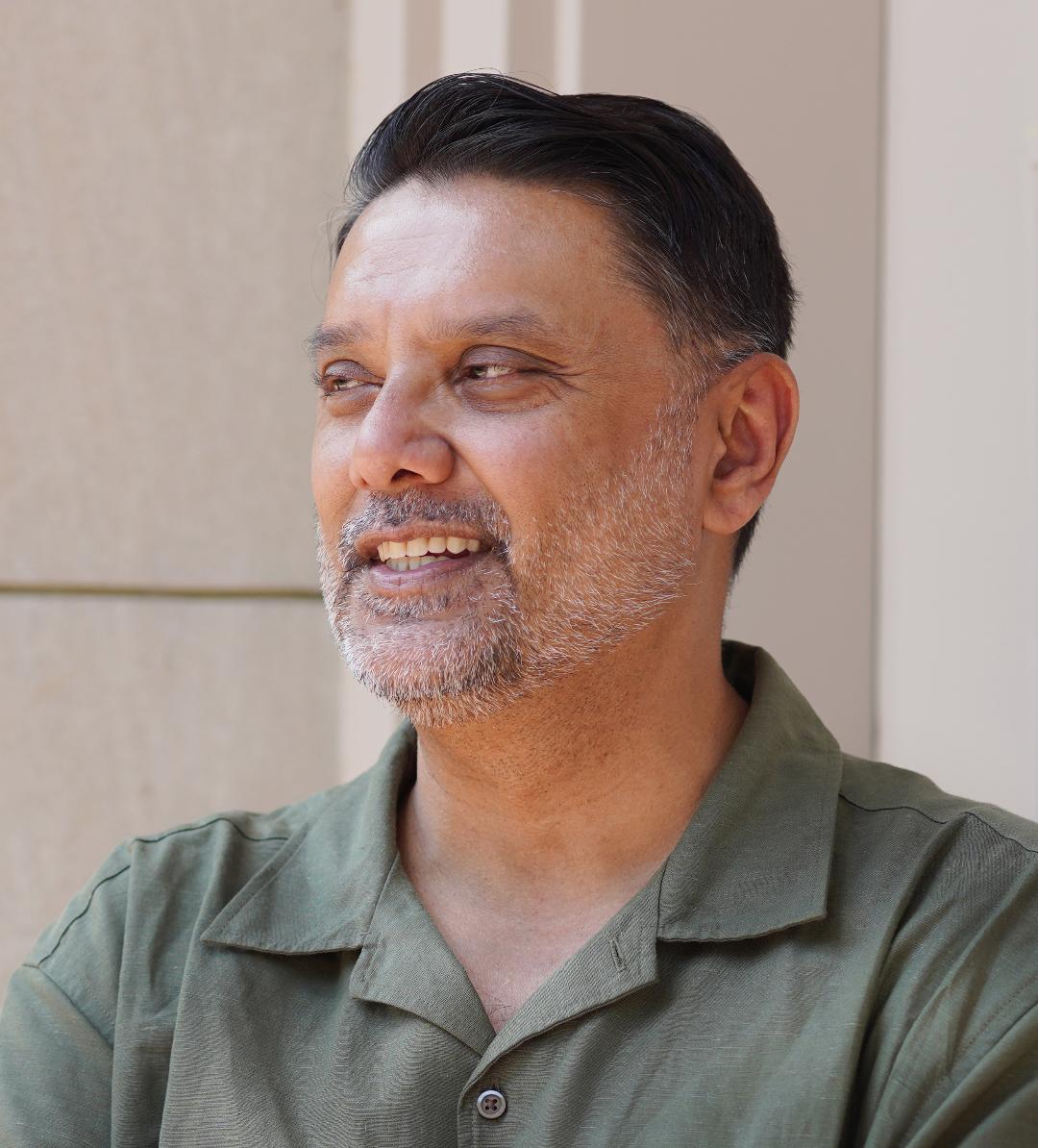
Amin Ahmad was raised in India and came to America at the age of 17. He worked as an architect for many years before turning to writing. His first two novels (as A.X. Ahmad) were thrillers--The Last Taxi Ride, The Caretaker--and his short story collection, This Is Not Your Country, won the 2020 GS Chandra Prize. He teaches creative writing at Duke University, and lives in Durham, N.C., with his family and a very mischievous cat. When he's not writing, he can be found on his front porch, drinking tea and watching the world go by. Ahmad's third novel, A Killer in the Family, will be published by Holt on April 7, 2026.
What was the initial spark, idea, or character that prompted you to write this book?
Sometimes I have an idea and it takes years for it to coalesce. When I came to the United States in 1985 to go to college, there were no novels about the Indian-American experience. I remember reading a lot of American classics like Faulkner and Steinbeck and Fitzgerald. The one novel that stuck with me was The Great Gatsby. I would re-read it over the years, but I didn't understand my attraction to it until I grew older and realized Gatsby is just like an immigrant. He changes his name from James Gatz to Jay Gatsby, tries to reinvent himself, tries to be accepted by the East Coast elite. That story was really poignant for me, and I always wanted to write an immigrant version of The Great Gatsby, because coming to this country and reinventing yourself is really an immigrant experience. Many years later, I picked up New York magazine and read an article about this Indian guy, a very wealthy real estate developer who was building an estate out on Long Island and re-creating India out there in this big, Gatsbyesque mansion--and things started just coming together. I started imagining a wealthy real-estate family, the Khans, and what kind of conflicts they would have, and the novel grew from there.
Power and who wields it is a strong theme in the novel and the characters access that power either with money or with information. Which one do you think is more important?
I think that what drives families is power dynamics. In the case of the Khans, of course money is a huge factor, because things can be bought and people can be bought. But at the same time, the whole book is about information: who has what information at what time, and there's a twist at the end of the book which has to do with information that's being withheld. Yes, money is a blunt instrument and it can definitely be used for clout, but if you know the deep, dark secrets of somebody's life, you could probably control them forever.
Immigration and acculturation also feature strongly here. Can you speak a bit about the differences and similarities of the immigrant experience within the Khan family?
The novel is really about two different generations, and how their experiences differ. The older generation of immigrants, like the patriarch, Abbas Khan, have had to claw and fight for every penny that they have. They've had to really extend themselves and operate in an alien culture, a Darwinian battlefield, in order to make their fortunes. When that older generation of immigrants becomes successful in America, they give every opportunity to their children, but when the children are more at ease here--they want to have fun and enjoy life--the older generations think, Ah, these people are soft. They're spoiled; they don't get it. They don't understand how hard the world is. This is the conflict between the first generation, who have no illusions about how power and money work, and their children who are born into a more sheltered, privileged life: the second generation are resented by their parents, who actually created this life for them and wanted it for themselves. So in my novel, the immigrant experience is deeply intertwined with the dynamics of the Khan family.
There are many delicious details involving art, real estate, and toys of the megarich here. How much research did you need to do to create the world of the Khans?
I trained as an architect and worked in architecture offices for about 15 years. When you're trained as a designer, it's a disaster, because it gives you expensive tastes for furniture and clothing and beautiful houses that you can't afford. So for a long time I lived vicariously through architecture and lifestyle magazines. I developed these visions about a certain kind of opulent, well-designed life, and when I wrote the book, I was like an art director with an idea of what I wanted--and I would go out there and find it. Thank God for real estate websites where you can see the inside of people's bedrooms or go through every room in a supertall skyscraper apartment. All these ingredients went into the stew, and it was very freeing. If I wanted to, I could put a $30,000 couch in Ali's living room. I could use elite designers to furnish his apartment and if I wanted Ali to give his wife an Issey Miyake coat from the latest collection, I could do it.
The Khans have enough secrets to carry them through several sequels (or prequels). Are you planning to revisit them in your next novel?
This book took me about 18 months to write. I was not well at the time, and sitting in a chair all day was hard for me. I thought, when I'm done with this book, I'm going to be so elated, I'm going to have a 10,000-pound monkey off my back. Plot-wise especially, it was a high-wire act towards the end to pull it all together. I thought, Once I'm done with this book, I'm going to lie on the couch and watch Netflix, go for walks, work out and get healthy. But instead, I got so depressed. I really missed the Khans and the excitement of living in that world. I can imagine writing a sequel and maybe even a third novel down the line, where the next generation of Khans grow up and want more power, and maybe they venture out into the realm of politics. While I would definitely love to write more about the Khans, my next novel has a different cast. It's a murder mystery set in the fashion industry in India. Still, it has all my obsessions in it, family secrets, the past, and all sorts of hidden dynamics.
And murder! There are many different themes running through A Killer in the Family but it is, ultimately, a mystery/thriller.
Genres like crime fiction, science fiction, and fantasy can be so liberating for writers of color because you can use that genre space to talk about identity, immigration, assimilation, capitalism, the underbelly of the American dream, rather than the usual immigrant story of coming to the U.S. and forging a life that has been done many times. When I teach Intro to Fiction, I actually teach it through writing genre. We start with fairy tales and move on to suspense, sci-fi, dystopian and magical realism, and what the rules are in all these different genres. It's very interesting to see my students absorb the rules of each world and then play with that form. It's liberating for them to realize that anytime you start with a form, you can modify it and make it your own. --Debra Ginsberg