Monday June 29, 2026: Maximum Shelf: Return to the Shack
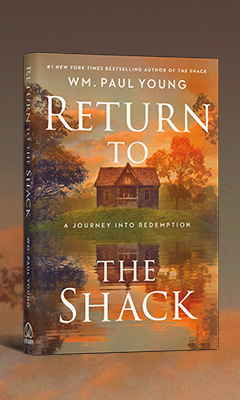
Return to the Shack: A Journey into Redemption
by Wm. Paul Young
In Return to the Shack: A Journey into Redemption, Wm. Paul Young tells the story of a couple's confrontation, and remarkable reconciliation, with the most painful chapter of their lives. Crafted with simplicity, grace, and raw humor, Young invites readers back into the world he created in his enormously successful debut, The Shack, to explore themes of forgiveness and healing. The "severe grandeur" of being human lies at the heart of Young's marvelous novel, a universal experience in which every reader shares a stake.
The story opens 10 years after the devastating events that shattered Mackenzie and Nan Phillips' family. Their young daughter Missy was murdered by a serial killer and now, on the eve of what would have been her 16th birthday, Mack receives an unexpected visit from the FBI agent who worked on Missy's case, Sam Wikowsky. She's accompanied by two younger FBI officers, Amir and Billy; all three characters serve pivotal roles as the drama unfolds.
As with its predecessor, Return to the Shack is narrated in the form of a journal written by Willie, a close confidant of Mack's who admires the way his friend tangles with the deeper questions of life, including "faith, God, suffering, and death." Willie, an entertaining narrator, refers to Mack jokingly as a "rascally type saint." He sets the scene for those who have not read The Shack, so that it's not necessary for readers to be familiar with the original plot of Young's novel.
The Mackenzie family home, where Mack and Nan raised their family, is nestled amid large pines in the Pacific Northwest. Their children Kate and Josh have long since flown the nest and Nan has moved out while the couple muddle through a separation. It is a lonely time for Mack, and here Young lays bare the difficult truth that love on its own is not enough to save a marriage. Instead, each party must muster the internal resources to grow and adapt for the sake of the union. Born into a difficult childhood, Mack's habit of "future-tripping," his need to control outcomes, and his issues with trust are his "Achilles' heel." It is while he is grappling with this truth that Agent Wikowsky and her team turn up on his doorstep.
The FBI has an unusual request for Mack. Missy's murderer, still on death row awaiting execution, is willing to reveal the whereabouts of three other victims' remains on the condition that Mack visit him in jail. Known as "J," he is curious to understand how Mack discovered Missy's body all those years ago despite its remote and hidden location. For a father still mourning his child, this request feels like an outrage. It also places Mack in a horrible quandary. He understands how much the families of those missing girls need closure and the chance to bury their children's remains, but how can he be expected to tolerate being in the same room as J? What does he owe those families? Finally, does he have to forgive Missy's murderer to move forward with his own life? Forgiving the person who ruined your life is one thing; forgiving himself for not protecting Missy will be the true challenge Mack will face.
The "shack" refers to both a physical place--a remote, "ramshackle" dwelling where a grieving Mack found proof of his daughter's abduction all those years ago--and also a spiritual setting where he can access God. After his transcendent, life-altering experience meeting "Papa" God at the shack when he was searching for Missy, Mack finds himself returning there in his dreams as he seeks God's guidance on whether he should visit her murderer. Readers will discover in Mack a rebel who struggles against the "theological concrete" of "fear-driven" religion while on a lifelong pilgrimage to embrace and accept God's pure and unconditional love. To do so he must empty his "anger tank," and overcome his addiction to "control, perfectionism, shame, self-doubt...."
As wondrous and life-altering as his experience meeting God was for Mack, his visits to the death row unit of the state penitentiary in Nashville turn out to be equally consequential. Before meeting with J, Mack is introduced to three inmates who have spent decades on death row while their appeals wind through the courts. Shattering all his assumptions, the men he meets--Akil, Terry, and Kevin--are pious, respectful, and profoundly humane. A sense of peace and calm surrounds them despite their captivity. As their friend Harold said, two weeks before his execution, "Freedom is what happens in the human heart," and in that respect the men are, for the time being, freer than Mack. It's a far cry from the unsavory characters Mack was expecting to meet, although nothing can prepare him for what he is about to encounter with J.
Return to the Shack takes on a suspenseful, thriller-like quality as Mack confronts J in sessions that take him to the edge of his fury and pain. J, a survivor of "horrifying abuse," is imprisoned in "concrete and steel," but Mack is in his own mental prison. As the interactions between the men intensify in a shocking plot twist, can Mack free himself in time to rescue his marriage and heal his heart?
A story rooted in human connection, Young's brilliantly crafted drama will captivate readers with its spiritually profound message of forgiveness as a form of salvation.--Shahina Piyarali
Apiary/Hachette,
$30,
hardcover, 272p., 9781546008873,
October 6, 2026
Return to the Shack: A Journey into Redemption
by
Wm. Paul Young
Canadian-born Wm. Paul Young resides in the Pacific Northwest and is the author of four books. His forthcoming novel, Return to the Shack: A Journey into Redemption (Apiary/Hachette, October 6, 2026), is a sequel to his groundbreaking debut, The Shack, published almost 20 years ago. Following his protagonist, Mackenzie Allen Phillips (Mack), through marital struggles and a confrontation with the serial killer who murdered his daughter Missy, Return to the Shack is ultimately a celebration of the common humanity that miraculously binds seemingly disconnected individuals to one another.
What was the inspiration behind Return to the Shack?
I was asked over the years to write a sequel, and I would always decline and say it's not possible. I thought of The Shack as a standalone novel and did not give it any further thought. About nine years ago, I heard from a friend who, going through a rough patch, had decided to focus his attention on helping others. When you are stuck inside your stuff it's good advice to think about other people instead. My friend went to the death row unit at the state penitentiary in Nashville to minister to the men there, and it changed his life. One of the men had read The Shack, and my friend asked me to sign a copy of the book for the inmate. I told him I would, but only on the condition that I could deliver it myself.
I became good friends with several inmates on death row. They are some of the freest people I know. One of them refers to prison as a gated community with good security! My friends on death row supported me when my father died, we have an incredible relationship. A few years ago I started thinking of the serial killer in The Shack. What if he ended up on death row, in the same unit as my friends? What if my protagonist had to actually face his daughter's killer? It's one thing to forgive the idea of a person, it's another to actually confront the person.
Do you recommend readers become familiar with the story behind The Shack before reading your new novel?
You don't have to, it's not essential, but I always think it's good to read the first book in a series or watch the movie version. It gives you context. I wrote Return purposely in such a way that someone who hasn't read The Shack can still pick it up. Return is a very different book.
Could you describe for readers the difference between the books?
If The Shack is a solo, Return to the Shack is a choir. It is more involved, with a wider range of characters. Those individuals, like Mack's wife, Nan, who played a small role in The Shack, have blossomed into major characters in Return. In this sequel, I am interested in understanding in what ways Mackenzie's life-altering experience with a higher power in The Shack impacts his world. What is the fallout of that spiritual experience a decade later? How does that event work itself into the character's world?
Mack, your protagonist, befriends three men on death row at the state penitentiary in Nashville. Naturally they all have strong views on the death penalty. Do you share those views?
The discussion of the death penalty is incidental to the storyline. It wasn't my intention to write a secret agenda to attack the death penalty. But when you look at the facts, there is a 10% error rate in convictions. I am not comfortable with that. Clearly there should be improved rights for victims, but in the nine years since I've become friends with death row inmates, four of them have been proven innocent. One person who they attempted to execute recently, they couldn't find a vein and after several attempts they had to give up and now he's been granted a one-year moratorium.
Constantly amazed at his life, Mack's motto is "who would have thought." Does that motto resonate with you?
God can give us all sorts of names and identities. My history includes parental abuse, sexual abuse, trauma, and tragedy. I buried it for many years and did a lot of harm to all kinds of relationships, especially to my wife and children. I consider the fact that I didn't take my own life a huge accomplishment. Instead, I spent 11 years on a difficult journey towards change and transformation. Part of my redemption was my wife catching me in an affair. I wrote The Shack as a Christmas present for my children. Against the odds it became a phenomenon in the world and has done so much healing to so many.
A joke, riddle, or enigma, that's how I see my life. God is a redeeming genius; he lives in us all.
You refer to yourself as a "blue-collar" writer. Could you elaborate?
I am a street theologian who never took a writing class in his life. In that sense I consider myself an accidental author. I don't write books for a particular agenda or outcome but for my children and those out there who are lost and don't have a voice. For the first two years after publishing The Shack, I struggled with imposter syndrome.
When I write, I don't have a plan. The writing takes on a life of its own. My writing is simple and accessible to blue-collar people like myself. I think my books connect with people because I don't have an agenda, I am not trying to convert people. I simply write human stories.
Christians have lost the ability to communicate without an agenda. My atheist friends give The Shack to their Christian friends and insist they read it.
Are there any unfinished stories you hope to write?
My memoir, my own story, is sitting on a shelf and one day it may rise to the surface. The timing needs to be right. My parents' deaths opened up space for a memoir. My relationship with my father in the last few years of his life transformed and became something wondrous. I finally forgave him enough to let go of any expectations that he would change. I let him be a human being, someone whose story matters instead of someone who is constantly disappointing me. Learning to live without expectations changed everything. When my father turned 80, I realized I had locked him into a photo album of all the things he had done wrong.
I think I got my creativity from my father. He could blend different fairy tales into a story. He was secretly working on western novels when he was younger.
In life when you let go of expectations, everything becomes a gift. I believe that expectations are disappointments waiting to happen. --Shahina Piyarali