

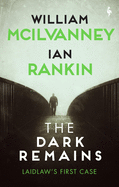
William McIlvanney, the father of tartan noir, made his mark on crime fiction with 1977's Laidlaw, the first book in a trilogy revolving around rule-snubbing detective Jack Laidlaw. McIlvanney died in 2015, leaving behind an unfinished manuscript and an opportunity for a from-the-beyond collaboration with his obvious literary heir, Ian Rankin, author of the Rebus series (Rather Be the Devil; Standing in Another Man's Grave; Saints of the Shadow Bible). In The Dark Remains, the Scottish masters make poetry out of the putrefaction that undergirds their unsparing story.
A prequel to Laidlaw, The Dark Remains finds the detective cutting his teeth with the Glasgow Crime Squad, which is investigating the murder of lawyer Bobby Carter, a hireling of gangster Cam Colvin. Carter was found stabbed behind a bar that's the acknowledged turf of Colvin's rival, mobster John Rhodes, which leads to much conjecture about whether Rhodes is behind the hit or being framed.
Unfolding across six days in 1972, The Dark Remains delivers a fully formed story and a fully fleshed Laidlaw, whose physical and verbal muscularity is achingly offset by his vulnerabilities (to migraines, to the lure of women who aren't his wife). Detective Sergeant Bob Lilley, Laidlaw's partner, takes a crack at deciphering the man: "He really believes there's truth to be found on the streets that exists nowhere else." This isn't to say that Laidlaw sees truth as a path to justice: "The law's not about justice," he tells Lilley. "It's a system we've put in place because we can't have justice." --Nell Beram, author and freelance writer