

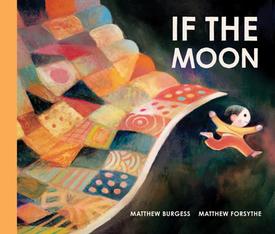
 If the Moon, written by Matthew Burgess (author of the Caldecott Medal-winning Fireworks, illustrated by Cátia Chen) and illustrated by Matthew Forsythe (Mina; Pokko and the Drum), is a quiet, thoughtful meditation on nighttime worry and imagination.
The book, which invites readers to reconsider the phrase "if" as an opening toward possibility, is structured almost entirely through questions. A young child lies awake under a quilted blanket, eyes wide in the dark. Burgess begins, "If can be a dark room where worries swell and rise...." In just a handful of words, paired with a single image, the emotional stakes are clear: this is a child held in the grip of fearful thoughts. A page turn offers a pivot: "Or." The child dives into a quilt panel as if it's water. The text's tone begins to loosen as the waves of color ripple out from the point of exuberant impact.
From there, "if" becomes a launching point rather than a trap. Burgess writes, "if can be a raft./ You climb aboard/ and drift" and the child floats into imaginative terrain. The questions that follow extend the invitation: "If you were a fish,/ would you peer through the silvery mirror of the sea?" If you were a hummingbird, an owl, a bat, a snowflake, stars in a galaxy, even a dinosaur--what would you notice? Where would you go? If you were a "bear snuggling in a winter lair, which memories would warm your fur?" Each scenario builds on the last, gently expanding the child's mental landscape away from worry and toward curiosity. Forsythe's illustrations reinforce this shift with formatting and a soft, cohesive palette. Night skies glow with moonlight, a dinosaur cuddles with a plush bear, planets wear friendly expressions, and snowy scenes feel calm rather than cold. As the child's curiosity deepens, the illustrations expand as well; they move from contained panels to full pages and then to sweeping double-page spreads with fewer visual boundaries. The effect suggests that imagination is not an escape from the child's world but an ever-widening extension of it.
Burgess avoids overt instruction. There is no direct statement about managing anxiety. Instead, the book trusts readers to recognize the transformation: "If" moves from unease to a prompt for creative thinking. By the final pages, the child returns (by rocket!) to bed, with the earlier tension eased. Spare in text yet expansive in implication, If the Moon offers a gentle reframing of a familiar childhood experience and positions imagination as a steady, accessible counterbalance to worry. --Julie Danielson
Shelf Talker: If the Moon is a gentle picture book that turns late-night worries into moments of wonder.