Susan Sheehan, a Pulitzer-winning writer "whose meticulously built-up portraits of individuals trying to endure on the margins of society originally appeared in the New Yorker, and often were published later as books," died February 17, the New York Times reported. She was 88.
Sheehan published eight books. Her 1983 Pulitzer Prize general nonfiction winner Is There No Place on Earth for Me? was "about a woman's struggle with schizophrenia as she moves between her parents' home, a supervised apartment and a mental hospital," the Times noted. The project started in 1981 as a four-part New Yorker series called "The Patient," which drew 500 reader letters and was credited with raising awareness of the 1.5 million people treated in psychiatric facilities yearly.
"I think it's our obligation to tell of the horror and the ludicrousness of the situation in these hospitals," Sheehan told Times in 1982.
Describing her reporting style as "third person invisible," Sheehan published immersive accounts of a welfare mother in Queens; a prisoner at a maximum-security prison; and a teenager ensnared in the child welfare system, the Times wrote. These later became the books A Welfare Mother (1976), A Prison and a Prisoner (1978), and Life for Me Ain't Been No Crystal Stair (1993).
Vince Aletti wrote in the Village Voice that "Sheehan's scrupulous, vivid case histories are constructed bit by bit, fine webs of evidence and observation dense with fact but charged with feeling."
Sheehan and her husband, Times correspondent Neil Sheehan, both reported from Saigon during the Vietnam War and shared a professional partnership. In 1971, Neil Sheehan secured what would become known as the Pentagon Papers, with Susan Sheehan accompanying him to Cambridge, Mass., in 1971 to examine 7,000 pages of government records leaked to him by Daniel Ellsberg. "She helped photocopy the trove of documents under the suspicious eye of a copy shop owner who was nervous about the classified markings," the Times wrote.
Neil Sheehan ultimately spent 16 years writing a reckoning of the Vietnam War, A Bright Shining Lie: John Paul Vann and America in Vietnam (1988), which won a National Book Award for nonfiction and Pulitzer Prize in general nonfiction. Susan Sheehan typed and helped edit the multiple drafts.
She also wrote articles for the Times, the Atlantic, and Harper's. Her other books include A Missing Plane (1986), about the discovery in New Guinea of a B-24 bomber lost during World War II with 22 men aboard.
Observing the freedom and editorial support she received as a New Yorker writer, Sheehan told the Washington Post in 1982: " 'I want to write about an insane asylum,' and he says, 'fine,' and you come back a year and a half later with over 100,000 words, and he prints them."




SHELFAWARENESS.1019.SX.TOTALHOMEANDGIFTMARKET.gif)



 Sugar and Spice Books, a romance-focused bookstore, opened in Boulder, Colo., on February 7, per Boulder Reporting Lab.

 After nine years in business,
 SHELFAWARENESS.1019..TX.TOTALHOMEANDGIFTMARKET.gif)

 Barnes & Noble has introduced the

 Before We Wake
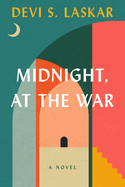
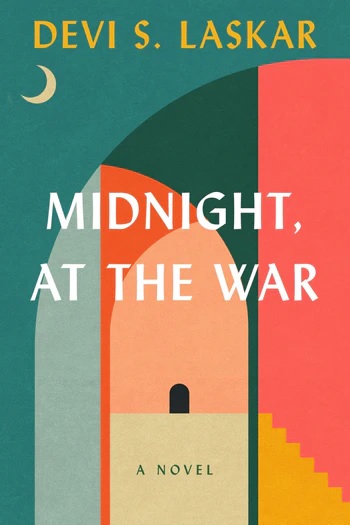 Devi S. Laskar's absorbing Midnight, at the War spotlights an international reporter facing personal, professional, and global conflicts. Former journalist Laskar credits real-life icons "Christiane Amanpour & Sylvia Poggioli, their tenacity is in part the spark for this novel."