Wednesday March 4, 2026: Maximum Shelf: Everything Was Beautiful and Nothing Hurt
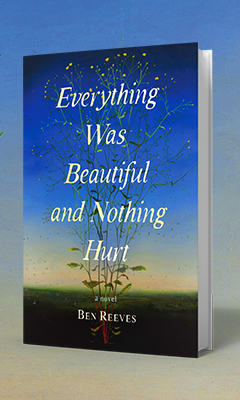
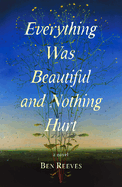
Everything Was Beautiful and Nothing Hurt
by Ben Reeves
Ben Reeves, winner of the 2024 Bath Novel Award, has crafted a sensitive and moving novel that forces readers to face death. Or perhaps that should be Death. Death's name, in Reeves's poignant debut, Everything Was Beautiful and Nothing Hurt, is Travis Smith. Travis lives in a mostly empty apartment, "no trinkets, no plants, barely a stick of furniture." His sweater is grey and baggy, and the purring cat that comes in through his window refuses to accept that he doesn't need a companion. Though he is gentle and patient, Travis has no friends or family. His job is to put people at ease in their final moments.
The people Travis aids in their transition are brought tenderly to life in vignettes. At the start of the novel, readers meet Samuel, who'd planned to propose to his pregnant girlfriend on New Year's Day, but is now trapped in his mangled car after a bad accident. Travis finds him there, strokes his hair, comforts him as dies: "His face is tight and brave. And we rest in the stillness, just he and I, silent." A few pages later, there's John Lamb, still grieving the loss of his faithful dog Virgil and his loving wife and walks now alone: "His hand is empty with no Virgil leading the way, and his arm feels too light, like it could float away and reach his dog and his wife waiting up there somewhere." Before Travis finds John in his apartment in those final moments, he watches him, observing carefully the way he says "g'morning, g'morning, g'morning, and when a stranger looks at him, he knows he's not a ghost." In these small moments, Reeves shows the power of careful attention skillfully applied.
It's the stray cat that sends him to the apartment across the hall, where he encounters Dalia and her daughters: baby Neda and eight-year-old Layla, who promptly asks Travis to watch her play a video game and invites him to her birthday party. Though Travis knows he must hold himself apart from the people he encounters, with Dalia and Layla, his resistance is futile. Before long, his customary detachment is set aside as he finds himself enfolded in their small family, falling for Dalia, despite knowing that there's no way for it to end happily. In "these impossible hours where the world doesn't know itself" as Dalia kisses Travis, he tries to forget: "I am happy to unknow myself." Their relationship unfolds between the stories of people dying, some suddenly and some after years of waiting and hoping for the end to finally come. They all recognize Travis when the final moments arrive, understanding, as we all must, that Death is a certainty. When tragedy touches Dalia and her family, Travis must reckon with his own certain truth: who he is and what he must do.
The relationship between Travis and Dalia is touching, but Reeves is at his best in the in-between moments, spot-on descriptions of otherwise insignificant experiences, like riding the bus, which "rattles and clatters like an old projector, the filmstrip of windows with the dust and scratches of a world flickering by, black and white, and no one says a word." Or Giselle, approaching 50, standing before a full-length mirror, lamenting the way her body has changed while her husband whistles at her and kisses her: "He squeezes her sagging backside. And she smiles and throws the crochet blanket back over the mirror." Or the profligate spill of details from a thousand Christmas mornings, which begins, "The vicar lights a candle in the vestibule while Louis checks on the turkey that's been cooking all night--his whole house is thick with the savoury smell--and Erin pats the stocking at the end of her bed" before carrying on, capturing so many stories in one gorgeous paragraph. Through Travis's careful gaze, readers will see themselves anew, falling in love with humanity as they stand with Travis, "peeking like an urchin through a sweet shop window."
Though it is about death, Everything Was Beautiful and Nothing Hurt is a book that celebrates life and humanity, even when the portrait focuses on the non-human, as when a fawn is attacked by an old stag or in the final imagery that chronicles the brief life and transcendent death of a group of mayflies who realize that "This day. This first day they flew. This is their one day, their last day." In all these portraits of lives lived and lost, readers will be reminded of the sacredness of every ordinary encounter or commonplace experience: "In these tiny moments, when the spectacle is stripped away, when there is no reason for the day, what's left appears to be something true, something fundamental to being a person."
Reeves's novel is a beautiful antidote to hate and fear, its dark subject matter notwithstanding. Everything Was Beautiful and Nothing Hurt will linger, perfect for book groups unafraid of deeper conversations, or for solo contemplation. --Sara Beth West
Ben Reeves won the 2024 Bath Novel Award for what would become his debut novel: Everything Was Beautiful and Nothing Hurt (Avid Reader Press, July 7, 2026). In addition to writing, the multi-talented Reeves also paints and makes music. He lives with his family in Peterborough, U.K., where he works as a web designer for a book printing company.
Everything Was Beautiful and Nothing Hurt is about death. Why would someone choose to read and even fall in love with a book about a topic we typically avoid?
One thing about death is that we all know it's coming for us. So we can either pretend it doesn't exist, or we can be scared of it, or we can confront it and see what truth we can draw out of the fact that we're going to die one day. In this book, I've tried to show that an awareness of death can make your life more meaningful. It can give you perspective, it can help you figure out what's important. It can give you clarity in your day-to-day life. If you've got a subconscious awareness of your own timeline, in a sense, your own ticking clock, it can make you care more about the small, joyous things, like something as simple as your child giving you a picture that they drew at school. Those things become so much more precious when you're thinking about the fact that one day this is going to end.
How did Travis--his mannerisms and preferences and style--come to be?
For a long time, I knew that I wanted to write a story from the point of view of Death. And I knew I didn't want the classic Grim Reaper or anybody too morbid. I thought that Death would be someone patient, gentle, non-judgmental, a good listener, and his job, essentially, is as an usher out of this life. I also wanted to think who he would be when he's not being Death, when he's not taking someone into the afterlife. What sort of person is he? I think he'd be quite lonely because he wouldn't want to make many friendships because they're all gonna die. And he's omniscient. He can see everything, from the very, very small worm underground to the very, very big and far away planets colliding. He can see all of nature. He can see inside every house, he can see down every street. We're only offered a glimpse of what he's seeing. We're just seeing this one town, but presumably Death is everywhere, all at once. So he slowly morphed into what he is in the book, and I'm really happy with how he turned out.
I got the sense of Travis being Death for this location and this time, but that there are infinite versions of Death for different cultures, different climates.
Yes. Because it would be crazy for Travis, this skinny, dark-haired, pale-skinned guy, to be Death in the middle of Africa or something like that. It makes sense that he would have all these different guises for different people that are dying. I did toy with the idea of seeing Travis in all these different forms, in different countries, in different times. But I wanted to tell a smaller story.
Throughout, you offer portraits of the people Travis visits, some brief, others more extended. Did writing their stories change how you see people, how you interact with strangers?
I think it did, yeah. When we're just passing a stranger on the street, we see them as a stranger. But that person has a life just as rich as yours and, especially as a writer, you need to pay attention and think about people and the way they behave. Writing those characters, you want to get into the specifics: Where do they live? What kind of family do they have? What job do they have? What do they enjoy doing? And to do that, you have to really think about people. So, yeah, I think writing them helped give me more empathy. I think every character that you write affects you in some way, and they've definitely stayed with me.
It's a collective novel, and it feels capacious in its empathy. It's not just about one small life (and death), but all of our small lives and how they all matter, right?
I think that's the power of stories because it's one thing to be told this is how you should behave, and this is how you should think about people. It's one thing to read essays and nonfiction, but a story--where you're really living it and putting yourself in someone else's shoes--it's pure magic. You are actually living another life through words. I think it's one of the greatest empathy generators that we've got at our disposal. It's just incredible. I think that the best writers are those who really make us believe that other lives are just as worthy as their own.
Dalia is a midwife, which might seem like a direct contrast to what Travis does. But the two roles are more similar than one might think, aren't they?
Yeah, there's the obvious parallel, the end of life and the beginning of life. But I think there's a lot of parallels. They both deal with very emotional people; birth is a very emotional event, for the parents and for the little kid screaming coming into the world. And obviously, death is very, very emotional. In both instances, you're dealing with strangers. Dalia doesn't necessarily know these families. She's just meeting them for the first time, or she's seen them once or twice before, same with Travis.
But it is the usher thing, isn't it? Travis is ushering them out, and Dahlia's ushering them in, and I think it makes sense that Travis would be drawn to her. He is unable to keep himself detached, because that's what it is. He's drawn to them and he just can't help it. And I think that's really fun to see because you're watching a character act against his better judgment.
The book's title comes from Vonnegut's brilliant anti-war novel Slaughterhouse-Five. What makes those words a good fit for your novel?
Obviously, we don't know for definite what Vonnegut meant by those words, but I think it's meant a bit ironically, but at the same time, absolutely sincerely. I think he believed those words to some extent, but also in the midst of a war novel, and in the midst of so much death in my novel, there's a hint of irony to it. Because obviously everything is not beautiful and lots of things do hurt. But there's a sense in which you can still believe it, even after all the terrible things that you can witness in a life. You can still hold on to that sentiment. I think it's interesting that it's in past tense. It's not everything is beautiful and nothing hurts. It's everything was beautiful and nothing hurt. It's the sort of thing that you can only say or think about at the end, looking back. --Sara Beth West



_Ben_Reeves.jpg)