Tuesday April 7, 2026: Maximum Shelf: The Wild Beneath
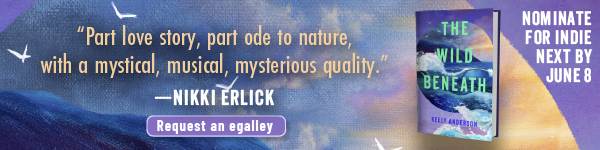
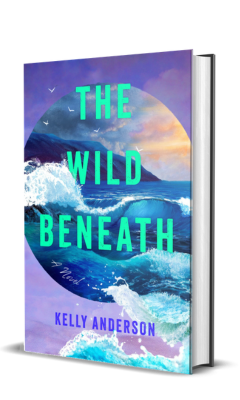
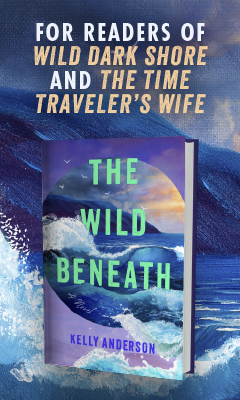
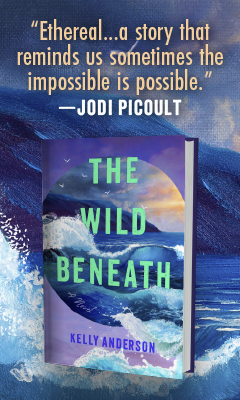
The Wild Beneath
by Kelly Anderson
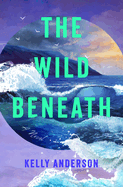
Kelly Anderson's debut novel, The Wild Beneath, is an astonishing act of imagination, firmly rooted in the physical world of a small coastal village and in the ocean itself. With threads of the magical laced throughout, a limited cast of characters wrestles for balance between land and sea and in their relationships with one another. Ever surprising, this spellbinding story holds both science and wonder, always in close touch with the natural world.
The Wild Beneath opens with a scene of beauty and terror. "She begins with a lullaby that sends coyotes fleeing up mountains. Honeybees abandon their hives to the shrill calls of songbirds and barking dogs. Beneath the seafloor, the tectonic plates loosen and rearrange.... A liquid mountain rises in the Pacific Northwest." The earthquake and tsunami destroy a human settlement and take many lives; the effect is power and pain and loss, described in harrowing detail, but "the ocean will call it a song." The ocean is never far from the consciousness of Anderson's characters.
Annie MacLeod is 19, and it is an accident of timing that she happens to be ashore with her grandmother Ruth when the tsunami hits their Canadian village, Hale's Landing. In all her life, she has spent very few nights away from her parents and their sailboat, Amphitrite. "Maybe they're not dead," Ruth tells Annie, although hope fades with time. The two women scour sand and scum from Ruth's cabin and sift the detritus on the beach for mementos or for anything useful to meeting their most basic needs. Annie suffers from blinding grief and a change in her relationship to the world around her, due to events just before the tsunami that are not immediately revealed. She's also experiencing a fracture in her relationship with Evan, the boy she's grown up with, the two of them pushed and pulled like tides. Evan has spent summers on Amphitrite since they were both small, but for most of the year he belongs to the land, where his father, Isaac Hale, runs the timber company that gives the town its name and livelihood. Where Annie is accustomed to listening to the ocean's nuanced song, Evan listens to the trees.
Then, at the edge of the land and the end of the world as she's known it, Annie encounters a new arrival walking slowly down the beach. Washed up on the shore, stark naked, about her own age, with "a startling vacancy about him, not fully there, looking past her. His irises are sea-urchin grey with streaks of silver." He accepts the name Annie offers him: Walker. It seems to Annie that he emits a hum, a sound she feels deep in her bones, that soothes the parts of her that have been jangled by recent events. "This out-of-place person in front of her... who is he? Why does she want him to like everything about her?" Walker is tall and handsome, but almost above those descriptors: he seems elementally tuned to the ocean in a way that speaks to Annie's bones. He is quiet and patient, he makes her feel safe in a different way than Evan does. In an entirely disordered world, Annie--raised by her two loving parents and by the sea, mostly outside of human society--is unsure of where to turn. Toward her best friend and first love, who offers both stability and complication on land? Or toward the strange newcomer, whose pulse feels like home, and who beckons her to return to the ocean?
With lyricism and a quiet sense of awe, The Wild Beneath reveals a careful focus on balance, rhythm, push-and-pull relationships. It is inhabited by many paired forces: Annie's parents, Evan's parents, the land and the ocean, Walker and Evan, the question of whether one stays or goes. Anderson orders the book by the tides: Low, Slack, Flood, High, Ebb. Within each section, there are shifts in time: Now, Before, Six years after, Forty years before. These cycles punctuate Annie's experiences, which are highly keyed to the natural world: humpback whales, tide pools, sea stars, sand dollars, wind. Flashbacks also offer glimpses of Annie's father, who was himself once a young person navigating the push-and-pull of land and sea. He loved the ocean, but Annie's mother seemed preternaturally linked to it--like Walker now. Annie's upbringing on the boat was one version of balancing those two approaches; now in adulthood, she must chart her own. In perhaps another cycle, Annie's life represents an attempt to balance her two parents' experiences of their world, but readers will wait for most of the book to discover what those experiences were.
Anderson offers a novel that is quietly astounding, beautiful even when it conveys profound pain. With unhurried but propulsive pacing, she draws readers into a plot that is both bewildering and bewitching. The Wild Beneath asks wise, subtle questions about the line between science and magic, and suggests that both are found in the natural world. Annie's struggles with grief, with coming of age, with tough choices, and with a sense of being pulled in two conflicting directions at once, are both universally recognizable and shockingly unique. Her story is haunting and unforgettable. --Julia Kastner
Park Row,
$30,
hardcover, 384p., 9780778306061,
August 2026
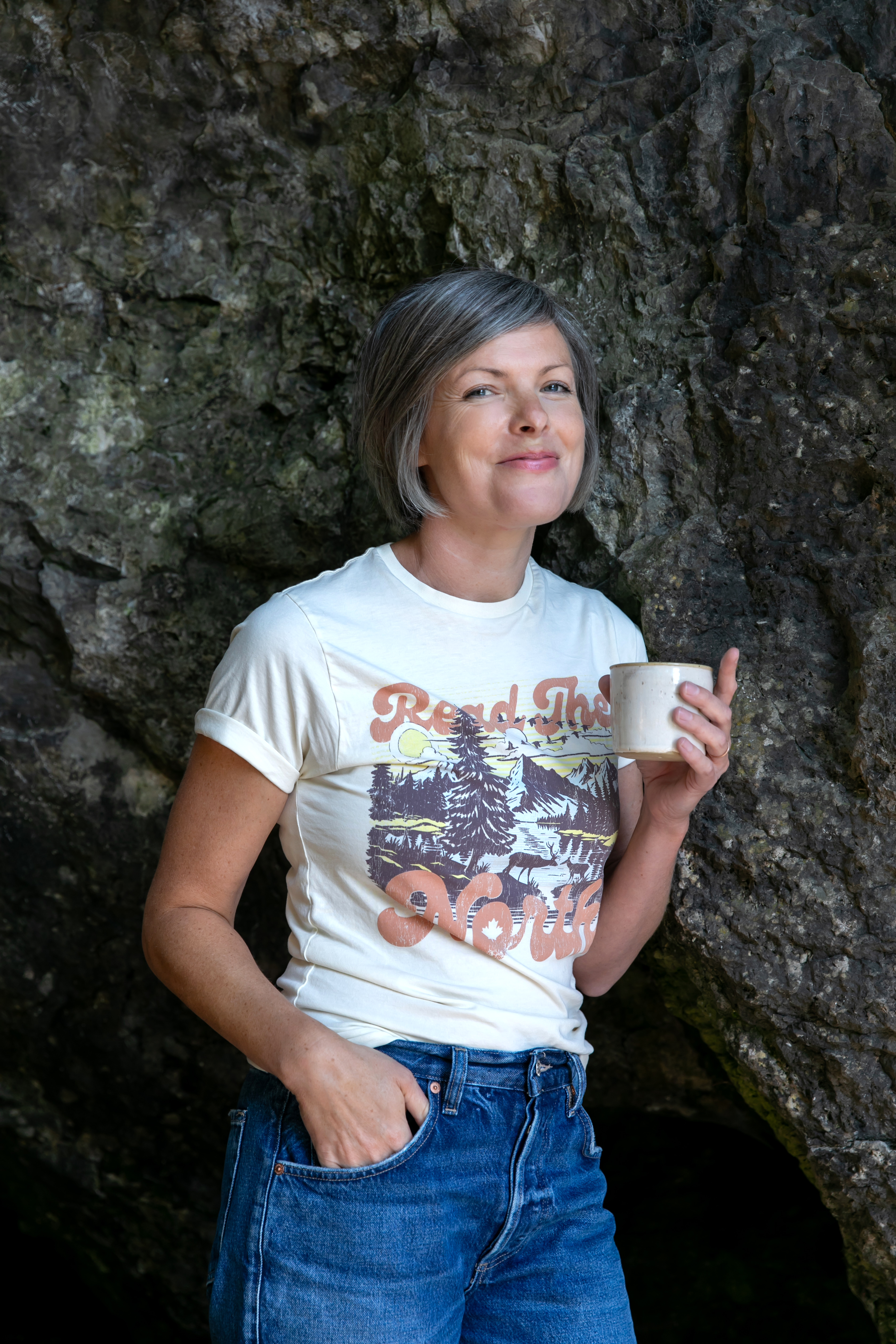
Dr. Kelly Anderson is a family physician with fellowships in HIV and emergency medicine. She has worked in rural and remote emergency departments, spent 15 years at the Inner City Family Health Team at St. Michael's Hospital in Toronto, and built the clinical team at Felix Health. She completing the Bookends Novel Fellowship and the Gateless Writing Academy and is a certified Gateless writing teacher. Anderson spent much of her childhood in British Columbia, and now lives in Guelph, Ontario, with her family. Her first novel, The Wild Beneath (Park Row, August 4, 2026), is an astonishing story about beauty, magic, and loss on land and sea.
Where did this story begin, for you?
This story began in 2019 while I was quietly drowning inside my own life, working shift after shift in the emergency department. Somehow, even though I was highly functional and effective at my job, I felt disconnected and flat. I had forgotten what I wanted and needed. I never planned to write fiction. I was doing a three-point turn in my driveway on a winter morning; the sun was blindingly bright and I'd forgotten my sunglasses. It was Walker that found me first, and the idea that as people, we can turn into other things. Metamorphosis. I needed to find metamorphosis in my own life, and it started with writing the first lines of The Wild Beneath.
Those opening lines have a matching sense of huge change. Did that represent directly the need for change in your life?
I knew I wanted to feel more alive. But I had no idea how to do it, and it took me years to change the building blocks of my life. The closer I got to writing Annie's freedom, the more recognition I faced about my own unrelenting desire for it. Eventually, I left emergency medicine and academic medicine--two things I couldn't imagine doing before writing the book. I still practice medicine in ways that feel important and meaningful to me, but I had to change the containers I was in and build new ones.
You have been involved in two kinds of work that appear to be very different: medical practice and novel writing. How does one inform or inspire the other?
I think they're similar work, in that both writers and doctors care so deeply about understanding people. In medicine, we see the most unpolished, vulnerable versions of our patients. In writing, we're trying to understand human intimacies in order to make our characters feel real on the page--so we can benefit from their wisdom in our own lives. I love my work in medicine. It's a privilege, and it informs the way I write. It's an honour to be involved in healing, and at times, I watch modern medicine save lives. But writing is the thing that saves my own life--in small and big and repetitive and enlightening and surprising ways each day when I sit down at my desk.
Your characters and scenes are fully and physically tied to the natural world. Did that require research?
I wanted Hale's Landing to feel as real as possible, so readers could fall for the landscape in the same way I fall head-over-heels for the Pacific Northwest each time I'm there. British Columbia was my childhood home, so writing about it feels innate. But many experts shaped the details. I've read more whale articles than I can count! Understanding whale communication--the little we know about it--felt important to get right. I gathered everything possible about humpback songs; how they're shared and evolve over seasons and time. I am so grateful to all the wildlife, avian, tugboat, and forestry experts that were willing to spend hours on the phone with me (literally). Please check out the acknowledgements for a long list of these kind human beings.
Are writing and research separate processes?
Always back-and-forth. I write my scenes in uninterrupted 25-minute chunks. If I don't know something, I insert a placeholder and come back after I've researched.
More importantly, I watch for what surfaces in my own life as research. For example, while I was writing The Wild Beneath, friends would send me relevant documentaries or articles, and say, "I don’t know why, but I think you need to read-watch-see this." It would be an item about sperm whale clicks or tsunamis or women crossing the ocean in a sailboat or logging in Alaska. When things repeatedly surface in front of me, I take it as a sign it belongs in the book.
Where is the line between so-called hard science and magic?
Are science and magic separate, or actually the same thing at different points of human discovery? Is magic just science that we haven't discovered yet, or don't yet have the tools or language to measure? In medicine, I'm frequently reminded of how provisional our knowledge is--what we "know" about the body is often temporary and replaced by something else more "true." In the novel, the imaginative elements point toward what lies beyond our current knowledge of nature, but I wonder if parts of it could actually be true. What we call magic is the presence of mystery--the recognition that we can't fully explain life with our current models. I'm always on the lookout for magic. If everything were fully explained, there would be no awe, no reverence, no reason to keep listening.
Where do you find magic in medical work?
I think your question speaks to a more general human conundrum--where is the magic? Is there any left? When we aren't looking for magic, or believe there is none... we can't find it anywhere. We aren't sure it exists. But when we believe in something, the evidence for it grows because we're paying attention. To help me, I have a list in the back of my notebook called "proof that magic exists."
When I say magic, what I mean is: I believe that life is bigger than we can understand with the human mind, and that benevolent forces are all around us. I choose to believe this because I see it, and because it's a beautiful and supportive way to live. Because I'm looking for magic, I find proof of it in the smallest of places, including every day in medicine.
It feels like this story could have been set nowhere else than this stretch of Pacific Northwestern coast.
When I was little, I would wander the beaches of southern British Columbia and think to myself: everything is okay because the ocean is here. I believed it. I might still believe it. The trees and water in the Pacific Northwest feel primordial and wordless in a way that awes me. I have so much difficulty fully describing the awe that I had to write a whole book about it.
What are you working on next?
I'm in the middle of writing my second novel! It's a love story, with similar reverence for the natural world woven inside, and I'm excited to see how it unfolds. I also write a weekly Substack that explores writing, intuition and the mystery of being human. --Julia Kastner