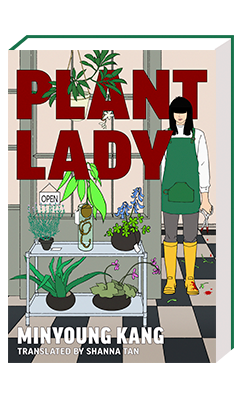
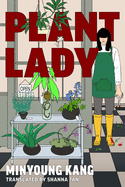
If the perfect opportunity to deliver justice presented itself, would you take it? South Korean author Minyoung Kang offers an emphatic yes in her thoroughly entertaining, admittedly chilling, distinctly satisfying novel Plant Lady, engagingly translated by Shanna Tan.
Choi Yoohee is the eponymous plant lady. Her store is a remodeled historic house located in a quiet neighborhood of a bustling city. She's named it Plant Shop, convinced that customers will remember the name for its simplicity. Working with plants "was the only thing she had ever wanted to do." Her previous colleagues had been rudely skeptical when she quit her job to start her own business: "What would she know about anything since she had only ever worked in an office." Following her dream, however, quickly paid off: "In a short time, Plant Shop became known, not just in Sejin city, but across the whole country." Two years into her notable success--because of her well-tended plants, the "plant sanctuary vibes," and her highly sought-after advice on how to choose and care for any plant--Yoohee expanded to provide an e-mail consultation service for a small fee.
In this near-perfect life she's created, perhaps the only element missing is love. " 'Humans are just like plants,' she often told herself. With a little attention and tenderness, she could nudge them back on the right track." But that conviction was repeatedly challenged, "and it always had to do with men." Then Jihoon walks in, seeking guidance on germinating his avocado pit--and regularly returns. "He was the first man in her life who was actually enthusiastic about plants, and that made her feel safer." But he, too, reveals his true self when she overhears him on the phone dismissively referring to her as "an easy woman." This time, she won't be the victim: a slippery floor, sudden darkness, a muted thud later, Yoohee claims control. Difficult, dangerous men are not rare, Yoohee well knows, but perhaps she's found an efficient method to permanently break the debilitating cycles of their dominance.
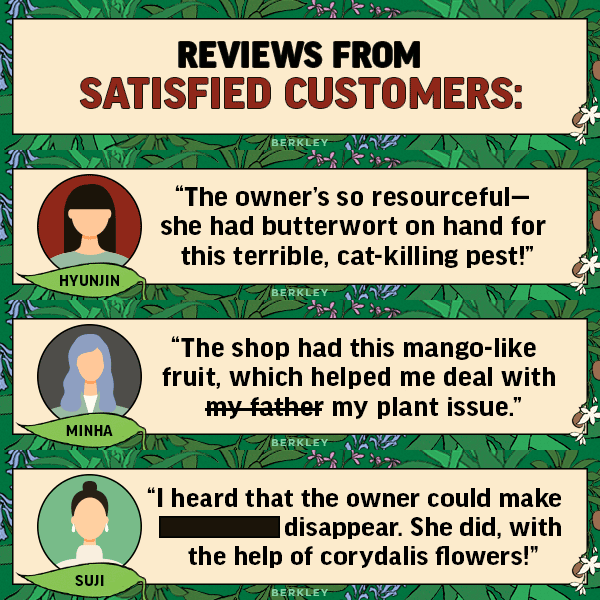
Hyunjin is the first to benefit. Her initial e-mail to Yoohee shows healthy petunias, but she arrives in the shop a short time later with limp flowers in a shattered pot. Yoohee sends the plant home restored, yet when Hyunjin returns less than a week later with fresh wounds--on the plant and herself--Yoohee's response is unequivocal: "It's time to put an end to everything.... I'll help you." Yoohee next assists young student Minha, recognizing a fellow plant lover from the monstera leaf keyring on her backpack. Minha leaves her first visit with hope--and a lithops, a succulent commonly known as a living stone. Because it bruises easily, she nervously considers how to keep it safe from her brutal father: "Can the living stone survive?... Will I make it, too?" Yoohee makes sure Minha can.
Soon enough, desperate women approach Yoohee directly. Frantic Suji is immediately transparent: "This is where... you can help to make someone disappear... right?" She's being relentlessly stalked by a vicious serial cat abuser who was caught, fined 500,000 won, and released with "not even a slap on the wrist." Yoohee suggests, "Best to give him a taste of his own medicine, don't you think?" Yoohee is triggered when regular customer Myungha reveals how Yoohee's plants have helped transform her small studio apartment into a much needed sanctuary--away from the sexual bullying, online and in real life, she's been silently enduring. Yoohee viscerally recalls her own unbearable teenage experiences, leading her to take explosive measures.
Shockingly, her own bully from all those years past steps into the store. Jinho, of course, hasn't changed--but Yoohee has. Just as she showed Jihoon she was no "easy woman," she proves she's also not--and never was--"that easy girl."
Yoohee's actions, alas, are not without consequences. One persistent detective, Dokyung, notices that certain missing persons share an overlapping location: "I just think it's worth digging into this," he nags his superior. "Isn't it strange that they seemed to have visited this shop?" The captain isn't swayed: "Anyone who lives in Sejin city would've gone to that shop at least once, no? Heck, people even travel there from afar." Dokyung won't give up, especially since he's got a plant of his own needing Yoohee's attention.
With astute clarity and poignant empathy, Kang writes every victimized woman's fantasy come true. The actual reality here is the everyday horror that ruthlessly looms: "Women have suffered much, and for the longest time.... But the world continues to fail us, and that's why the novel is as it is," Kang adds in her afterword. Every reader will, alas, know--or perhaps have been--a Hyunjin, Minha, Suji, Myungha. They will be disturbingly familiar with the Jihoons and Jinhos. "Even as I was writing it, horrible incidents continue to happen to women.... If only Yoohee could do something about it, I found myself thinking." And Yoohee certainly does--at least on the page. As if setting up for future volumes--tragically, the world will continue to fail women--Kang cleverly establishes an inviting structure here: a troubled plant, its tormented owner, a waiting solution. Kang powerfully presents a well-deserved antidote to male violence. --Terry Hong
Berkley,
$28,
hardcover, 208p., 9798217187577,
August 4, 2026
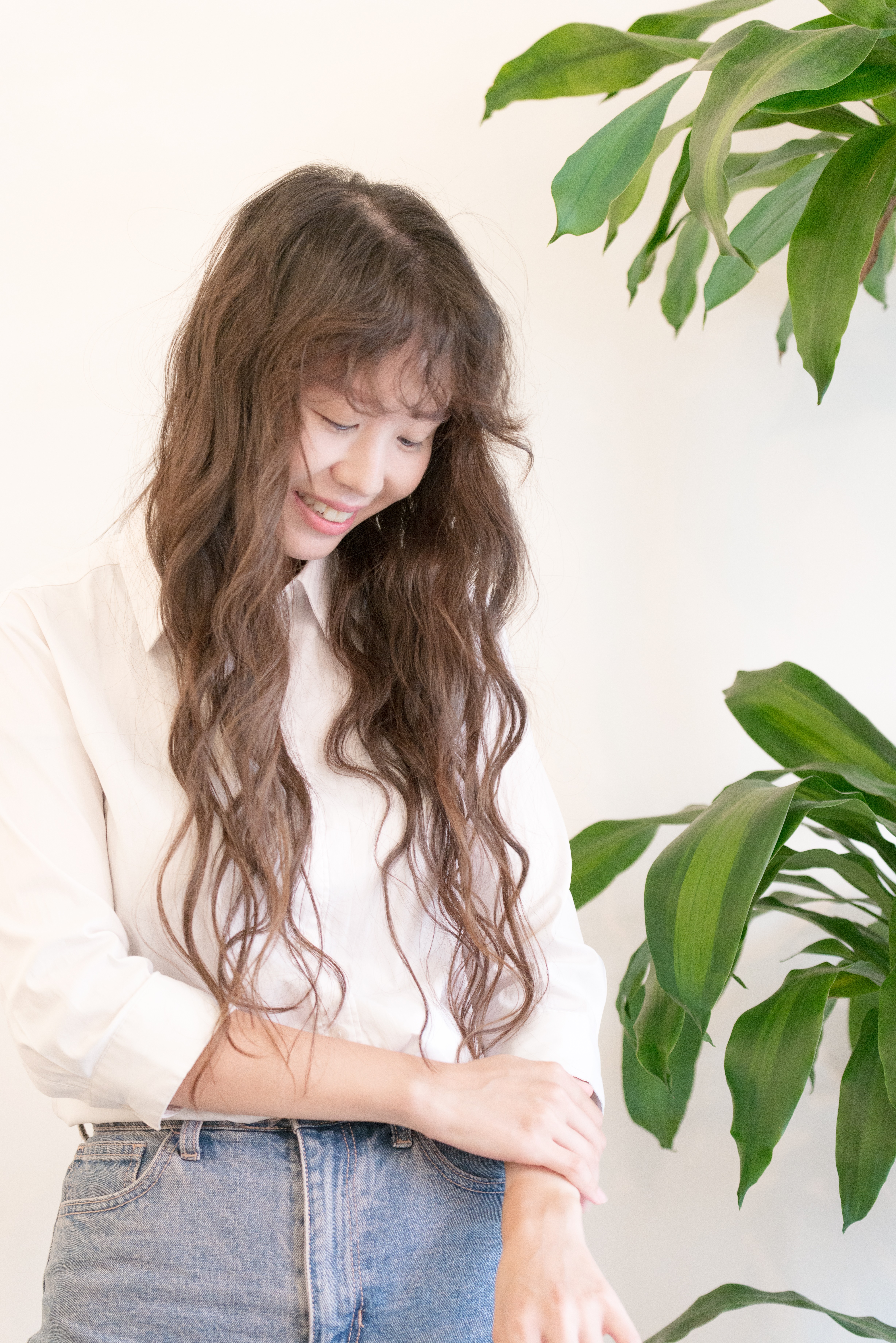
South Korean author Minyoung Kang is awriter and editor-in-chief of the film magazine CAST. Her publications include the novel Don’t Let Me Freeze Up and the essay collection Ride a Bicycle and Keep Going. She also publishes short stories on the popular Korean e-book platform RIDIBooks. Her novel Plant Lady (coming from Berkley on August 4, 2026) is about a serial murderer, yes, but most--if not all--readers will readily agree her targets are undoubtedly deserving of their gruesome fates.
Plant Lady, the novel, grew from a short story, in fact the first short story you'd written. What was the original inspiration?
At first, I simply thought it would be great to have a novel that contrasts green and red, plants and blood. Looking at quiet shops, I imagined what the scene would be like if a murder was happening inside but people walked by without knowing it, and that's how I wrote it.
Are you a plant lady--in that you keep and nurture plants? Are you as knowledgeable about plants as Yoohee seems to be?
I wanted to get close to plants, but I couldn't. Before writing this novel, I was a "plant killer" who kept killing plants. Around the time I started writing the novel, I made up my mind and brought in two plants, and they have been growing well until now. I acquired a certain level of information about plants when I started the novel.
I'm sure most women wish they had a Yoohee in their lives--a sad statement about society, as you mention in your afterword. Do you have less fatal advice for women who might seek your assistance about plants--and life?
When going through difficult times, I want them to think that they are not alone. Someone will definitely hold their hand, and that held hand will be passed on to another helping hand. If you have a problem that is difficult to solve yourself, actively ask for help around you. Someone will definitely respond.
Plant Lady has been out in Korea for a year now, and been quite successful. What were your expectations and hopes for the book as you were writing it?
To be honest, I never thought Plant Lady would be published worldwide like this. In Korea, there were many women who felt indignant, made resolves, and moved forward while reading this novel. I am looking forward to seeing what the reaction will be overseas. Rather than having certain expectations while writing the novel, I kept thinking about and working on a narrative flow perfectly filled with women's stories. There are many people thirsting for such novels and content, and I hoped Plant Lady would be the answer to that.
Do you have a general idea of who your Korean audience is? Gender? Age group? Background? What have been some of the most memorable responses?
I understand that women, especially readers in their 20s to 40s, make up the largest group. I don't know the detailed ages or backgrounds, but naturally, female readers are overwhelmingly the majority. The most memorable responses are probably those of readers comparing events in the novel to similar incidents that occur in reality. In particular, given the reality where men who abuse and kill animals are frequently released on probation, the ending of the "Corydalis" chapter was shared extensively across social media. The overwhelming reaction was that it was cathartic.
Readers of nine other languages will soon have access to the book. Do you think readers from different countries and cultures will react differently?
I think there will be reactions similar to those in Korea. Some might say it's too ruthless, while others might say it makes no sense. However, in reality, situations that make even less sense than in a novel often occur. Yoohee is a kind of fixer to resolve such incidents. At least among women, who were the main readers of this novel, I believe similar opinions will grow.
Your afterword mentions a man in your writing workshop interrupting with the question, "Hey, aren't the guys getting killed off for no reason?" Do you have an answer now for him?
I believe that if he is still writing, he would have realized it even without my answer. But if not, that's also his own burden to bear. This novel is fiction, a made-up story, but it also deals with crimes happening right at this moment. Women are simply overcoming them and moving forward. Because, in the end, this novel is a story about strong women. Those who don't understand this will probably just remain stuck where they are.
Your bio mentions that in addition to being a writer, you're also the editor-in-chief of the film magazine CAST. Your novel seems absolutely camera-ready. Did you imagine it being a film when you were writing?
I don't write with a film adaptation in mind, but I do try to work in a way that naturally brings cinematic scenes to mind for myself. I believe that's what makes it fun, highly immersive, and enjoyable for readers when they read it. Since I always imagine cinematic scenes when reading other novels, similarly, I write hoping that readers will do the same when they read my novel.
As the world sadly, aggravatingly, tragically, continues to fail women, someone like Yoohee seems more necessary than ever. Are you planning a sequel? Or better yet, a series?
By the time this interview is published, I will probably be in the middle of working on the sequel. As you said, there are so many places that need Yoohee, so I think Yoohee's story could continue to be serialized, whether it's through Yoohee or another woman. If a world comes where Yoohee is no longer needed, the world of Plant Lady will stop, and even I desperately hope for that, but since that realistically can't happen, the story is planned to continue. --Terry Hong