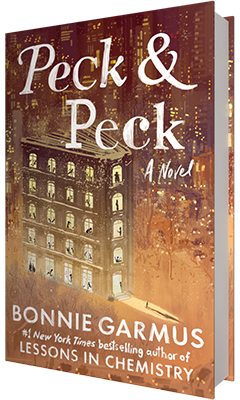
Bonnie Garmus laudably displays her admiration for and knowledge of poetry through narrator Batter Gray in her second novel, Peck & Peck, which takes its title from an erudite poetry quarterly headquartered in Manhattan. She demonstrates as great an appreciation for words, meter, and rhyme here as she did for science in her debut, Lessons in Chemistry. Mystery, romance, and poetry course through this enchanting tale of a twentysomething named for his parents' dog, and whose love for poems guides his path.
The novel opens when Batter is an adult, prisoner 83A0956. How does a poetry lover wind up in prison? That is the journey on which Garmus takes readers as she nimbly weaves the plot strands into a tapestry of words, colors, fealties, and betrayals, set against a backdrop of a changing late-1970s/early 1980s New York City, gritty and climbing out of bankruptcy (much like the periodical for which the novel is named).
Batter's mother designs typography and points out typefaces wherever she sees them, while his father is an ardent historian. As a result, Batter has approached poetry with the same kind of passion, since his school librarian introduced him to the poetry quarterly Peck & Peck when he was only 11.
In college, Batter, rudderless but inspired by Langston Hughes's "Mother to Son," writes a paper that earns him the admiration of his professor and the offer to write Batter a law school recommendation. "That's how I used poetry. To understand the world. To decode, analyze, interpret, think," Batter thinks, as his pre-law college roommate dismisses Batter's poetry reference. Batter eschews law school and moves to New York City, working three jobs to make his rent: running photocopy machines at Copy-A-Go-Go, folding clothes at the Gap, and working at a restaurant. In between, he attends amateur poetry readings. In search of one such event, Batter finds himself at a "classically beautiful" building graced by English boxwood topiaries and two glass domes: Peck & Peck. He overhears two people exiting the building; they're hiring. Batter interviews with editor-in-chief Salton Peck, and gets a job in the copy room, where he copies poems the 39 editors are considering, which must remain in the building. Batter even manages to win over his parents to his cause: "Just last week my poetry-averse father announced that in honor of me, he'd assigned Jabberwocky to his students. 'I couldn't believe it, Batter. It led to the most spirited discussion of the never-ending battle between good vs. evil I've ever witnessed.' "
With humor and intelligence, Garmus guides a story in which typefaces, history, and, of course, poetry all play major roles. Twins, like couplets in poetry, are an essential plot thread. Batter himself was a twin but--as he points out--like Elvis, he was the only survivor. Peck & Peck was founded by twins Patrius and Argentio in 1900. Cusp and Rye were the next set of twins to run the magazine in 1925. Twins Salton and Declonius were next in line to run the periodical, but Peck & Peck hurtled toward bankruptcy and each blamed the other for its demise.
Garmus's use of dualities creates a stereoscopic sense of depth for her characters and their conflicts: Declonius, forbidden from entering the magazine's offices, and Salton both develop a strong fascination with Batter and his intellect. A rivalry soon arises between Batter and Salton's assistant, Dexter, first over poetics, then over Dexter's "better half," a woman named Wren. Eventually, Batter is sent to work with 25-year-old starlet Xing Xing Yao, publicly perceived as "the Sexiest Woman Alive" while privately she aspires to poetic greatness instead. He coaches Xing Xing on her poems, saying, "Each letter is an atom, each word, a molecule; together they create phrasing, and phrasing gives rise to substance." Through a series of twists and turns involving her poetry notebook and diary, Batter finds himself at the center of a criminal conspiracy for which he is imprisoned, as Peck & Peck once again wobbles on the edge of existence.
What unites these eclectic perspectives is the powerful draw of poetry, often for unexpected reasons. And while poetry provides a springboard, relationships provide the heart as Garmus skillfully navigates through drama and humor as the players follow their passions. She does an especially strong job of contrasting Peck & Peck's lofty mission with the political dynamics of its corporate environment, as represented within its twinned office domes. The best poetry lingers because of a surprise--an unexpected turn of phrase; a double entendre that opens up the poem's meaning. And this is precisely what Garmus does: she proves that poetry is born of emotion, unlocks hidden truths, and is essential to humanity. As she concludes: "Originality. Beauty. Substance.... Anything less is extinction." --Jennifer M. Brown
Scribner,
$30,
hardcover, 432p., 9781668251065,
October 13, 2026
Bonnie Garmus: Poetry Teaches Us to Defy Extinction
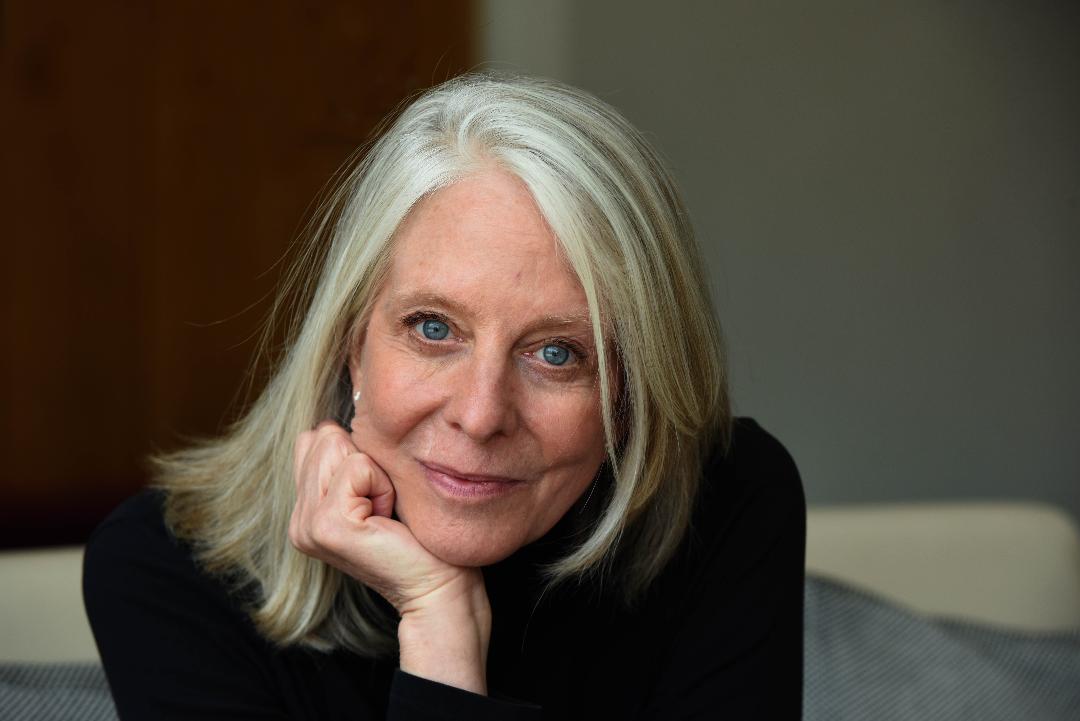
Bonnie Garmus (photo: Moya Nolan)
Bonnie Garmus's first novel, Lessons in Chemistry, has been translated into 43 languages and was made into an Apple TV series starring Brie Larson. Her second novel, Peck & Peck (coming on October 13, 2026, from Scribner), stars poetry-obsessed Batter, who is just starting out in New York and lands a job at the revered poetry quarterly from which the novel takes its title. Born in California and most recently from Seattle, Garmus currently lives in London with her husband.
How long have you been a poetry lover?
In eighth grade I met my first real poet, my English teacher, Mr. Schramm, a shy, slim, worried, gay man who'd (it was rumored) successfully dodged the draft. That's what had brought him to Bogotá, Colombia, where I was. And that's what had inspired him to hand us Langston Hughes's "Mother to Son." After we read it, he played a recording of it and managed to transform a classroom of bored 14-year-olds into a small army of budding radicals.
Decades later I stumbled upon a poem by Nikki Giovanni--another Schramm's class pick. I realized Schramm hadn't just been a gifted teacher. He'd been a curator, an editor. He wanted to ensure we only read the best. So I started reading poetry again. I rediscovered Auden, Stevens, Whitman, Carver, Neruda, Angelou. I began to wonder about this particular art form. Why does poetry persist? How does it persist? And then I realized: poetry defies extinction because it constantly evolves. And this made me think: if the least read, least celebrated, least studied artform can defy extinction, could it teach us to defy our own?
Was Peck & Peck inspired by one or more periodicals devoted to poetry?
It's a completely idealized, fictional view of what I imagined a well-curated quarterly would be like. Every selected piece would be electrifying in some way. To find this work would take a small army of people, each one a different flavor of Schramm. They would insist on creativity and originality; they would demand surprising meters and important messages; they would fight the mundane, the plagiarized, the craft-lite. Each selected piece would educate the reader in the world's dizzying complexity while tying it to our common humanity. Each poem would ground the reader--bring them "home." Thus, every Peck & Peck quarterly would be fronted by the short poem by George MacDonald: "Come/ Home."
Both of Batter's parents also have their passions. Are you, like Rainey Gray, an aficionado of type?
I'm a huge typography nerd. I studied type at the Colorado Institute of Art (the CIA... seriously) as well as graphic design. But it was typography that really spoke to me. At school we had to memorize different typefaces, study their glyphs and curves, understand their varying degrees of readability, research their histories, feel their emotions, trace them in order to memorize them, and then kern [adjust the horizontal spacing] them with the diligence of a neurosurgeon. Some of those faces are over a thousand years old--and still in use. How many things in the world can we say that about? Typography is culture, communication, and character.
Are you also, like Batter's father, John, passionate about history?
I often picture historians waking up in the morning, and after reading the headlines, shaking their fists and shouting, "It's not like we didn't warn you!" We all know that those who don't study history are destined to repeat it--and that's what we're doing now.
In Peck & Peck, I wanted to frame today's struggle with AI against a backdrop of yesterday's same struggle. Plagiarism and theft aren't new. Neither is AI. In the case of LLMs [Large Language Models], I want people to pause and consider that not only are we all being robbed (of copyrighted work, education, individual purpose, invention), but we're also being had. Every day we're told AI is here to stay--it's inevitable; no going back. But just the opposite is true. As Rainey and Salton would argue, "new and improved" doesn't actually mean "new and improved." We don't have to accept the hype. But fighting it will take guts (and typography!).
How did you decide which poems to include?
I'd earmarked over 400 possible poems for inclusion. The first few drafts were poetry-free. My original idea was to make this a book about poetry, but without any poetry. Poetry works best as a standalone. It's ineffable, ephemeral, slippery. I worried that including a line here or there wouldn't work because it couldn't possibly do the entire piece justice. In art museums, you only ever see the entire work at once. But in a novel, including bits of poetry is kind of like sprinkling confetti; the lines work well as a unit, but each individual phrase could be mistaken for trash. I really hope the small bits I included will never be mistaken for trash.
Batter says, "I can hear the color of words." Is that in part why he feels such an affinity to the physical building in which Peck & Peck is housed?
Graphene color synesthesia is a phenomenon in which people connect certain letters or numbers with a color--about 4% of the population experiences this, including the blind, like my grandmother, who identified every song on the radio by color (Sinatra was orange). Batter has a touch of this, but when he sees the bird eggs [kept in the so-called Aviary meeting room]--their colors, shapes, speckles, sizes--he's not only seeing words as colors, but referencing the impossibly wide range of form poetry takes. That's why I think poetry survives. Like matter, it can't be destroyed. It simply takes another form.
What is the significance of twins? Does it have to do with the importance of couplets in poetry?
The numbering system at work in Peck & Peck starts with the couplet, a poetic pairing of two lines that share the same meter and structure and may rhyme--or not. Just like twins. Nearly everyone assumes twins are best friends. But what if they aren't? What if they don't rhyme? Meet Salton and Declonius Peck. Brothers, twins, opposites, enemies.
Throughout the book there's an undercurrent of twinned opposites: truth and lies, right and wrong, acceptance and rejection (the evil twin is real!). But poetry rejects black-and-white thinking. Poetry is every color in the world. Batter can hear these colors; their diversity is reflected in the bird eggs; and the feeling they communicate is enhanced by a typeface, each a separate personality in itself--a face. Even Xing Xing is a representation of a type of twinning (Xing Xing means "twinned stars"). She's both the sexiest woman alive, but also a vulnerable, thoughtful, struggling poet. Whether or not any of us are actual twins by birth, we all have a twin--our interior selves.
As for the idea of who's telling the truth and who isn't--that remains a surprise. --Jennifer M. Brown
Bonnie Garmus: Poetry Teaches Us to Defy Extinction