Wednesday September 2, 2026: Maximum Shelf: The Minute Givers
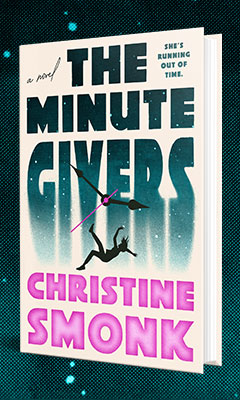
The Minute Givers
by Christine Smonk
In Christine Smonk's clever debut novel, The Minute Givers, Toronto film continuity supervisor Renee Carron has an unusual superpower: every time she falls in love, she gains the ability to rewind time for one minute. This power, which first appeared when Renee was a child, makes her excellent at her job, which demands keen attention to detail. It has also exacerbated her tendency to rethink her every interaction, hampering her ability to connect, since she has a habit of rewinding countless small interactions with the current object of her affection, using her power to test-drive her own responses (and make sure her jokes land).
When her extra minutes, amassed from every man she's ever loved, suddenly start disappearing, Renee learns of the deaths of several of those men. As the deaths stack up, Renee becomes convinced someone is bumping off her exes on purpose--but why? Trying to balance her worry with her amateur criminal investigation and her latest film project (Santa's Secret, a low-budget Hallmark-esque Christmas movie with a bizarre murder-mystery twist), Renee must enlist both her time-rewinding power and a few friends to find the killer before her clock truly runs out.
Smonk (who has herself worked as a continuity supervisor) plunges readers into the shadowy, off-camera world of Renee's workplace, where she must take copious notes to ensure each small detail of a film remains consistent throughout shooting. When she first sees Dash, the actor playing one of the two lead elves in Santa's Secret, Renee feels a familiar click: the arrival of an added minute, along with the gush of a brand-new romantic attraction. As she and Dash flirt, both on set and via text, Renee learns of the death of Seven, her most recent, and married, ex. Though it's strange, it doesn't set her truly on edge until she hears that her teenage crush Leo, her third minute giver, has also died.
Leo's death, and the disappearance of a scrapbook with mementos relating to all her minute givers, prompt Renee to track down all her remaining former loves to confirm that they're still very much alive. One of them, Oscar--Renee calls him Four--ends up joining Renee in her sleuthing quest. His wife, Lydia, comes along too, acting out of compassion as well as an urgent desire to make sure Oscar survives.
Smonk's narrative plays out through Renee's unusual perspective. Wry, self-deprecating, and a keen observer, she has spent most of her life at a distance from other people. Though she tries to use her superpower for good when she can, its limitations "prevent [her] ascension beyond good Samaritan." She can stop someone from stumbling or spilling their coffee, but she can't prevent (or undo) car accidents, illnesses, or, more pertinently, murder. Mostly, Renee uses her power for harmless ends: perfecting the art of the polished comeback, picking a lottery ticket or a blackjack hand she knows will win. But her power, and the necessity of keeping it a secret, has also left her isolated and deeply lonely.
As her minute givers continue to turn up dead, Renee is forced to re-examine her past relationships: not only her kindergarten crush (Peter, aka One) and middle-school pen pal (Henry, or Two), but the men she's loved as an adult, and the different reasons those connections didn't pan out. She briefly considers the possibility that her love might be cursed but decides it's far more likely that someone holds a grudge against her minute givers, or against Renee herself. As she reviews her past interactions with the men who've captured her heart, Renee starts to realize how much she's always idealized love itself. For years, she has centered her life on the hope that one day, she'd find a minute giver who would permanently shift her timeline in a different way: "The man who would give me my last minute and then never leave." Though she's certainly not alone in dreaming of a soulmate, Renee must reckon with the possibility that she's trying to manipulate time--and love--in impossible, if well-intentioned, ways.
Alongside these philosophical musings, Renee's investigation into Seven's death--made trickier by the presence of his wife, Molly--yields few clues to either the identity of his killer or the larger plot to eliminate Renee's exes. Meanwhile, Dash, Renee's movie elf and eighth minute giver, is hiding a few secrets of his own. As Renee, along with Oscar and Lydia, crisscrosses Toronto in an effort to find the killer, she'll receive help (and hindrance) from a few unexpected quarters, perhaps gaining a new perspective on life and love, even as she loses a minute or two.
Blending slapstick humor and witty sarcasm with an unusual twist on the serial-killer trope, The Minute Givers is a wildly entertaining, genre-bending ride through Toronto and through time. --Katie Noah Gibson
Berkley Books,
$30,
hardcover, 352p., 9798217190126,
January 26, 2027
Christine Smonk is a writer and product manager based in Toronto, Canada. When she's not writing, she enjoys learning piano, playing video games, and orchestrating credit card points hacking schemes. Her debut novel, The Minute Givers (Berkley, January 26, 2027), combines her love of speculative fiction with her experience as a continuity supervisor on local films.
What was the inspiration for The Minute Givers?
In the year leading up to writing The Minute Givers, I became obsessed with time loops. I watched every time-loop movie, read many time-loop novels, and even played a few time-loop video games. (My favourites in each respective category: Timecrimes; On the Calculation of Volume; The Forgotten City.) I enjoy how this genre often flips our fear of death on its head and instead presents us with a more horrifying fear: infinite life.
The Minute Givers didn't start out as a time-bending novel. I wanted to write a simple story about a woman whose greatest dream is to fall in love. As a lifelong wallflower, I was inspired by my own (mostly painfully awkward) journey from daydreaming about love to finding it in the real world.
But as I started writing, my time-loop obsession found its way onto the pages, thus leading to a bizarre marriage of two separate sources of inspiration: the story of a serial-killer-hunting, time-travelling romantic, which would eventually become The Minute Givers.
The book takes an unusual approach to time travel. How did you decide to link Renee's time-rewind power to her relationships?
Since I was writing a character who idealizes love, I wanted to create a mechanism where falling in love had a magical consequence (in this case, gaining a minute to turn back time). It immediately became the perfect metaphor. Who doesn't feel like there's magic coursing through their veins when they fall in love with someone for the first time?
The metaphor extended nicely with Renee's character arc. At the beginning of the book, she puts so much importance on the significance of the minute givers--they must be special because they gave her the literal power to rewind time!
But by the end of the book, Renee's on her way to realizing it's actually the opposite: those who fall in love are the magical ones. They are the ones being vulnerable and putting their hearts on the line. And even when her heart is broken, the magic remains, because it belonged to her all along.
The book also has an unusual take on the Christmas movie industrial complex. A murder between elves isn't what most people would expect!
My first job after college graduation was in the bizarre world of low-budget films. Like Renee, I worked as a continuity supervisor (and occasional extra, as proven by my IMDb film credit as "Christmas Shopper" on Operation Christmas List). While I was a terrible continuity supervisor (my attention-to-detail stats are 0/10), I absolutely loved my time in the film industry.
In The Minute Givers, I enjoyed highlighting the somewhat bizarre stories that can be made when thrift requires the team to use creativity, instead of budget, to entertain an audience. More generally, I tend to gravitate towards unhinged plot lines. The movie-in-a-book plot of Santa's Secret [the film Renee works on in the book] could be as strange as I wanted it to be, because it doesn't impact Renee's plot. While not every reader will be invested in the outcome of Santa's Secret, I wanted those who pay attention to have their own mini-twist when Santa's secret is finally revealed.
Renee's ability to rewind time has certain benefits for her, but it also has some far-reaching consequences. How do you think it has shaped her life, for good or ill?
The most obvious benefit is that Renee doesn't need to work for money. Low on cash? She can simply head to the casino and use her power to tip fortune in her favour! As a result, she can work in a job she truly loves without any financial pressures. After spending my 20s religiously devoted to my budgeting sheet, it was fun building in a world where the main character hardly needed to consider her bank account balance at all.
On the flip side, Renee's endless redos mean that she has an issue with authenticity. Her conversations are often a performance, catered to the preferences of others. This leads her to get into bad relationships and lose friendships. How can you learn from your mistakes if you never truly get to make them in the first place?
The book asks interesting questions about time: not only the ability to rewind it (briefly), but how much of it we have, how we choose to spend it, how fully we can inhabit the time we have.
I wrote this book for people (like me!) who spend more time in their heads than in real life. Our brains are not dissimilar to Renee's rewinding power. We spend all our time playing and replaying future interactions, hoping to erase all imperfections. We become devoted to idealized versions of reality, and we can suffer when real life fails to live up to these dreams.
The lesson I've had to learn is how to find that middle ground between respecting my inner world and allowing myself to be spontaneous in the real one. Similarly, I wanted Renee's character to move away from this quest for perfection, toward building a reality where she can feel content without having to rewind every interaction. --Katie Noah Gibson