Tuesday September 22, 2026: Maximum Shelf: Goliath
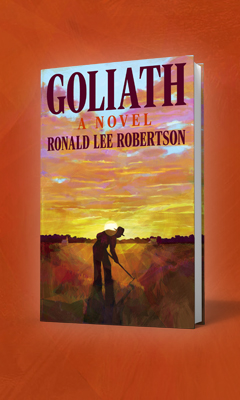
Goliath
by Ronald Lee Robertson
When most people think in general terms of Goliath, they're likely to conjure the biblical reference. A goliath is, of course, anything of considerable and often intimidating power, like a patch of land and the history behind it. Variations on that theme resound with powerful urgency in Goliath, Ronald Lee Robertson's debut novel--a lyrical reimagining of the Bible story, with this version centered on a Black family in the Southern United States at the turn of the 20th century.
The narrator of this evocative work is Little Bit, the third son of David Jeremiah Lightfoot. David, born in Chicago in 1896, was destined for an ordinary but fulfilling life in his hometown. The plan was to have a career, a wife, and a good school for his children. "Instead," Robertson writes in a phrase typical of the novel's direct but beautiful and poetic prose, "he traveled to a state where they wanted to break him." Life's first surprise arrives with the death of his father when David is 14. To the shock of his orphaned siblings, he announces that he's heading to Mississippi to claim their father's property, where, as his eldest brother warns, "Aint nothing growed there since it was Goliath!" David, undeterred, makes the journey, "for land he'd only heard of and a life he'd never known. But he craved air that he could selfishly breathe alone."
When David arrives on the 20-acre property, he meets Big Man, a friend of David's father, Jesse, and "the largest man he'd ever met." Big Man is a preacher whose church is one he built himself. Within minutes of David's arrival, Big Man informs David that this is not a life he wants. He tells David this in his usual Big Man way: by quoting scripture. "Foolishness is bound in the heart of a child; but the rod of correction shall drive it far from him!" He is no more persuasive than David's siblings. "I been called to this land," he tells Big Man. So begins a relationship--feud might be the better word--between two men of indomitable will, with repercussions for which neither man is fully prepared.
Life on the farm begins inauspiciously. David discovers he's not much of a farmer. He loses "battle after battle to the plow, struggling to lay straight rows." A wooden fence he erects collapses almost immediately. He begins attending church despite "his ambivalence to communal religion," and other pieces soon fall into place. He fishes in the creek with Big Man's son, Jonathan. He falls in love with Big Man's daughter, Micah--a variation on Michal, David's first wife in the Book of Samuel--and marries her. He begins chiming in during church services. He follows Big Man as he ministers to residents in their homes. By the time David is 16, his singing in the choir is so beautiful that parishioners from all over the county attend his services. Big Man notices David's surge in popularity, which slowly usurps his own. But as Little Bit explains, "My father would never be a joyous preacher. He preached as if something had grabbed him and would not let him go." Nevertheless, the congregation is enrapt.
Soon, David and Micah build a life together. They have three children, first Amnon, whose "skin was stark white" and whom David initially rejects as "Not his blood"; then Absalom, a cautious, curious youngster whom David dotes on with the affection he denies Amnon and who, like his namesake in the Bible, lets his hair grow luxuriously long; and then a daughter, Ladybird. Last comes Little Bit, the novel's effortlessly charming, and omniscient, narrator.
Little Bit relates the many joys and tragedies the Lightfoots experience. Family members must be hidden from "the Flood," a mob of angry white people seeking revenge after a frightening skirmish disfigures a white boy. There are also the family's relations with Jonathan and his son, as well as the eventual usurpation of David over Big Man. The younger man acquires even greater wealth and power than Big Man, leading to confrontations that, while not quite biblical, still require David and others to summon the same fortitude to surmount overwhelming obstacles.
Robertson gave himself an enormous challenge with this work--an intelligent meditation on faith, prejudice, and the mettle required to triumph against adversity. He does a fine job exploiting the multiple interpretations of Goliath, not just the giant of legend but the vastness of other forces, from the ancestral land David claims to the legacy of his family and that of the American South. This remarkable story is enhanced by dazzling prose: "a summer day broken open to the first jealous winds of fall," or "an unpredictable daughter that he cherished cautiously, as if the slim frame were a knife without a handle. Big Man was no fool. He knew how much my father longed to grasp that blade." In Goliath, Robertson has fashioned an impressive and original work, a veritable masterpiece. --Michael Magras
Scribner,
$29,
hardcover, 336p., 9781668204016,
February 2, 2027
Ronald Lee Robertson: Race and the Mixed Blessing of Inheritance
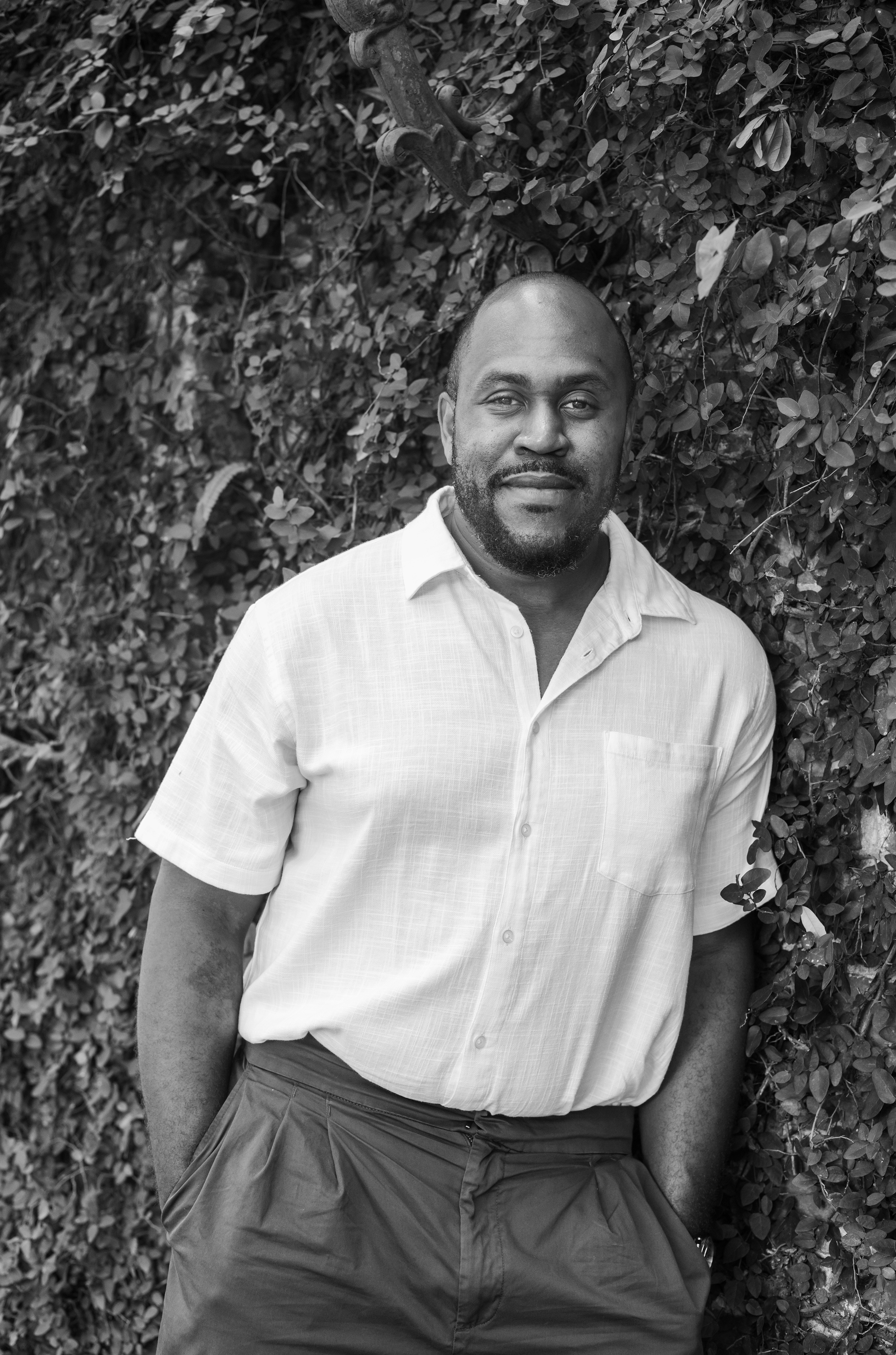
Ronald Lee Robertson (photo: David. G. Spielman)
Inheritances come in many forms, not all of them desirable. There's money and property, but there's also the inheritance of one's race or background. For a first-time novelist to tackle all these issues is an inspiring feat of ambition. That's what Ronald Lee Robertson has done with Goliath (Scribner, February 2, 2027), a hypnotically poetic retelling of the David and Goliath story, relocated to Mississippi in the early 20th century and featuring one of the most ingenious narrators in recent fiction. Robertson and his wife live in New Orleans.
What drew you to this material?
In the early 1900s (against his own brother's advice), my mother's grandfather bought 80 barren acres in southern Mississippi with the unshaken belief that the land would one day shelter not only his family and descendants, but also his disbelieving brother. My paternal grandfather founded one of the oldest churches in Baton Rouge, and my father followed in his footsteps. I was raised in that church, and when I was younger, to keep myself awake, I would read the Bible during service. First and Second Samuel were my favorite books. The epic of David and Goliath, the feud between King Saul and David, David's subsequent reign and ultimate fall, all of these stories were fascinating to me. How these elements came together to form Goliath is still a mystery.
What was it about this time period in U.S. history, the era of the Great Migration, that made it an appropriate choice for this novel?
I'm not sure if the characters come first or their setting. Characters are peculiar to their time. Each interaction they have with each other, each want, fear and proclivity; all are influenced by the specific historical moment. The era of the Great Migration is the appropriate era for the story because that is the era that birthed men with Big Man's demons, with David's idealism, and Micah's unyielding will. Who knows who these people would be had they been born today?
Did you do a lot of research, and if so, what sources did you turn to aside from the Bible story?
Top of mind are conversations with my family. I've been hearing some of the stories in Goliath for the last 36 years. Libraries of photo albums. The work of Henry Louis Gates, Zora Neale Hurston, and similar researchers (The Sacred and Profane was illuminating as to the secular and spiritual tensions in the novel). I love used bookstores and find all kinds of things there: almanacs, textbooks, biographies, etc. For me, the old adage is true: I throw nothing away; I compost.
Do you have a character you relate to most closely in this novel?
I don't know if I relate to them so much as admire their qualities. Sometimes I daydream about taking up as much space as Big Man. I wish I had Micah's fierceness. I try to emulate Jonathan's steadfastness and nurture a curiosity as insatiable as Absalom's. I adore Amnon's wildness, and envy Ladybird for her ability to comfort others. I often pray for David's bravery. I'm working on developing a fraction of Little Bit's empathy.
Can you talk a bit about the power dynamics in this book? What do you want to say about the nature of power in general and, more specifically, as it relates to Black families of this era, and today?
Power exists simultaneously on a number of planes. In the same way as power requires a subjugation, it also requires a joinder; at what point do the oppressed become the foundation? Understanding this duality, and existing within it, has been central to black survival in the United States. We have rooted ourselves here. Bare branches do not necessarily indicate a weak tree. I think of Toni Morrison's Tar Baby. The question is not so much who is powerful, but who is powerful when, and how?
The novel also touches upon the corruptibility of wealth. Do you see wealth as having a more corrosive rather than beneficial impact?
Wealth may be nothing more (or less) than: "I have this and you have that," inevitably followed by the question "why?" and shortly thereafter: "What now?" The way we engage or refuse to engage with these questions determines, on both a communal and individual level, whether wealth will benefit us, destroy us, or do any number of things in between.
Another of the book's major themes is that of ancestral legacy. What are your thoughts on the lure of family ties?
For many of us, inheritance is not so much a bequeathal as a series of sacrifices, handed down through familial narrative and manifesting in the increasing opportunity given to subsequent generations--a bill of love. However, at times this inheritance feels like a debt. What we've been given is clear, what we owe--if we owe--is another matter entirely. I believe David's decision to challenge Goliath reflects similar considerations, as does his siblings' reticence.
Another fascinating and clearly biblical element of the book is that of sibling rivalries. What do you hope readers will take away from this book about the nature of them?
When I think of the siblings in Goliath, I think less of rivalry than I do of love. One of my favorite Baldwin quotes (liberally applied) is: "Love does not begin and end the way we seem to think it does; love is a battle, love is a war, love is a growing up." In Goliath love is often not patient. At times it is neither kind nor gentle. It certainly keeps a record of wrongs. It clings; it captures, flees and rages. I tell my siblings I love them all the time. There's a world in that word.
If you can do so without giving away key plot developments, why did you portray the story arc of Little Bit, the book's narrator, in this way?
I wish I knew. He's narrated the story from the beginning.
Do you feel that the story of David and Goliath is uniquely suited to a modern-day commentary on race? Did you consider adapting other bible stories, or stories from other sources?
I never considered this story's unique suitability vis-à-vis racial commentary. All American novels, whatever the subject, are commentaries on race. Outside the boundaries of cultivated tolerance remains the chaotic milieu of class, ancestry, pseudo-science and culture that undergirds our country. Whether a writer chooses to engage explicitly with this fact is their prerogative; its existence is not. Even in the transposition of a story thousands of years before the invention of blackness, once on American shores, the concept of race becomes inescapable. --Michael Magras
Ronald Lee Robertson: Race and the Mixed Blessing of Inheritance