
Theories of Mass Incarceration
.jpg) |
|
| photo by Chris Taggart, courtesy Fordham Law School | |
The United States contains about 5% of the world's population, yet holds nearly 25% of its prisoners. John F. Pfaff, a professor of Law at Fordham Law School, in Locked In: The True Causes of Mass Incarceration--and How to Achieve Real Reform (Basic Books), argues that current accounts of the causes of this mass incarceration are fundamentally misguided, and wants us to reconsider what we must to do build a more equitable and humane society.
He says, "The most widely accepted explanations--the failed War on Drugs, draconian sentencing laws, an increasing reliance on private prisons--actually tell us much less than we like to think. Only about 20% of people in state and federal prisons are there for drugs. Over half of all people in prison have been convicted of a violent crime.... The dominant factor in the rise of our prison populations is rising admissions, not longer sentences. Most prisoners are locked up for very short periods of time." Other factors include a major shift in prosecutor behavior in the mid-1990s, when prosecutors began bringing felony charges against arrestees about twice as often as they had before.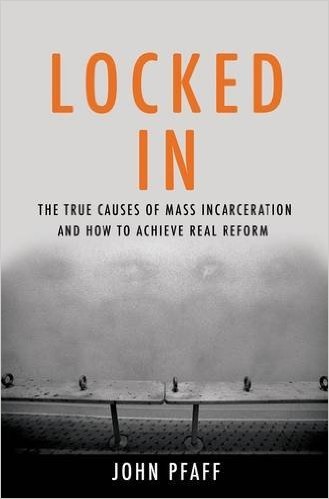 "One theory is that we simply have more prosecutors: as crime dropped over the 1990s and 2000s, the number of prosecutors rose from 20,000 to 30,000, and those additional 10,000 prosecutors needed something to do. Another theory is that prosecutors may have become more aggressive in hopes of using a tough-on-crime reputation to win higher office."
The current discussion about incarceration is often about the inflated rates for African Americans: "The black-white incarceration rate remains shockingly wide, with the black rate more than 5 times greater than the white rate. Surprisingly, imprisonment for drug offenses explains almost none of this racial gap. Urban prosecutors, for example, focus most of their attention on crime in the cities, but they are elected by county, not city, voters. This results in wealthier, whiter suburbanites having a strong say over who enforces the law in the city, even though those suburbanites do not feel the costs of over-enforcement borne by more-minority urban residents." --Marilyn Dahl