
Regional Fiction: Reading Outside the Boundary Lines
I love "regional" fiction, but my reader's DNA compels me to say that I don't read "regional" authors. I read, whenever possible, great books by authors who happen to live in--and even write about--a place, though their work transcends compass points. 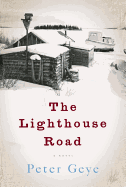 Consider Peter Geye's The Lighthouse Road (Unbridled Books), a beautifully crafted tale of hardscrabble settlers on the North Shore of Lake Superior at the beginning of the 20th century. The novel evokes a visceral sense of place while telling a universal story (see Geye's "Letter to Readers" for a nice introduction to his characters).
I discovered The Lighthouse Road last month at a Southern booksellers' trade show in Florida, where Geye was a guest author. After devouring the novel back home in upstate New York, I was recommending it to everybody by the time I headed to Minneapolis a couple weeks later for another trade show.
Is this a "Midwestern" novel? Absolutely, to its core. But I agree with Texan Valerie Koehler, owner of Houston's Blue Willow Bookshop, who told me: "I don't think our customers limit themselves to regional books. We look for novels with compelling narrative, characters and resolution. Peter's characters can be found anywhere. The setting does give us Southerners a peek into the harshness of the winters, but I wouldn't call it regional any more than I would call a book set in L.A. or N.Y.C. regional."
What I love, ultimately, about great "regional" fiction is the way it adheres to a dictionary definition ("part of a country or the world having definable characteristics but not always fixed boundaries"), even as it lures us outside those boundary lines.
As Theron O'Connor, co-owner of Apostle Islands Booksellers, Bayfield, Wis., put it when he introduced Geye in Minneapolis: "We are ecstatic when local and regional turn out to be world class." --Robert Gray, contributing editor, Shelf Awareness