Latest News
Norton Young Readers: Road Home by Rex Ogle
WHAT TO READ NEXT: REVIEWS OF GREAT BOOKS
Your eyes don't deceive you. We have a new look! For years, we have been dedicated to bringing dozens of fresh reading recommendations directly to your inbox every week, and this new format puts those book reviews back in the center spotlight. We've made it even easier to find excellent titles across numerous genres, to learn more about authors' creative processes, and to rediscover backlist that continues to inspire writers and thinkers today. Our resolution, as always, is to spark the curiosity of our readers, and what better time to reinvigorate that commitment than the beginning of a new year? Happy reading!
--Dave Wheeler, senior editor, Shelf Awareness
FEATURED TITLES
Cover

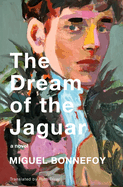
The Dream of the Jaguar

Miguel Bonnefoy, trans. by Ruth Diver

This vibrantly imagined and beautifully written novel combines a history of Venezuela with a colorful multigenerational family saga.
Cover

The Dream of the Jaguar

Miguel Bonnefoy, trans. by Ruth Diver

Other Press | $18.99 | 9781635425505

Novelist Miguel Bonnefoy (Heritage) combines a layered and vibrantly imagined history of Venezuela with a multigenerational saga based on his own ancestry in The Dream of the Jaguar, an enchanting novel filled with colorful and unforgettable characters.

The novel begins in Maracaibo, Venezuela, when a surly beggar, Mute Teresa, discovers an abandoned infant, Antonio Borjas Romero, on the steps of a church and decides to raise him as her own. After a formative stint as a servant in a brothel, Antonio goes on to medical school, where he meets the love of his life, Ana María Rodríguez. Both Antonio and Ana María excel in their field and become greatly involved in helping the straitened people of their country. When their daughter is born on the same day the dictator Marcos Pérez Jiménez is defeated in 1958, they name her Venezuela. Years later, Venezuela moves to France, marries a Chilean expatriate, and has a son, Cristóbal. As Bonnefoy did, Cristóbal becomes a writer and rediscovers his heritage in South America.

Bonnefoy's prose, expertly translated from the French by Ruth Diver, is radiant and dreamlike with touches of magical realism, evoking Gabriel García Márquez as an influence but maintaining its own originality. Though Bonnefoy's sweep of history is wide, even the minor characters populating his version of Maracaibo shine like stars. As Ana María says, "In every litter of kittens there is a jaguar.... It grows up differently. It emancipates itself. Those are the builders of this city. We are all the sons of a dream of a jaguar." --Debra Ginsberg, author and freelance editor

Cover

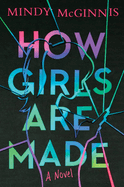
How Girls Are Made

Mindy McGinnis

Three teen girls run a secret after-school sex ed class while facing the darkness of social media, emotional abuse, and predatory men in this scathing YA indictment of the way girls are taught to be.
Cover

How Girls Are Made

Mindy McGinnis

HarperCollins | $19.99 | 9780063370692

Three teen girls, all struggling with abusive men, support their classmates by running an after-school sex-ed class in the keen and sharply truthful How Girls Are Made by Mindy McGinnis (The Female of the Species).

Eighteen-year-old overachiever Fallon thinks sex ed should better prepare girls "for the reality of a penis" and launches a secret class with fellow "pretty-­white-straight"­ seniors Shelby and Jobie. Shelby is a locally famous fighter whose new boyfriend, Baxter, showers her with admiration. When his love rapidly turns to negativity, Shelby begins believing she's "gross," "disgusting," and a "shitty girl." Jobie, hungry for online validation, joins a forum in hopes of making the $75,000 she needs to surgically achieve a "heartbreakingly gorgeous" face. She accepts requests for foot pictures and a video of her eating cottage cheese, but sharing nudes would make money faster. Meanwhile, Fallon deals with a brutally upsetting DM on her own: "my stepbrother rapes me every night. Please help."

McGinnis's pitch-perfect YA novel characters demystify sexuality for their peers and exemplify the nefarious tools of abusers through their blazingly candid alternating first-person POVs. Shelby, fluent in physical violence, evinces the difficulty of recognizing emotional manipulation. Jobie shows how easily it is to be subsumed by social media's dark side. Fallon flounders trying to fill the spaces where appropriate sex education and victim services should be. McGinnis peppers in riotous humor and discussions of outrageous misinformation ("No, Mountain Dew is not a spermicide") while hinting at a looming tragedy in this stellar portrait of what female teens endure. --Samantha Zaboski, freelance editor and reviewer

Sourcebooks Landmark: The List of Suspicious Things by Jennie Godfrey
Cover

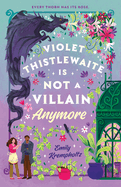
Violet Thistlewaite Is Not a Villain Anymore

Emily Krempholtz

A witch fleeing her dark past falls for a grouchy neighbor in this charming romantasy novel about redemption and community.
Cover

Violet Thistlewaite Is Not a Villain Anymore

Emily Krempholtz

Ace Books | $19 | 9780593954300

A young witch seeking redemption falls for a grouchy neighbor desperate to protect his family's legacy in Emily Krempholtz's charming feel-good debut romantasy, Violet Thistlewaite Is Not a Villain Anymore.

Violet Thistlewaite is just like any other small-business owner: she has big dreams, a can-do attitude, and a secret past as a supervillain's right-hand henchwoman. A hero killed the evil sorcerer who raised Violet to be his weapon. She considered killing Violet as well, but spared her life on one condition: "Just be good.... And don't make me regret this." Violet starts anew in the town of Dragon's Rest, where she rents space to open a flower shop from twin siblings struggling to keep their recently deceased parents' failing apothecary shop alive. Pru, the sister, befriends Violet instantly. Nathaniel, Pru's handsome but socially uptight brother who prefers "his emotions like his workspace: tidy, uncomplicated," decries Violet's flowers as useless compared to medicinal herbs. When an unexplained magical blight strikes Dragon's Rest, Violet and Nathaniel connect with each other by investigating the threat, but saving the town may require Violet to reveal her dark history and risk losing her new home and Nathaniel forever.

Krempholtz proves that a novel containing a knife-wielding pothos ivy can also successfully support thoughtful reflections on redemption and forgiveness, as Violet heals and learns to trust herself with the support of the colorful denizens of Dragon's Rest. Fans of Sarah Beth Durst's Spellshop series will adore this romantic comedy set in a bewitching fantasy world. --Jaclyn Fulwood, blogger at Infinite Reads

Cover

The Mirror of Great Britain: A Life of King James VI and I

Clare Jackson

The violence-strewn life of King James VI and I--the first monarch of Great Britain--receives a convincing and elegant reassessment in this absorbing reappraisal.
Cover

The Mirror of Great Britain: A Life of King James VI and I

Clare Jackson

Liveright Publishing Corporation | $35 | 9781324094999

The life and legacy of King James VI and I receives a sympathetic and compelling reassessment in The Mirror of Great Britain by Clare Jackson. Crowned King James VI of Scotland in 1567 as an infant and King James I of England and Ireland in 1603, King James is most known for the 1611 Bible translation that bears his name, the "most influential and widely sold English-language work ever produced." But there is much more to the man, Jackson argues, and a new appreciation to be had for the "sheer difficulty, intensity and complexity" James the ruler faced in late-16th-century Scotland and as the first king of Great Britain.

Taking a nonchronological, thematic approach to her subject, Jackson assumes reader familiarity with James, but her charming prose and profusion of primary source material--including a plethora of the king's own writing and correspondence--invites readers into James's violent childhood in Scotland and his kingly vision of "a new state of Great Britain" that set the geopolitical stage for centuries to come. Along the way, Jackson explores James's "irrepressible love of lexis and wordplay," his same-sex relationships, and the "arduous, lonely, and exhausting" task of "ruling three separate kingdoms, over six decades, while simultaneously sponsoring a nascent global empire" in North America. The Mirror of Great Britain is an absorbing reappraisal of the man and "wordsmith monarch" who changed the face of Europe and Bible reading everywhere. --Peggy Kurkowski, book reviewer in Denver

Knopf Publishing Group: When Cranes Fly South Lisa Ridzén, translated by Alice Menzies; One Day Everyone Will Have Been Against This by Omar El Akkad
BOOK REVIEWS
Cover
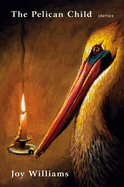
The Pelican Child by Pulitzer Prize finalist Joy Williams collects a dozen stories, alternately creepy and magical, that touch upon age-old questions of death and immortality.
Cover

The Pelican Child

Joy Williams

Knopf | $27 | 9780525657583

Death and immortality: The former is definitely real, but what about the latter? That question has vexed authors since The Epic of Gilgamesh. Good topics never go out of fashion, however, as Pulitzer Prize finalist Joy Williams (Concerning the Future of Souls) demonstrates in The Pelican Child, a collection of a dozen excellent stories in which she puts her deceptively minimalist spin on the subject of finality. Consider "Stuff," in which a 63-year-old nature writer for a community newspaper learns he's dying of lung cancer--the poor guy smoked too many "work sticks"--and visits his 100-year-old mother in her care facility. Add to the mix the fact that she's a gnostic prone to philosophical musings, and the result is a beguiling dialogue spun from a simple premise.

Williams does the same in all of these stories. In "Chaunt," a woman in yet another nursing home comes to grips with the death of her young son. "Chicken Hill" is a story about a woman who, after attending a funeral for a little boy, befriends a little girl who quotes Thomas Aquinas and asks provocative questions such as, "What would you say your discomfort level is right now, on a scale of one to ten?" And then there's "Baba Iaga & The Pelican Child," in which the "bony, ill-tempered" supernatural witch from Slavic folklore smells "cruel death" when John James Audubon asks to draw her pelican-child daughter and "make her immortal." Alternately creepy and magical, these stories are further evidence of Williams's skill at concocting unsettling works that are more profound than they first appear. --Michael Magras, freelance book reviewer

Cover
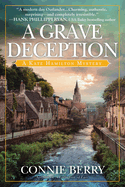
Connie Berry's sixth Kate Hamilton mystery plunges the antiques expert into a tricky case involving both a 14th-century grave site and several 21st-century murders.
Cover

A Grave Deception

Connie Berry

Crooked Lane Books | $19.99 | 9798892422932

Connie Berry's intriguing sixth Kate Hamilton mystery plunges the antiques expert and her police officer husband into a tricky case centered on a 14th-century Suffolk grave site--and a few 21st-century murders.

Kate is thrilled to be asked to appraise some valuable goods, including a stunning pearl, found with a well-preserved female body on the grounds of a local estate. But when the lead archeologist, charismatic, arrogant Simon Sinclair, is found murdered at the dig site, Kate's husband, Tom, asks her to assist in unearthing his killer. Meanwhile, Tom and his team hunt for a killer in a different case, and aspects of Sinclair's death display some startling parallels to yet another unsolved murder from nine years earlier. Kate must draw on her appraisal experience and diplomatic skills to navigate the prickly mix of personalities on the archeology team, plus the strange warnings from an eccentric local woman who has led protests against the dig.

Berry (A Collection of Lies) delves into the Suffolk area's medieval history, sending Kate down several research rabbit holes that have bearing on the cases past and present. A subplot involving Kate's pregnant veterinarian friend, Angela, provides a bit of needed levity. Kate and Tom make a thoughtful investigative team as they sift through evidence and attempt to identify both the medieval body and the modern-day killer--before the latter gets to them first. Readers will appreciate the novel's fascinating local history, well-constructed plot, and meditations on death, legacy, and love. --Katie Noah Gibson, blogger at Cakes, Tea and Dreams

Cover
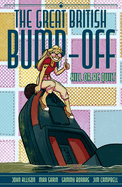
Comics creators John Allison and Max Sarin develop a boisterous quilting caper for their inimitable sleuth, Shauna Winkle.
Cover

The Great British Bump-Off: Kill or Be Quilt

John Allison, illus. by Max Sarin

Dark Horse Books | $19.99 | 9781506745503

Author John Allison and artist Max Sarin, the entertaining graphic creators of The Great British Bump-Off, return with another rambunctious episode, The Great British Bump-Off: Kill or Be Quilt. This time, thanks to Uncle Jim's generous loan of his boat, Shauna Winkle's off on a summer holiday through England's canals. She makes her first stop, three hours after departure, in Barton-on-Wendle, where she meets Bryn, whose charms are so irresistible that she barely notices the barge coming unmoored. It then scrapes against concrete posts and handrails. The damage, she'll learn soon enough, is a whopping £4,000 to fix, which means she needs to find work ASAP.

Bryn takes her to Canalside Crafts, his mother's quilting shop. "If you can make a cup of weak tea, work a computer, and put an order in a Jiffy bag... you've got a job," Daphne offers. That night, when arson claims Daphne's car, she's convinced it's sabotage--by a disgruntled former employee, Pat, who left to start her own rival shop, Stitch Pickings. With Quiltfest coming that weekend, Daphne can't risk losing to her nemesis: "We're putting you in undercover with the other lot." Shauna, who insists she's "been solving mysteries for more than half [her] life," just might figure out who's doing what to whom.

Allison's delightful cozy mystery gets mirthfully enhanced with Sarin's quirkily (over)dramatic characters, populating brilliantly saturated, riotously colorful panels. Sarin excels in capturing all manner of expressions in convincing detail--particularly those of unstoppable Shauna, who plots, hallucinates, worries, and vanquishes her way to hopefully, finally return to smooth sailing. --Terry Hong

Cover
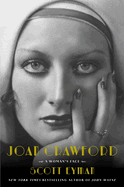
Preeminent Old Hollywood biographer Scott Eyman presents an admiring corrective to the high-camp Joan Crawford persona while honoring his subject's objectively outsize personality.
Cover

Joan Crawford: A Woman's Face

Scott Eyman

Simon & Schuster | $31 | 9781668047309

Much has been written about Oscar-winning screen queen Joan Crawford--most notoriously by her daughter Christina in her knives-out 1978 tell-all, Mommie Dearest, whose movie treatment imprinted the high-camp Crawford persona on the public's imagination. With Joan Crawford: A Woman's Face, Scott Eyman presents an admiring corrective that also honors his subject's objectively outsize personality.

Crawford was born Lucille Fay LeSueur, probably in San Antonio, Tex., probably in 1905 (the records are sketchy). When she and her working-class family were living in Lawton, Okla., she became besotted with the movies. Crawford chose dancing as her path to show business and eventually earned a chorus-girl job in New York, where Metro-Goldwyn-Mayer screen-tested her; on January 1, 1925, she was Hollywood-bound.

Eyman (Cary Grant; Charlie Chaplin vs. America) is surely the preeminent living biographer of Old Hollywood, and Joan Crawford is yet another showcase for his fathomless film knowledge and wit. (On one shaky early Crawford vehicle: "Romantic comedies about archaeology are few and far between, and I Live My Life shows why.") Crawford's self-curated image of indomitability was so fortress-like that she may not be truly knowable, but Eyman gets damned close. His book incorporates his interviews with Crawford's surviving colleagues, her deceased peers' offspring, and her grandson, who shared his fondly remembered grandmother's papers with Eyman. As for Crawford's diva reputation, Eyman notches many episodes but dispatches the Mommie Dearest persona with a perfect swipe at the movie: "The film's sole positive attribute was that it seriously damaged the careers of everyone connected with it."--Nell Beram, author and freelance writer

Cover
The book's critical role as an "idea machine" is explored in this sweeping history of the bound word as a mobile information device whose impact on human knowledge continues to increase over time.
Cover

The Idea Machine: How Books Built Our World and Shape Our Future

Joel J. Miller

Prometheus Books | $34.95 | 9781493088935

In The Idea Machine, Joel J. Miller celebrates the book as the quintessential information technology that shaped--and continues to shape--the world. Books, he suggests, "do for ideas what mosaics do for stones," and in this sweeping study, Miller identifies the distinctive circuitry of writing, ideas, and portability that books represent in spurring and forming thought across the millennia. From ancient Greek book culture to Roman poets, the Renaissance, and beyond, Miller highlights not only the importance of the book as a vessel of recorded thoughts but also as a tool for facilitating further idea generation: an "idea machine."

Underscoring his theme of writing as thinking, Miller provides examples from history; the scroll evolved to the codex and made the dissemination of knowledge and ideas--and the reactions to them--easier and faster. The codex form allowed authors to create "with a larger scope at a grander scale," Miller writes, and its contents lived beyond the author, thereby extending the reach of the author's ideas. He also praises monastic monks for their contributions: not only did they laboriously copy manuscripts by hand but they also improved the way books were written and read, introducing lexical technologies such as space between words, upper- and lowercase letters, chapter headings, paragraphs, and more. Miller includes a clunky "idea grid" to visualize the book's impact across time, but his chapter-ending "marginalia" vignettes are far more engaging. Overall, The Idea Machine is a diverting tour of bookish history that bibliophiles should gobble up. --Peggy Kurkowski, book reviewer and copywriter in Denver

Cover
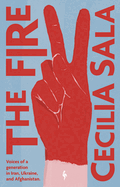
Journalist Cecilia Sala writes with the urgent poignancy of the young people she covers in the midst of conflicts in Iran, Ukraine, and Afghanistan.
Cover

Fire: Voices of a Generation in Iran, Ukraine, and Afghanistan

Cecilia Sala, trans. by Oonagh Stransky

Europa Editions | $18 | 9798889661504

Italian journalist Cecilia Sala plunges readers into three turbulent regions in her unflinching Fire: Voices of a Generation in Iran, Ukraine, and Afghanistan, translated from the Italian by Oonagh Stransky. Beginning with Iran, Sala brings readers close to recent conflicts, such as the protests that erupted after Mahsa Amini's death in 2022. She shares the perspectives of personal friends, including Nabila, a gay kickboxer and wrestler, and sources like Sadira, who is part of the Woman, Life, Freedom movement.

Though parallels can be loosely drawn between the three countries and the people Sala reports on, who are mostly in their 20s, Fire is essentially three accounts in one, tenuously connected by Sala happening to have been a reporter in these places at key times. Fortunately, Sala provides plenty of necessary context and relevant history to catch up readers who may not be familiar with the intricacies of each country's conflicts and revolutions. These include Ukraine's Orange Revolution and Euromaidan protests, and the Haqqani network's origin and impact in Afghanistan.

The section on Afghanistan highlights U.S. interventions in the region. Here, Sala cross-examines and finds wanting the aftermath of the 2020 Doha agreement, negotiated by Donald Trump's administration with the Taliban, and Joseph Biden's disastrous 2021 withdrawal from the country. Sala turns her sharp eye on the loss of Afghan women's rights, safety, and future with a poignancy that cuts.

Sala pulls off a tricky feat, keeping the page count extremely reasonable while creating a book that feels thoroughly researched and reported. Fire is a whirlwind trip through three countries that gets to the heart of what matters. --Nina Semczuk, writer, editor, and illustrator

Cover
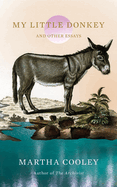
Martha Cooley's lyrical personal essays braid together her own experiences--aging, moving to Italy, her relationships with family and animals--with fateful accounts from history.
Cover

My Little Donkey: And Other Essays

Martha Cooley

Catapult | $27 | 9781646223022

The 13 absorbing autobiographical essays in My Little Donkey, Martha Cooley's fifth book, employ braided structures to reflect on aging, family relationships, her recent move to Italy, and life's fateful moments.

Befriending a donkey on a Venetian lagoon island, Cooley (Guesswork) examines mulish stereotypes. Has she shed her burdens and proved her stubbornness in retiring from New York City to Tuscany in her 60s? She prefers to think of it as adopting John Keats's "negative capability. This entails a balancing of perceived opportunities and losses." Age poses challenges: Italian cobblestone accidents in "Falls," ceding the joy of music to tinnitus in "No Such Thing," and clearing her parents' apartment in "The Box." And in the heartbreaking "Something to Pay," Cooley bids farewell to her old, ill cat before moving overseas.

Most essays interweave multiple strands. For instance, "Bonnie and Clyde" starts with childhood pets and segues into the Aeneid, fatherhood, and duty. Often, a personal story reminds Cooley of someone else's. Musing on sibling bonds in "Out of Hand," she recalls a friend's brother's financial misconduct and delves into the history of Ponzi schemes. A few pieces overstretch with their long asides, but it's generally delightful to follow the narrative thread. In "The Spitter," Cooley wonders why an unhoused man spat on her at a subway station--and also tracks the Holocaust experiences of Franz Kafka's sister. "Flukes," detailing a 1963 Italian landslide, is a fascinating meditation on contingency. By turning struggles and tragedies into stories, these intricate essays make sense of randomness. --Rebecca Foster, freelance reviewer, proofreader, and blogger at Bookish Beck

Cover
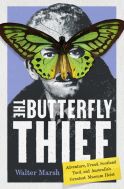
This well-researched work of history details the captivating true story of Australia's largest museum heist.
Cover

The Butterfly Thief: Adventure, Fraud, Scotland Yard, and Australia's Greatest Museum Heist

Walter Marsh

Scribe Us | $24 | 9781964992204

From the 1911 theft of Leonardo da Vinci's Mona Lisa at the Louvre to the Ocean's Eleven movie franchise, heists have long fascinated audiences. Walter Marsh's The Butterfly Thief: Adventure, Fraud, Scotland Yard, and Australia's Greatest Museum Heist will appeal to nature lovers and true-crime aficionados alike.

Australia's unusual biodiversity was a boon for lepidopterists (those who study butterflies and moths) seeking new species. Naturalists established massive collections in the early 20th century, and George Lyell donated his assemblage of more than 51,000 specimens to the National Museum of Victoria. It was displayed, 60 cases at a time, in a rotating exhibit expected to last years. But on January 13, 1947, hundreds of butterflies were found missing, and panic quickly spread as natural history museums across Australia realized that their collections had also been robbed.

Well-researched and methodical, The Butterfly Thief traces the lives of museum staff, Australian lepidopterists including Lyell and Athol Waterhouse, and the backstory of Colin Wyatt, the man eventually suspected of the thefts. A member of a famous English family, Wyatt was a mountain climber, skier, and adventurer whose swaggering exploits often made the British tabloids. He also was a gifted artist and naturalist who traveled the world to explore, paint, and photograph nature.

Marsh's narrative becomes increasingly engrossing as the investigation unfolds, particularly once Scotland Yard comes onto the case. Even more than 70 years later, museum researchers are still finding errors and falsifications meant to conceal the thefts. The Butterfly Thief is an excellent history and a captivating work of modern crime. --Jessica Howard, former bookseller, freelance book reviewer

Cover
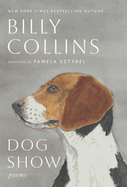
This heartfelt, accessible poetry collection celebrates the special bonds between humans and their dogs, and its soulful watercolor portraits reinforce the affections.
Cover

Dog Show: Poems

Billy Collins, illus. by Pamela Sztybel

Random House | $20 | 9780593979419

The 25 poems of tenderness, humor, and pathos in Billy Collins's Dog Show celebrate the canine characteristics that resonate with humans most. These short, accessible verses are accompanied by artist Pamela Sztybel's striking full-color watercolor illustrations. Collins, the author of 15 poetry collections (Water, Water; Aimless Love) and a two-time United States Poet Laureate, dedicates Dog Show to 85 dogs, arranged alphabetically from Adele to Zeke.

The joy in dogs' carefree approach to life recurs in the poems. "Dharma" begins: "The way the dog trots out the front door/ every morning/ without a hat or an umbrella,/ without any money/ or the keys to her dog house/ never fails to fill the saucer of my heart/ with milky admiration." Collins ends the poem by acknowledging the dog owner's emotional dependence: "If only she were not so eager/ for a rub behind the ears,/ so acrobatic in her welcomes,/ if only I were not her god." He describes the "anthropomorphic skylarking" when a dog "will sometimes allow itself to be dressed up" and the contentment of breakfast time, when "we hold our mutual gaze,/ me reading his mind and he reading mine." Collins also honors the heartbreak of a beloved dog's passing, "when the collar/ is slipped,/ over his ears,/ and off his body,/ freeing him for good."

Dog Show's whimsical poems concisely reflect the canine-human relationship. Readers might even attach their own beloved canines' names to Sztybel's fetching, heartwarming portraits--the terrier with one cocked ear, the regal collie, the smiling beagle--whose intense eyes cast soulful gazes from the page. --Cheryl McKeon, Book House of Stuyvesant Plaza, Albany, N.Y.

Cover
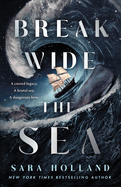
Break Wide the Sea, the first book in a beguiling YA duology, is a dark, oceangoing fantasy marked by sparks of love, betrayal, and the "smell of petrichor and brine."
Cover

Break Wide the Sea

Sara Holland

Wednesday Books | $21 | 9781250854490

Break Wide the Sea by Sara Holland (Phoenix Flame) is the first installment of a captivating, darkly romantic series containing aquatic fae and a tidal wave of betrayed love and ruinous curses.

Eighteen-year-old, "dark blonde"-haired Annie Fairfax is cursed. "In the old days," when finfolk magic was stronger, "they could curse an entire... bloodline." The Fairfaxes, who run one of Kirkrell's prosperous whaling companies, are one such family, doomed by a monstrous "heartbreak" curse that passes through the generations. A brokenhearted Fairfax becomes a scaled, clawed creature blinded by bloodlust.

Annie's curse activated six years ago when her parents drowned in a finfolk attack and Annie took control of the Fairfax Whaling Company. Whalers hunt Livyati, magical whales prized by the seafaring people of Kirkrell. However, Livyati sightings are decreasing as finfolk attacks increase. At least Annie has stalwart fiancé August by her side. When half-finfolk captain Silas Price seeks Annie out to tell her the curse can be broken, he insists she must agree to stop killing Livyati. If she doesn't, devastating war with the finfolk is inevitable. And, Silas says, Annie desperately needs to lift the curse soon--August is about to betray her.

Holland's oceanic setting is inherently high-stakes, and the author capitalizes on the danger and romance that long days and nights on a whaling expedition afford. Holland undoubtedly succeeds at the difficult task she has set for herself: create a compelling plot with a main character who is, in her own words, "weak and avoidant and fragile." Hand this title to fans of Tricia Levenseller's Daughter of the Pirate King or Bethany C. Morrow's A Song Below Water. --Lynn Becker, reviewer, blogger, and children's book author

Cover
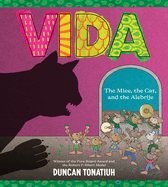
In this fanciful picture book creation myth of the Mexican folk creatures known as alebrijes, a young mouse solves the city's cat problem by making her own fantastical creature.
Cover

Vida: The Mice, the Cat, and the Alebrije

Duncan Tonatiuh

Abrams Books for Young Readers | $18.99 | 9781419764592

Color, creativity, and culture are front and center in Duncan Tonatiuh's energetic Vida: The Mice, the Cat, and the Alebrije, a worthy entry in Tonatiuh's growing series of Mexican-inspired folktale picture books (Feathered Serpent and the Five Suns; The Princess and the Warrior).

Vida is a mouse who lives in Mousetepec, a bustling city full of music, mercados, and fiestas. She lives with her banda-playing dad, piñata-making mother, and younger brother, Máximo. One night a wild cat pounces from the shadows, trashing the city and scaring the mice into hiding. With the markets empty of the people, their food, and music, Mousetepec begins to turn lifeless and gray. When Vida has a dream featuring an alebrije, a fantastical Mexican folk creature, she rallies the community to build their own alebrije. Together, the mousefolk use the alebrije, instruments, and their voices to scare off the villainous feline and return the city to its bright, bustling glory.

A brief note at book's end explains that Mexican artist Pedro Linares is "known for coining the word and concept of 'alebrije.' " Included alongside this description is an image of one of Linares's sculptures, painted in bright, clashing colors with several different patterns. Using thick black outlines and fully saturated colors, Tonatiuh's expressive hand-drawn and digital collage work mirrors the tactile and prismatic elements of such sculptures. Innately political, and bursting at the seams with color, Vida is a reminder that creativity and community are valuable tools to defeat the shadows that threaten peace and happiness. --Luis G. Rendon

Cover
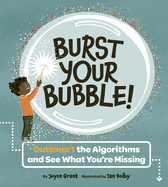
Learn how algorithms work, how they can be both helpful and hurtful, and how to break out of the bubbles they create in this handy middle-grade nonfiction guide.
Cover

Burst Your Bubble!: Outsmart the Algorithms and See What You're Missing

Joyce Grant, illus. by Jan Dolby

Owlkids | $19.95 | 9781771477123

The information silos of the digital world are challenged in the engaging, fact-filled Burst Your Bubble! by the duo behind the Gabby picture book series, author Joyce Grant, co-founder of TeachingKidsNews.com, and illustrator Jan Dolby. The algorithms that organize the Internet help users stay in their comfort zones, but Grant argues "that might not always be a good thing."

Dolby's illustrations of digital bubbles fill the pages with friendly figures akin to those of Chanel Miller or Charles Schulz, creating a welcoming atmosphere as Grant distills complicated ideas into easy-to-understand comparisons. "Algorithms are not 'good' or 'bad'--they're just tools" but "tools can be programmed, by humans, to do things you may not like." For example, choices that can at first seem harmless, like seeing posts about cats or dogs, can become more serious when "it's not only dogs or cats in your bubble but... only people who have the same skin color as you." Sidebars encourage readers to consider their echo chambers and lean into creative discomfort by expanding their bubbles. Grant's explanations of how "AI" and Google work to re-enforce bubbles are much needed, though more criticism could have been levied at the misinformation found in "artificial intelligence" and Google's biased algorithms.

Burst Your Bubble is a useful primer for young readers who want to learn more about the Internet and for librarians and teachers looking for a useful aid in the fight against digital misinformation. --Nicole Brinkley, bookseller and writer

The Writer's Life

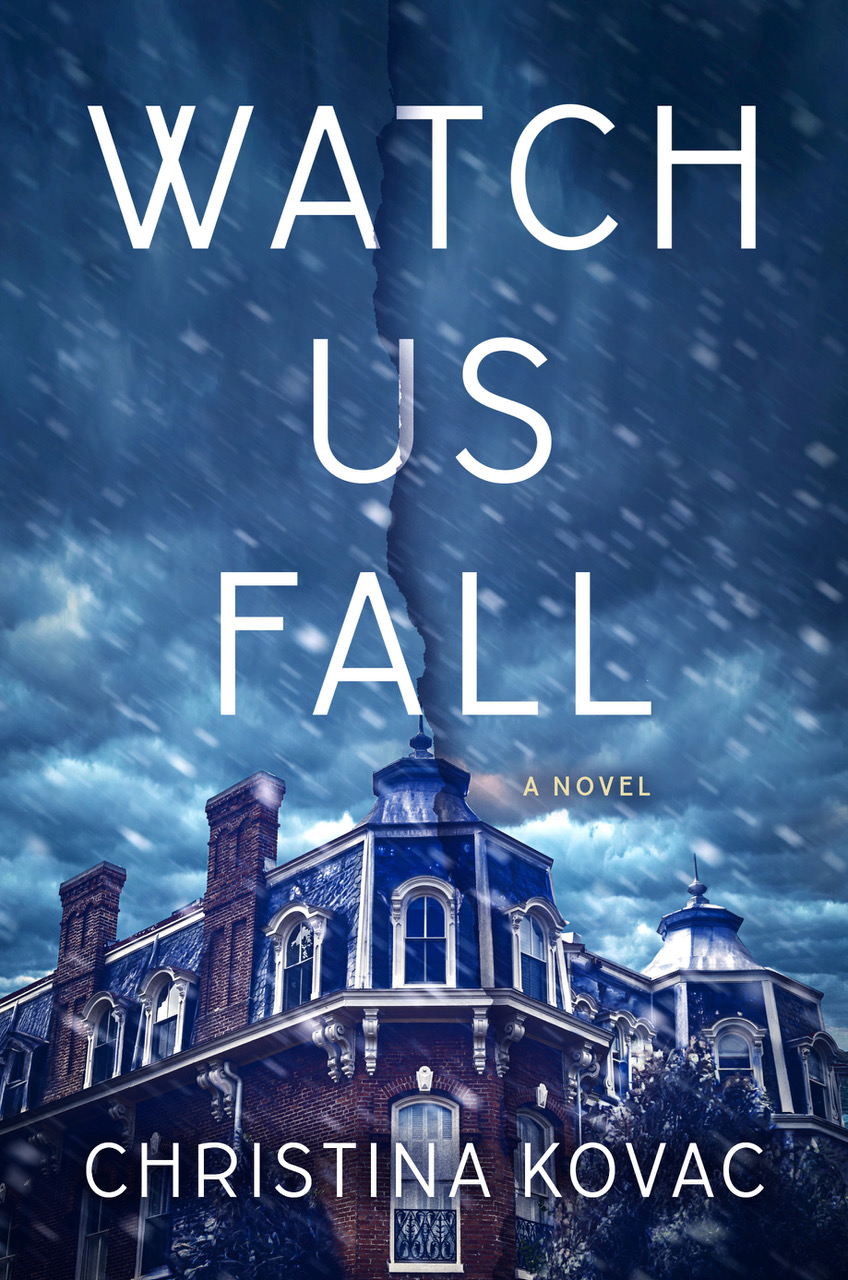
Christina Kovac writes suspense novels set in Washington, D.C. Her career began in television news, where she covered crime and politics, work that informed her novels, including her newest, Watch Us Fall, which follows four best friends who become embroiled in the investigation around a reporter. Discover the detective fiction that influenced Kovac most at an early age and which classic novel's twist still leaves her breathless....

The Writer's Life

Reading with... Christina Kovac

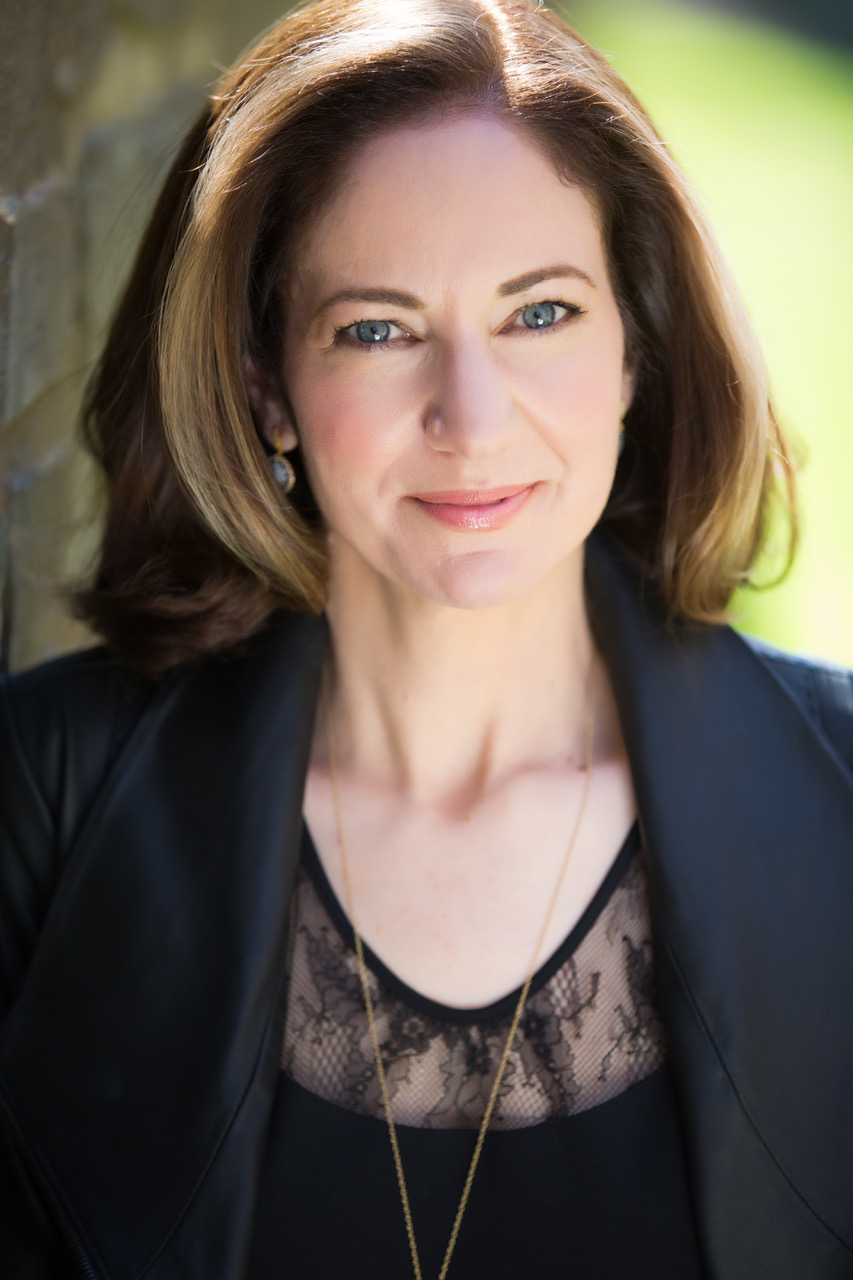
photo: Tina Krohn

Christina Kovac writes psychological suspense/thrillers set in Washington, D.C. Her career began in television news, where she covered crime and politics as a news producer and editor at the Washington Bureau of NBC News for The Today Show and Nightly News. This work informed her novels: The Cutaway and Watch Us Fall (Simon & Schuster, December 2, 2025), a work of psychological suspense that follows four best friends who get embroiled in the investigation around a reporter. Kovac lives outside of Washington, D.C. with her family.

Handsell readers your book in about 30 words:

Four best friends are living in a shared house in Georgetown, when one of their ex-boyfriends disappears. Police come calling, delusions hidden beneath the friendship surface, and things fall apart fast.

On your nightstand now:

Watch Us Fall comes out very soon, and I'm racing to finish my current manuscript (book three! yay!), so I'm crazy busy and a bit exhausted and reading much slower than usual, but:

The Bewitching by Silvia Moreno-Garcia is everything I need right now for the cool fall weather. I'm not deep into it yet, but if you loved Mexican Gothic like I did, you'll be so, so happy you picked up this book. Everything I love about Moreno-Garcia's writing is right there in the first line: "When I was a young woman, there were still witches..."

Favorite book when you were a child:

When I was very young, I read everything Nancy Drew. I have this vivid childhood memory of sitting next to my mother on the floor as we stacked her old Nancy Drew books onto my newly painted bookshelf. The smell of new paint and old books, the feel of pages under my small hand, those same pages my mother turned when she was a little girl. The timelessness of books, how they survive everything, even childhood, that's what I love as much as The Hidden Staircase.

Your top five authors:

I have degrees in English and journalism, so this is an impossible ask, but I'll tell you my favorites who are thankfully still writing at the top of their game today--Angie Kim, Lou Berney, Lily King, Liz Moore, Janelle Brown. I can't wait for what they do next.

Book you've faked reading:

The Bible. My hot take: everyone fakes this. I mean, look at this world.
Book you're an evangelist for:

Long Bright River by Liz Moore. And yes, I know, I know, The God of the Woods was the best book last year and maybe into this year, it was on the bestseller list forever, and I'm not knocking that--but hear me out: Long Bright River is her best. It tackles the most intractable problem in our country head-on. The novel makes you live through addiction that is the destroyer of worlds, so that you feel your family ripped apart, your sister lost to you, and the neighborhood you grew up in and the city you love destroyed--all while telling a pretty damn good murder mystery. Her characters are that real, and the book is that good.

Book you've bought for the cover:

Lou Berney's November Road. A little girl leans out the window of a fast car, her long hair blowing. You see her from behind. You feel like you were that girl, maybe, and that still grabs me--like: come along for the ride, you've got to see this. November Road was the first Lou Berney book I read, by the way, and I've now read everything he's published. Just a great, great writer.

Book you hid from your parents:

Ken Follett's Eye of the Needle. A spy thriller. At 12 years old, I was like, why can't I read it? By the way, never tell anybody not to read something--that's the exact book they'll steal, and I did. It was a worn paperback, and turns out, wowza, there was a very sexy sex scene in it--who knew? I read that scene about 12 more times before slipping it back in its spot on the high shelf.

Book that changed your life:

Daphne du Maurier's Rebecca made me want to write psychological suspense. I read the novel as a kid before I could really understand it--but I loved it, and I still can't figure out why. The main character is so weak she doesn't even have a name. Her husband is awful. The bad girl is fascinating, but oh by the way, she's dead so we never see her. And yet... and yet... I've read it at least four or five more times since I was a kid. I know the twist is coming, and it still catches my breath. I get a different read each time, and I just love how the meaning changes based on who you are now and what you bring to it as a reader, and I still wonder, how did du Maurier do that? What magic is this?

Favorite line from a book:

"Beauty is terror," from Donna Tartt's The Secret History. I don't entirely understand what she's saying, which I think is why the line works and why it stays with you. You puzzle over it for years.

Five books you'll never part with:

I have entire shelves of books from which I will never, ever part (much to my husband's horror). But if there was a fire, and I could only grab five books? The Secret History by Donna Tartt, The Bluest Eye by Toni Morrison, Anna Karenina by Leo Tolstoy, Happiness Falls by Angie Kim, and Presumed Innocent by Scott Turow--because while they're all great books, they all mean something more personal to me than what's contained within their cover.

Book you most want to read again for the first time:

Probably du Maurier's Rebecca as an adult writer, so I can feel that twist for the first time with knowing, writer eyes. Actually, I think I'll go pick it up now and give it a go. Maybe I can finally figure out its magic.


Book Candy
Rediscover

Poet and novelist DéLana R.A. Dameron, "whose work spoke with aching honesty about the Black experience in the modern South, and who moonlighted as a competitive horsewoman from her farm in South Carolina," died on November 29, the New York Times reported. She was 40.
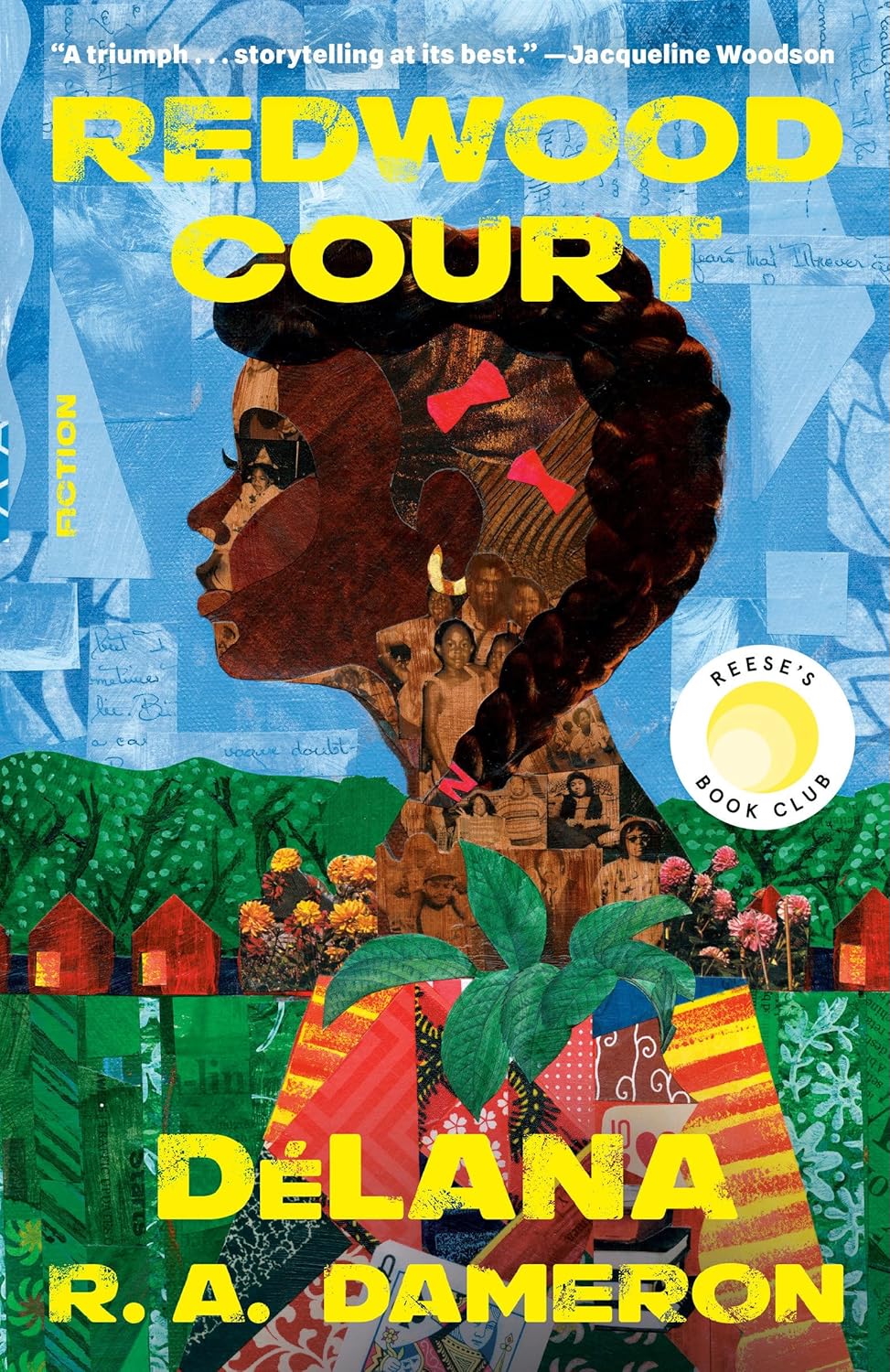
Dameron's debut poetry collection, How God Ends Us (2009), won the South Carolina Poetry Book Prize. Redwood Court (2024), her first book of prose, is a collection of linked stories.

Rediscover

Rediscover: DéLana R.A. Dameron

Poet and novelist DéLana R.A. Dameron, "whose work spoke with aching honesty about the Black experience in the modern South, and who moonlighted as a competitive horsewoman from her farm in South Carolina," died on November 29, the New York Times reported. She was 40.
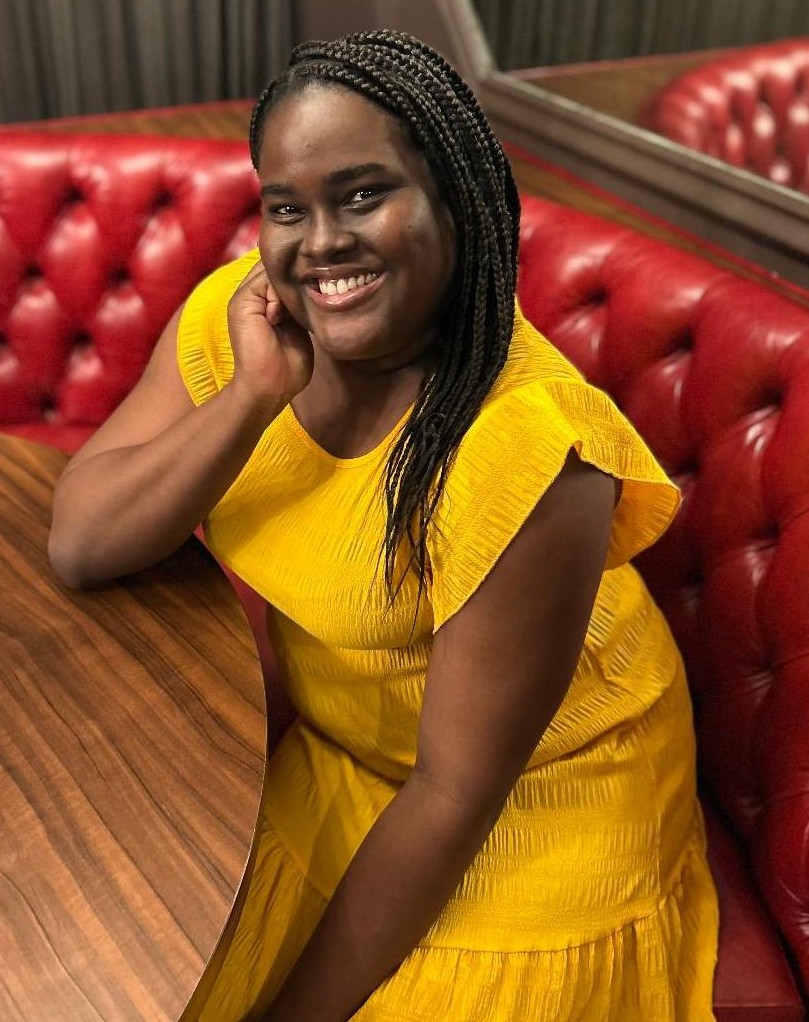
Dameron's debut poetry collection, How God Ends Us (2009), won the South Carolina Poetry Book Prize. Redwood Court (2024), her first book of prose, is a collection of linked stories. Novelist Charmaine Wilkerson praised the author for doing "a beautiful job weaving in local vernacular and casting a fresh gaze on an engaging, though flawed, cast of characters." Reese Witherspoon selected Redwood Court for her book club.

Dameron intended those books, as well as another volume of poetry, Weary Kingdom (2017), "to be the start of a 10-book cycle exploring everyday Black life in and around Columbia, her hometown," the Times noted, adding that she drew inspiration from playwright August Wilson's 10-play cycle set in different decades of the 20th century.

"She was a world builder," said Maya Millett, her editor at Random House, 

Dameron "wanted her cycle to encompass a variety of forms: poetry, novels, even children's literature. (She wrote a picture book about her horse Shadrach, which is currently in production.)," the Times noted. 

"I believe my project as a writer who is also Black and Southern is to document the experience of Black, Southern folks across multiple generations," she said in an interview last year with the website Indyweek.

Dameron returned to South Carolina in 2019 after 13 years in New York City. She started taking riding lessons, and, with her husband, Curtis John, purchased a farm, Saloma Acres, near Columbia in 2021. Within a few years she was riding competitively. She also made the farm "a public space, hosting events like theater productions and movie nights. Among the cultural groups she brought to the farm was the Luminal Theater, an organization, run by Mr. John, which shows Black-made independent films on a screen assembled in a field," the Times wrote.

"Her intention was to make sure that Black people felt comfortable in nature and were connected to the land," said Renée Watson, a writer and friend. "She was very good at gathering folks and making sure that everyone felt welcomed."

From her poem "When Mama died, I lost my air":

When Mama died, I lost my air. Hit with an anvil of grief. 
In dreams, the rains came. Streets filled with sorrow. 
I'm standing with Thomas at the bridge edge seeking relief. 

The sound of her voice is fleeting. Time is a thief-- 
she will never return to me. Thomas says not to follow 
his lead. Don't hold onto it. It's heavy. This anvil of grief.

PICK OF THE WEEK

Dark academia gets a 21st-century makeover in Kamilah Cole's brilliant An Arcane Inheritance, complete with a fictitious Ivy college, whispered ghost stories, a powerful Black female lead and incisive reflections on the intersections of class, race, and power in higher education and beyond.

Ellory Morgan was sent by her Jamaican parents to live with an aunt in the U.S. at a young age, cloaked with the expectations of success and financial freedom. "Every second Ellory spent in this country was devoted to building a future that seemed further out of reach the closer she supposedly got," emphasized by her inability to get any kind of scholarship or financial aid to support her parents' dreams of higher education. She is forced to defer enrollment until she can save up enough to begin classes, so when an unsolicited offer of a full ride arrives from Warren University, she leaps on the opportunity to attend as a Godwin Scholar. At the predominantly white, exceptionally wealthy Ivy League school, Ellory feels out of her depth as soon as classes begin...

PICK OF THE WEEK

An Arcane Inheritance

Dark academia gets a 21st-century makeover in Kamilah Cole's brilliant An Arcane Inheritance, complete with a fictitious Ivy college, whispered ghost stories, a powerful Black female lead and incisive reflections on the intersections of class, race, and power in higher education and beyond.

Ellory Morgan was sent by her Jamaican parents to live with an aunt in the U.S. at a young age, cloaked with the expectations of success and financial freedom. "Every second Ellory spent in this country was devoted to building a future that seemed further out of reach the closer she supposedly got," emphasized by her inability to get any kind of scholarship or financial aid to support her parents' dreams of higher education. She is forced to defer enrollment until she can save up enough to begin classes, so when an unsolicited offer of a full ride arrives from Warren University, she leaps on the opportunity to attend as a Godwin Scholar. At the predominantly white, exceptionally wealthy Ivy League school, Ellory feels out of her depth as soon as classes begin, despite having "like most Black women... a lifetime of microaggressions to prepare her for Warren University." Her sense of worry and vague apprehension grow as the early weeks of the semester prove stranger and stranger: "déjà vu had become a presence as constant as her shadow. And every time she tried to rationalize it, to ignore it, it returned more insidiously than before."

Warren's history contextualizes Ellory's experiences there, which begin to feel increasingly inexplicable and otherworldly as Cole builds the premise of An Arcane Inheritance with great care. The school was founded in 1954 by former members of the New England Society for Psychic Research as the School for the Unseen Arts, a name that lasted just a month before being changed to the blander and more palatable "Warren University." Unsurprising, then, that the school is marked with tales of ghosts and specters, occultism and witchcraft, further fueled by the number of missing students amassed over the school's history: "the Lost Eight."

Ellory, meanwhile, has had a touch of the mystical in her life since childhood, though her family discouraged her talk of spirits: "She stifled any magical potential to pursue a concrete future, proving her worth with grades and certificates, ribbons and trophies." But something at Warren seems to be re-awakening that part of her, a fact only too clear when she finds a tattoo on her neck that she has absolutely no memory of receiving. Then the ink disappears.

With her mind a seemingly "unreliable thing, an Etch a Sketch that shook itself clean at random," Ellory tries to figure out what's happening, opening herself up to the possibility of magical forces at play. What she finds in the process is a complex web of secrets and cover-ups, deeply rooted in racism and classism and perpetual power grabs--both figuratively and literally.

What if the power within such institutions was not purely metaphorical, but literal, magical power? "If you knew magic existed--if you could manipulate it to change the world--would you stop? Would you ever stop?" That kind of greed and desperation, Ellory reckons, reveals how people might act when no one is watching. "For most, this answer is shameful. And for those who have never before known what it is to want, this answer is downright chilling."

Cole uses this premise to great effect in An Arcane Inheritance, drawing on the secret societies, occult activities, and magical realism often seen in dark academia and twisting them to offer a sharp analysis of the many structural inequities at play within American institutes. As the forces behind Warren University's unusual success become more apparent to Ellory (and to readers), Cole probes the question of how those forces manifest for different students--with noticeably worse outcomes for students of color.

Any fantasy reader knows magic cannot exist without limitations; in the world Cole builds,that limitation comes in the price paid every time magic is wielded. ("For magic to live, something must die.... The world requires balance, and magic collects its debt in sacrifice.") But who makes that sacrifice, and who benefits from it, reveals layer upon layer of prejudice and injustice baked into the very foundations of Warren. While the school itself is fictional, it's not hard to extend this analysis to institutions of higher education in 21st-century headlines, making An Arcane Inheritance the best kind of fantastical reading: a novel that pulls you into a world where fiction and reality aren't quite as distinct as we like to believe. Smart, well-plotted, challenging, and often funny, An Arcane Inheritance is an irresistible story of ghosts, magic, and education combined to great, and horrific, effect. --Kerry McHugh

Click here to read an interview with Kamilah Cole

PICK OF THE WEEK

Kamilah Cole: An Immigrant in Dark Academia

Kamilah Cole
(photo: Dasha G)

Kamilah Cole is a Jamaican-born, U.S.-raised author. Her first two novels were a young adult duology retelling the story of Joan of Arc. An Arcane Inheritance (Poisoned Pen Press) is her first book for adults, a dark academia novel exploring themes of classism, racism, and elitism in institutions of higher education--but with a magical bent. A graduate of NYU, Cole now lives in the Pacific Northwest, where she works in publishing.

Would you classify An Arcane Inheritance as dark academia?

It is also a fantasy, it has romantic elements, it has thriller elements, mystery elements, but yes, it's dark academia. I love the genre. Give me a creepy school and I am all over it. But I felt there was a dearth of stories really talking about how difficult and confusing it can be to navigate higher education when you weren't born in America. The immigrant experience is a constant sense of non-belonging. That can be as scary; no matter where you go, what you do, and how hard you try, you're always different.

The core of An Arcane Inheritance is finding out that the only way that you can belong is to accept the parts of you that are you, that are different, and let the world fall in place after that. That's the journey Ellory takes, through magic and memory, and college parties and dating and ghosts, all of that. She has a more speculative journey to acceptance than most immigrants do, but at the end of the day, An Arcane Inheritance is a dark academia immigrant story. It is about disappearance and belonging, memory and knowledge, hidden tattoos, snarky rival men, and it's a commentary on elitism, classism, racism.

What draws you to this genre, as both a writer and a reader?

Education is such a big part of our life. And it's interesting to me as a writer to explore how no two people go through life the same way. Your socioeconomic place in this world really affects how easy or difficult things are, how hard you have to work, what opportunities open up to you, and I feel like nowhere is that inequality shown more than in school. We are told that education is an equalizer, that if you work hard enough, get good enough grades, you will get all the same opportunities. Then you graduate, and you still can't get a job because your father doesn't own a multimillion-dollar company. There are all these conversations about equality, but what is really needed is equity. The acknowledgement that not everybody starts at the same place, and to reach the same things, they need different kinds of help.

Could you talk a bit more about that distinction between equality and equity?

When first starting this book, even beyond the worldbuilding, I wanted to look at power on an individual level through various characters. I wanted to examine the fact that no matter what you give up for power, at the end of the day, there are some things that nothing but connections can get you. And that's part of the equity conversation.

I wanted to study how unexamined systems can perpetuate harm, not just for people outside of them but also for people inside of them. How actively choosing to uphold such a system hurts everyone, including yourself. You can't skirt close to white supremacy and expect it not to burn you as well. Then there are people who are born wealthy, and I wanted to explore the idea that it is not just required, but almost a calling to use that privilege--to create equity, to help other people, to be a kinder, better person, and create a kinder, better world.

At the end of the day, I think we've all got power. We all want control. We all want to be happy and successful and content, but we really need to look at not only the sacrifices that we are forced to make, but the sacrifices that we ask others to make, whether they can consent to that sacrifice or not. It is so easy to fall into the trap of thinking that the ends justify the means, but that's not the case.

In all of my books, but especially in An Arcane Inheritance, I introduce a lot of big themes, questions that I'm grappling with, but I try never to give a definitive answer. I just want people to think about these things. I don't want to tell them what to think. These are questions that we need to keep in mind, because the moment that we stop thinking about these things is the moment that people get hurt.

As someone who also works in publishing, have you found anything shocking from the author side of the process?

Yes! It's actually shocking to me how much I didn't know about the writer's side. I don't know when I'll hear about cover design, or how often deadlines shift, and how easily. I didn't know anything about how to be edited, from theme edits to line edits to copy edits, to cast pages, to proofreading and sensitivity reading. I had to learn all those steps.

It's also shocking how much writers don't know about publishing. I also get to be in spaces with other writers, and I try to give back by telling them things I do know about publishing. Again, it goes back to equity. If I have information that you don't have, I want to share it with you so we can all have that same access. But yeah, I'm still surprised sometimes by how much I don't actually know about publishing.

An Arcane Inheritance is your first book for adults. What felt different here after writing YA for your first two novels?

YA is often marketed as coming of age. But you come of age many more times in your life. So the difference for me was not in the kind of story that I was telling, but in the emotional beat of the story. There's an immediacy of emotion that happens as a teenager; everything feels so big and so awful, or so wonderful. But Ellory is older when she starts college, and instead of immediate emotions, she will feel something, and then she will take a beat before choosing how to express how she is feeling. That's not even to say that one reaction is better than another--repressing your emotions is not healthy! I really admire teens for being so, so themselves, in a way it feels like you can't be as an adult. You are no longer thinking about needing to find your place in the world, and more like, This is the world, and I need to fit into it.

What was most important to you when setting out to write An Arcane Inheritance?

I wanted to make this book as queer and as Jamaican as possible. I have a lot of critiques of higher education, but it is because of the people that I met in college and the people that I know now that I became a person who's so proud of my Jamaican heritage, and a person who is able to navigate queer spaces without questioning myself. So I think of An Arcane Inheritance as a love letter to Jamaicans, and to Jamaican Americans, and to queer people everywhere in a time when immigrants and queer people and queer books are under attack. I will always, always, always stand up for us. I will always continue to put my work out into the world and hope that people find it--and find themselves--within the pages. --Kerry McHugh

Advertisement

Poisoned Pen Press: An Arcane Inheritance (Deluxe Edition) by Kamilah Cole

Powered by: Xtenit