Latest News
Poisoned Pen Press: Impostor (Alexander Gregory Thrillers #1) by LJ Ross
WHAT TO READ NEXT: REVIEWS OF GREAT BOOKS

In a recent interview for Bookselling This Week, novelist Laura Dave (The First Time I Saw Him) expressed her relationship to books as "a coming home. I love them more than anything.... Every town I go to, the indie bookstore is the first place I go."

I can certainly relate, although a bookstore isn't often my first stop when I travel, typically having lugged three books around since leaving home: one I'm in the middle of, one I'm excited to start, and a backup just in case the second doesn't meet expectations. Nevertheless, I will absolutely veer into the first indie I notice as if it held the meaning of life itself. Which, as far as I'm concerned, is true. The only real question is how much of life's meaning will fit in my carry on for the return trip.

--Dave Wheeler, senior editor, Shelf Awareness
FEATURED TITLES
Cover

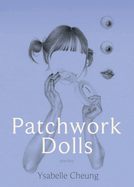
Patchwork Dolls: Stories

Ysabelle Cheung

Ysabelle Cheung's remarkable debut collection, Patchwork Dolls, presents 10 stories of women facing challenges simultaneously somehow both familiar and fantastical.
Cover

Patchwork Dolls: Stories

Ysabelle Cheung

Blair | $18.95 | 9781958888643

Throughout her debut collection, Patchwork Dolls, Hong Kong writer and gallerist Ysabelle Cheung writes with a beguiling matter-of-factness as she impressively explores seemingly fantastical impossibilities over 10 stories. In the disturbing titular story, these so-called "Patchwork Dolls" sell their facial features for thousands of dollars to "moneyed people seeking an upgrade to newer, trendier faces." This "method of transdermal patchworking" eventually comes under fire for "murky racial inequities": most buyers are "affluent white women dabbling in ethnically ambiguous faces," and sellers are "primarily disadvantaged women of color." The narrator, recalling the anti-Asian racism she endured, remains conflicted: "On a white woman, my face was desired, ambiguous, a symbol of power and wealth. But for me it had been a curse, something I desperately needed to scrub out."

In "Herbs," a septuagenarian widow can't escape her dead husband's clones of various ages--youthful 21, emotionally abusive 45, familiar 75--who appear by her side wherever she goes. In "Not in This Neighborhood," an extraterrestrial refugee has difficulty adjusting to life on Earth--"she had chosen America simply because she had been to no other place on Earth"--where her name is truncated to just "T" for the difficulty of its "sloping vowels," where, once she migrated, "the narrative changed from a language of community to one of singularity, of hostility."

What elevates many of Cheung's stories into standouts is her uncanny ability effortlessly to spin today's all-too-familiar challenges into tomorrow's speculative extremes: the jarring disappearance of books; escaping colonialism's destruction; matched cohabitation instead of dating. With inventive aplomb, Cheung skillfully strikes a memorable balance between the utterly disconcerting and thoroughly engaging. --Terry Hong

Cover

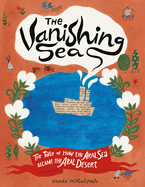
The Vanishing Sea: The Tale of How the Aral Sea Became the Aral Desert

Dinara Mirtalipova

Young readers learn about the once-grand Aral Sea and the devastating loss of its resources in this stunningly illustrated, thoroughly informative picture book.
Cover

The Vanishing Sea: The Tale of How the Aral Sea Became the Aral Desert

Dinara Mirtalipova

Chronicle | $18.99 | 9781797224596

In the enlightening picture book The Vanishing Sea, author/illustrator Dinara Mirtalipova (Woven of the World) introduces young readers to the tragic disappearance of the Aral Sea and the effects it has had on Central Asia. Her distinctive art, inspired by Uzbek and Russian folklore, accompanies the impassioned narrative, producing a singular cautionary tale.

"A long, long time ago, when the earth was removing its icy blanket, the Aral Sea was born. The lake was so vast that the People called her MOTHER SEA." The Aral Sea, situated between Kazakhstan in the north and Uzbekistan in the south, earned its designation of "sea" because "before the 1960s it was the fourth-largest lake in the world." Mirtalipova explains how vital it was to the area: "Like a caring mother, the sea gave [the people] her biggest fish... water to drink... ALL of her resources." Though the Aral enabled the people to feed themselves, build cities, and make money, they did not focus on preservation, and the Aral shrank to virtually nothing. "When the people returned to ask for MORE, they realized there was very little left of Mother Sea."

In her highly informative and striking work, Mirtalipova includes extensive back matter that has a timeline, an ecological impact explanation, and information about the fish found in the Aral Sea. The author/illustrator's artwork is transfixing as it uses a brilliant yet limited color palette, consistent floral patterns, perspective changes, and dramatic line work. Mirtalipova draws the audience into a land with which they may be unfamiliar and emphasizes the colossal changes it experiences with impressive visual precision. Any reader may find enrichment in this exquisite work. --Jen Forbus, freelancer

Cover

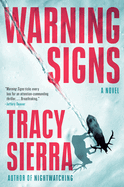
Warning Sign

Tracy Sierra

A boy faces a variety of dangers when he enters deep snow and high mountains with his father in this enthralling novel of horror, suspense, and psychological intrigue.
Cover

Warning Sign

Tracy Sierra

Pamela Dorman Books | $30 | 9798217059799

Tracy Sierra (Nightwatching) conjures a terrifying narrative with Warning Signs, in which a 12-year-old boy grapples with hazards on several levels. This novel of horror and abuse is both enthralling and thought-provoking, liable to keep the reader up all night for a single-sitting read or to inspire nightmares--all worthwhile for the masterful handling of serious topics.

Chapter one introduces Zach, aged 11, his younger sister, Bonnie, and their mother, Grace, as they ski uphill into the mountains. Grace, an expert outdoorswoman, educates her young children in assessing avalanche risks, in survival, and how to manage fear. Chapter two jumps forward a year. Zach heads into the same mountains with his father, Bram. Where Grace was kind and patient, Bram is visibly short-tempered and exasperated. They are to meet a group of men and boys at a backcountry ski hut for a fathers-and-sons ski trip, organized by Bram to secure investments from the wealthier men he envies and courts.

Warning Signs ratchets up the tension until it seems it can carry no more--and then ramps it up again. Zach is aware of at least three distinct threats: the perils of the natural world, including a very real risk of avalanche; his father's irascible self-interest and capacity for cruelty; and a mysterious creature stalking the dark and treacherously cold high-altitude woods. With its triple-punch of terrors, Sierra's sophomore novel is truly and profoundly frightening. Beyond the fine art of the horror or thriller novel, Warning Signs also considers domestic abuse and control, class and ambition, and how we try to care for those we love. Discomfiting, chilling, and unforgettable. --Julia Kastner, blogger at pagesofjulia

Cover

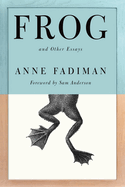
Frog: And Other Essays

Anne Fadiman

Anne Fadiman's gracefully written third essay collection displays her characteristic blend of erudition and entertainment.
Cover

Frog: And Other Essays

Anne Fadiman

Farrar, Straus and Giroux | $26 | 9780374608743

As she's shown in previous collections such as Ex Libris: Confessions of a Common Reader, Anne Fadiman (The Wine Lover's Daughter) consistently produces essays that are simultaneously erudite and entertaining. The seven pieces in Frog, covering subjects that include a not-so-beloved pet amphibian, the use of pronouns, and a pair of historical excursions, are more of these highly polished gems.

The collection's titular essay relates the hilarious story of Bunky, an African clawed frog Fadiman's son raised from a tadpole and which lived for nearly 17 years in an uncomfortably small aquarium. Fadiman conveys the family's ambivalent relationship to the amphibian; and yet, after six years of keeping Bunky in a Ziploc bag in the freezer following his demise, with their children grown and moved away, Fadiman and her husband gave him a dignified burial beneath their backyard weeping cherry tree.

Fadiman has been teaching nonfiction writing at Yale since 2005. The essay "Screen Share" recounts her pivot to Zoom instruction at the beginning of the Covid-19 pandemic, while "Yes to Everything" pays tribute to her student Marina Keegan, a brilliant writer who died at age 22 in a car accident. But Fadiman's at her best in "All My Pronouns," where she takes a description of her idiosyncratic method of eating M&Ms as an unlikely departure point.

Though these essays have appeared previously in publications like Harper's, Fadiman says she's made changes, some of them substantial, since their first publication. In its blend of personal and more academic pieces, it's hard to find fault with this collection, except that one wishes it contained even more of her consistently engaging writing. --Harvey Freedenberg, freelance reviewer

BOOK REVIEWS
Cover
Danish author Helle Helle's they is a beautifully crafted literary gem that explores the intricacies of a mother-daughter relationship.
Cover

they

Helle Helle, trans. by Martin Aitken

New Directions | $16.95 | 9780811239127

Helle Helle's they is a deceptively slight, minimalist novel that packs a huge emotional punch in its superb translation from Danish by acclaimed translator Martin Aitken. Each austere sentence brings a wealth of information about the mother-daughter relationship at the center of the narrative.

A mother and her 16-year-old daughter have moved frequently from place to place throughout their lives on the island of Lolland in Denmark. The story finds both of them at inflection points. The girl is starting high school and navigating the social landscape that goes along with it, while the mother must confront the news that she is terminally ill and undergoes treatment. Each seemingly insignificant moment is filled with the beauty of the everyday. While the daughter makes friends at school and engages in typical teenage things, her mother is hospitalized.

Helle, a recipient of the Danish Critics Prize for Literature, is an exquisite stylist who details both the sensory surfaces of life (tomato soup, weather, public transportation) and the intimacy inherent in any interaction. The daughter's world is populated by specific friends with names like Tove Dunk, Hafni, Bob, and Steffen, but she and her mother themselves go unnamed--their relationship is too primal and entwined for the distinction that names imply.

Ultimately, they beautifully investigates how people face the end of their shared world and shared story not with drama but with quiet, dogged determination. Helle Helle challenges the reader to find the meaning, the love, and the sacrifice buried deep within the most ordinary and prolonged silences. --Elizabeth DeNoma, executive editor, DeNoma Literary Services, Seattle, Wash.

Cover
One Sun Only is a nuanced and compulsively readable collection of stories powered by everyday absurdity and accentuated by ironic, observational humor.
Cover

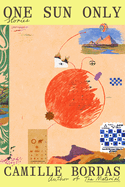
One Sun Only

Camille Bordas

Random House | $28 | 9780593729878

The stories of Camille Bordas's One Sun Only are powered by everyday absurdity and accentuated by sharp observational humor. They explore creativity and family via comedically myopic characters.

In the darkly funny "Most Die Young," Julie circles the question of whether anxiety can kill while explicitly avoiding the question with regard to her own anxiety. Instead, she works on a human-interest essay about the Pawong, a Malaysian tribe in which fear is highly valued. In "The Lottery in Almería," Andrés is visited by his sister in the house they inherited from their father in the titular city, a small-town vacation destination where "it was not every day that two different things happened." He moves through his day observing others' irrationality while oblivious to his own illogical beliefs about what might impact the likelihood of winning the lottery.

In "The State of Nature," an optometrist sees a patient who wants LASIK so he can be better prepared for societal collapse and a return to a more natural state, which he's excitedly anticipating. Here, Bordas's deadpan style reaches its peak. When the optometrist finds out her patient got the surgery, she tells him with apparent sincerity, "I'm happy for you.... Now you can just relax and wait for the world to collapse."

Bordas's collection thoroughly understands the strange subtleties of human psychology, affectionately poking fun and letting readers in on the joke. It's a nuanced and compulsively readable work from a celebrated contributor to the New Yorker and the Paris Review, full of humor and insight. --Carol Caley, writer

Cover
Jasmin 'Iolani Hakes's captivating second novel tells the story of a sacred Hawaiian stone and the women tasked with protecting it.
Cover

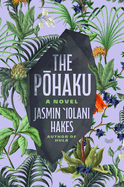
The Pōhaku

Jasmin 'Iolani Hakes

HarperVia | $30 | 9780063421134

Jasmin 'Iolani Hakes (Hula) returns to her native Hawai'i and its multifaceted history in her captivating second novel, The Pōhaku. Tracing the titular ancient volcanic stone and the fortunes of the women charged with protecting it, Hakes draws a sharp, compelling portrait of Hawai'i and its people on the brink of cataclysmic change.

Hakes's unnamed narrator tells her story from beside a hospital bed where her estranged granddaughter lies in a coma. Terrified of losing her, the narrator rushes to share the account of their family's kuleana (sacred obligation) to the pōhaku, which she believes is tied to the fortunes of their beloved islands. Traveling back and forth in time from the age of European exploration to the California gold rush to the 1990s, Hakes's narrative explores the exploitation of Native people and resources, and the seductiveness of power and greed. But she also highlights the women who go to great lengths to protect their families and the pōhaku in the face of poverty, abuse, and rapidly shifting political alliances. Hakes casts a new, unflattering light on the story of Hawai'i's path to statehood, emphasizing the machinations of white men determined to possess the land and extract its treasures. The pōhaku's survival, despite such plotting and hardships, prompts readers to consider important questions about ownership, connection to the land, and the weight of communal responsibility.

Lushly described and powerfully told, The Pōhaku provides a critical new perspective on Hawai'i's history and an urgent call to care for the planet and one another. --Katie Noah Gibson, blogger at Cakes, Tea and Dreams

Cover
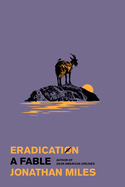
Jonathan Miles's taut, powerful fable pits an everyman against seemingly insurmountable environmental and personal problems.
Cover

Eradication: A Fable

Jonathan Miles

Doubleday | $25 | 9780385551915

Who wouldn't take a job that involves "saving the world"? Adi, the antihero of Jonathan Miles's powerful fourth novel, Eradication, is drawn to the job listing not just for the noble mission but also for the chance to be alone for five weeks on a Pacific island. A teacher reeling from his 11-year-old son Jairo's death and his wife leaving, Adi relishes getting away from it all. But he hasn't reckoned with the emotional challenge of eradicating an invasive species--and facing up to humanity's role in environmental crises.

Santa Flora once teemed with endemic birds and reptiles, but many species have gone extinct because of the ballooning population of goats. Armed with a sniper's rifle, Adi's task is to kill all of the island's estimated 2,000 to 4,000 goats. From the start, it's clear Adi's not cut out for this. The story nears the midpoint when he finally kills his first goat. He butchers it, but cries while eating the meat. In the meantime, he's made the mistake of becoming emotionally attached to the female goats hanging around his hut. He's identified individuals and named them; how can he kill them?

Miles (Anatomy of a Miracle) spins a taut parable where guilt and blame, responsibility and revenge, trade off. His island discoveries enhance a nuanced environmentalist message: a trash-covered beach; an injured bird thought to be extinct; and two drunken fishermen who illegally kill sharks and sell the fins to China. Human tragedies, like Jairo's accidental death, may be random. Those that befall the natural world, though--whether intentional or not--can only be laid at humanity's door. --Rebecca Foster, freelance reviewer, proofreader, and blogger at Bookish Beck

Cover
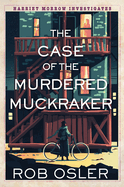
In this insightful historical novel, a young queer woman at a Chicago detective agency tries to prove a poor single mother's innocence in the killing of a reporter.
Cover

The Case of the Murdered Muckraker

Rob Osler

Kensington | $27 | 9781496749512

In The Case of the Murdered Muckraker, the sequel to The Case of the Missing Maid, Rob Osler vividly captures the challenges facing a young queer woman in 1898 Chicago who's trying to prove her skills as a detective while keeping her personal life private.

At 21, Harriet Morrow is the first female operative at the Prescott Detective Agency, a competitor of the Pinkerton agency. Harriet often is the smartest person in the room, despite her lack of formal education and people's assumptions about women. Agency head Theodore Prescott believes in Harriet and assigns her to investigate the murder of journalist Eugene Eldridge, who'd been trailing a corrupt politician. Harriet is eager to go undercover and is especially hoping to prove the innocence of Lucy Fara, a poor, single mother of four children. The police accused Lucy of Eugene's murder simply because she found his body at the University of Chicago Settlement tenement, where she lives. To go undercover, Harriet must set aside the men's trousers she usually wears in favor of conventional women's clothes. Harriet ferrets out information from Lucy's neighbors and follows a trail through Chicago's corruption, all the while keeping her sexuality secret despite growing feelings for another woman.

The Case of the Murdered Muckraker's strength lies in Osler's insightful characterizations of Harriet and the city in which she lives. The detective is determined that her 16-year-old brother will have more opportunities than she herself has had. And her maturity as an investigator parallels the changes in Chicago on the cusp of a new century, with its soaring population and talk of women being granted the vote. --Oline H. Cogdill, freelance reviewer

Cover
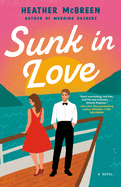
Heather McBreen's Sunk in Love follows Roslyn and Liam as they set sail and fake date their way to insatiable chemistry, heartfelt understanding, and a second chance at love.
Cover

Sunk in Love

Heather McBreen

Berkley | $19 | 9780593817643

Heather McBreen (Wedding Dashers) expertly combines humor and hope to turn heartbreaking unresolved feelings into a second chance at true love. Roslyn and Liam's marriage was once envied by everyone they knew, but following the death of Roslyn's mother, it has been submerged in devastating grief and harrowing tension. Their relationship is coasting straight toward divorce when Roslyn's unsuspecting grandparents decide to redeclare their own love with a vow renewal during this year's family trip, a Hawaiian cruise. Their only request is that Liam officiate the ceremony. Hesitant to tell her family that her seemingly perfect marriage to an incredibly smart and sexy British doctor whom they all love as one of their own is over, Roslyn has an idea: pretend they are still together and delay her family's disappointment.

A tiny cabin and prescheduled family zip-lining, shuffleboard, and beach days begin to muddy the waters between the couple's fake-dating skills and very real chemistry. As fun flirtation and heated sexual tension rise to the surface, Roslyn and Liam must decide if they should leave the past in the past or take back the helm of their relationship.

Alternating timelines intertwine Roslyn and Liam's nuanced past with their present journey to love and acceptance. As Roslyn navigates how to follow her heart despite her fear of her grief being too much for Liam, Liam determines how to confront his issues and finally let Roslyn in. Over the course of the family trip, Roslyn and Liam's past and present reveal the darkest and the brightest parts of love. --Clara Newton, freelance reviewer

Cover
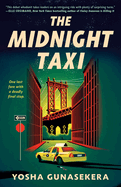
Sri Lankan American attorney Yosha Gunasekera cleverly and convincingly introduces a New York City cab driver and public defender working together to solve a backseat murder.
Cover

The Midnight Taxi

Yosha Gunasekera

Berkley | $19 | 9798217187539

Former Manhattan public defender Yosha Gunasekera convincingly takes to the page with The Midnight Taxi, her authorial debut. At 28, Siriwathi Perera is a New York City cab driver, more by circumstance than choice. Her immigrant father couldn't afford to buy a coveted taxi medallion, so he leased one instead. His heart disease, however, kept him from the wheel, meaning Siri and her older brother had to cover his shifts. Alas, "Thathi never got better, my brother died, and we were trapped in a ten-year lease. It all fell on me," Siri admits. Family debts, disappointments, expectations loom large.

"My true crime podcasts are a lifeline," Siri confesses about the daily driving tedium. "I spend most of my time thinking about murder." Thinking becomes shocking reality late one night when the fare she picked up has somehow been stabbed dead in the backseat by the time they arrive at Kennedy Airport. Suddenly Siri is the prime suspect for murder. Serendipitously, she has the business card for criminal defense lawyer Amaya Fernando, whom she'd ferried earlier that night.

Siri and Amaya just need to line up the clues in time to prove Siri's innocence. Gunasekera's plotting proves notably clever, and she writes with straightforward ease, relaying the step-by-step process of Siri and Amaya's fast-moving investigation as they crisscross the boroughs. The Sri Lankan American background she shares with her protagonists adds cultural and sociopolitical enhancements to her narrative, broadening the scope beyond the usual whodunit. Oh, and to ensure audiences stay properly hooked on these tenacious sleuths, The Midnight Taxi ends with the first three chapters of the next volume. --Terry Hong

Cover
Akira Kurosawa's Long Take, published posthumously in Japan in 1999 and translated into English by Anne McKnight, is an indispensable companion to the director's work.
Cover

Long Take

Akira Kurosawa, trans. by Anne McKnight

University of Minnesota Press | $24.95 | 9781517903299

The great Japanese filmmaker Akira Kurosawa's Something Like an Autobiography, published in 1982, is one of the best cinema memoirs ever written. He lived until 1998, however, and directed several films after the book's release. One assumes that even a publicly reticent figure like Kurosawa had more to say. That assumption is validated by Long Take, a collection of essays and conversations originally published in Japan in 1999, most dating from after the previous volume. Translated from the Japanese by Anne McKnight, this excellent work, along with Waiting on the Weather, a 2006 book by Kurosawa's former assistant Teruyo Nogami, provides an indispensable companion to the director's autobiography and a singular look at his perspectives on film.

The opening essay by Kurosawa describes his experience making Seven Samurai (1954) and explains that, for the final battle sequence, "[Mud] really got in everywhere. All my toenails ended up turning black and falling off." In an essay on Maadadayo (1993), his final film, he states that he'd rather be known as an artisan than an artist, adding, "Above all, people should be entertained." In conversations with two interlocutors, he discusses, among other topics, the process of filming the eight tales that constitute Dreams (1990). Long Take concludes with several entries by his daughter, Kazuko, including her reminiscences of Kurosawa's final three years and a list of 100 films that constituted his "ideal cinema viewing experience," among them Bicycle Thieves, Barry Lyndon, and, delightfully, the original Godzilla. Cinephiles need this book. --Michael Magras, freelance book reviewer

Cover
In this disquieting, exquisitely written YA novel, a teen tries to raise awareness about the huge corporation that is damaging the health of the people and landscape in her community.
Cover

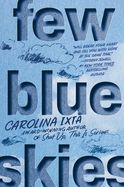
Few Blue Skies

Carolina Ixta

Quill Tree Books | $19.99 | 9780063287914

In this stunning, passionate YA novel, a teen and her community grapple with the impossible, complicated scenario of being forced to choose between jobs and health.

Mexican American teen Paloma's beloved Southern California town is inundated with warehouses for Selva, a mega e-commerce company. Selva's arrival brought jobs along with all the associated pollution and physical hardships on workers. Two years ago, Paloma and ex-boyfriend Julio learned about the group scholarship, Projects for Purpose, and planned to apply together: $100,000 each and a publication in the Young Scholars Journal. There, Paloma could raise national awareness about Selva's detrimental impact on the community. However, Julio's father died of lung cancer, and he stopped speaking to Paloma. Now, six months until graduation, Paloma's father insists on walking the picket line despite his clearly declining health. Reluctantly--and independently of each other--Paloma and Julio realize their best chance at winning the scholarship is to work together.

Pura Belpré Award winner Carolina Ixta (Shut Up, This Is Serious) pulls no punches in this painful yet tentatively hopeful novel inspired by true events about the disproportionate placement of warehouses "in areas with higher concentrations of Black and Latino residents." Despite the agonizing subject matter, Ixta's writing is dazzlingly lyrical, as when Paloma and her father go to fill a prescription alongside "so many people bending into their elbows," their coughs are "cacophonous, harmonizing, echoing through the pharmacy line." Few Blue Skies is well suited for fans of Jennifer Mathieu's Down Came the Rain and Ellen Hagan's Don't Call Me a Hurricane. Includes a map, author's note, and an impressive, extensive bibliography. --Emilie Coulter, freelance writer and editor

Cover
A genuine, honest middle-grade graphic novel about a tween struggling to find acceptance in his new school full of rich kids.
Cover

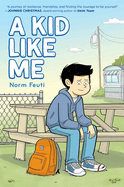
A Kid Like Me

Norm Feuti

HarperAlley | $15.99 | 9780063354104

Theodore Seuss Geisel Honor-winning author, illustrator, and cartoonist Norm Feuti (Beak & Ally series) sheds a gentle but decidedly direct light on the social and financial complexities of a working-class kid entering middle school.

Nathan and best friend Ricky are white kids living in the Millbrook Estates trailer park with their mothers. They'll be attending the same, majority-white middle school but have no classes together and Ethan is nervous. The nerves, sadly, prove prescient. On his first day, the bottom of his old, "falling apart" backpack rips open in the hallway. Next, Ricky embarrasses him at lunch, telling their rich classmate that Ethan is "only into nerd stuff" (the card game Bio Battle). Finally, another student publicly derides Ethan, saying it "must be nice" to get free lunch "while the rest of us have to pay." A chance encounter at the end of the day with Aiden, a fellow Bio Battle player, raises Ethan's spirits. But as Ethan and Aiden bond, Ethan begins to think Aiden might be just like the other rich kids.

Feuti expertly represents Ethan's struggle with being a child living in economically depressed conditions. Ethan is often embarrassed by and frustrated with his family's financial situation as he tries to make new friends and find acceptance. Feuti's story moves quickly, helped along by a mixture of thickly bordered panels with sharp edges, full page illustrations, and entirely borderless panels that keep the eyes moving rapidly across the page. An excellent read for fans of Rex Ogle's Free Lunch or Kelly Yang's Front Desk. --Kharissa Kenner, school media specialist, Churchill School and Center

Cover
Julie Flett's picture book follow-up to We All Play is a celebration of love and compassion.
Cover

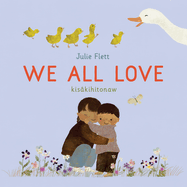
We All Love

Julie Flett

Greystone Kids | $18.95 | 9781778403279

We All Love is a contemplative picture book that asks young readers to consider care as a shared responsibility across species, generations, and communities. Cree-Métis author/illustrator Julie Flett (Let's Go!; We All Play) frames this tender and expansive book with a dedication to all children ("It could not be more important for you to know to that you are loved") that grounds the book and immediately establishes its emotional center.

Flett integrates into her story gentle moments of direct address to animals ("Little friend, would you like a warm nest?"): an adult bear watches a cub dangling precariously from a tree, a duckling drifts too far out to sea until a fish nudges it back toward its waiting family, and a large turtle helps right a smaller one stranded on its back. These spreads emphasize attentiveness and action, and suggest that love often looks like noticing when someone needs help. A shift to human children follows, accompanied by the bilingual declaration "We love too! kisâkihiwânaw kîstanaw." Subsequent spreads focus on warmth, protection, and guidance: animals sheltering together, finding their way, and keeping one another safe. The closing pages widen the lens further, turning to flowers, stars, and the acknowledgment that the "stories inside us help us to grow." Flett's earth-toned palette, accented with soft violets, and her textured illustration style lend a quiet intimacy to nests, grasses, and furred heads. Closing notes list the animal names in both English and Cree, include a brief explanation of aspects of the Cree language, and share a final note with readers: "we are loved and... we all love." --Julie Danielson

Cover
In this thrilling, romantic YA debut, two time-traveling Black teenagers try to break the curse that threatens to destroy their families.
Cover

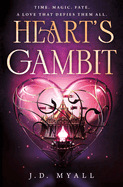
Heart's Gambit

J.D. Myall

Wednesday Books | $21 | 9781250365408

In debut author J.D. Myall's breathtaking and brooding romantic YA fantasy, Heart's Gambit, two 18-year-olds fall in love as they attempt to destroy a centuries-long curse.

Emma Baldwin and Malcolm Davenport are members of two feuding Black families whose enslaved ancestors fell in love and were bound by the cruel sorcery of the magical plantation owner. Both bloodlines were granted supernatural "gifts" and forced into endless enmity. Additionally, once a generation, a Baldwin and a Davenport must fight in an enchanted duel, the Tethered Gambit, in which a death preserves the witch's immortality.

Emma, who has a very tenuous hold on her "gift" (granting wishes), feels unfulfilled performing in her family's nightly circus, where her brother "reaches into... minds," her mother has telekinetic skills, and her father can conjure the unbelievable. At the same time, Malcolm performs on his guitar, creating illusions in his family's evening revue. But Malcolm wants to do more--to change the world for Black people all over. When Emma and Malcolm are chosen to compete in the Tethered Gambit, the teens are drawn to each other. One must die for the bloodlines to survive but the newly-in-love teens are desperate to rewrite fate.

Myall creates a bewitching and original setting by fusing sci-fi time travel tropes with the witch's "gifts." The characters traverse heightened moments in U.S. Black history such as "Mississippi Delta, 1904," "Harlem, 1943," and "Philadelphia, 2024." Emma and Malcolm's alternating first-person perspectives show the teens grappling with tradition as they attempt to heal generational wounds. Heart's Gambit is a daring, romantic, and enthralling first installment in what will surely be an exciting series. --Natasha Harris, freelance reviewer

The Writer's Life

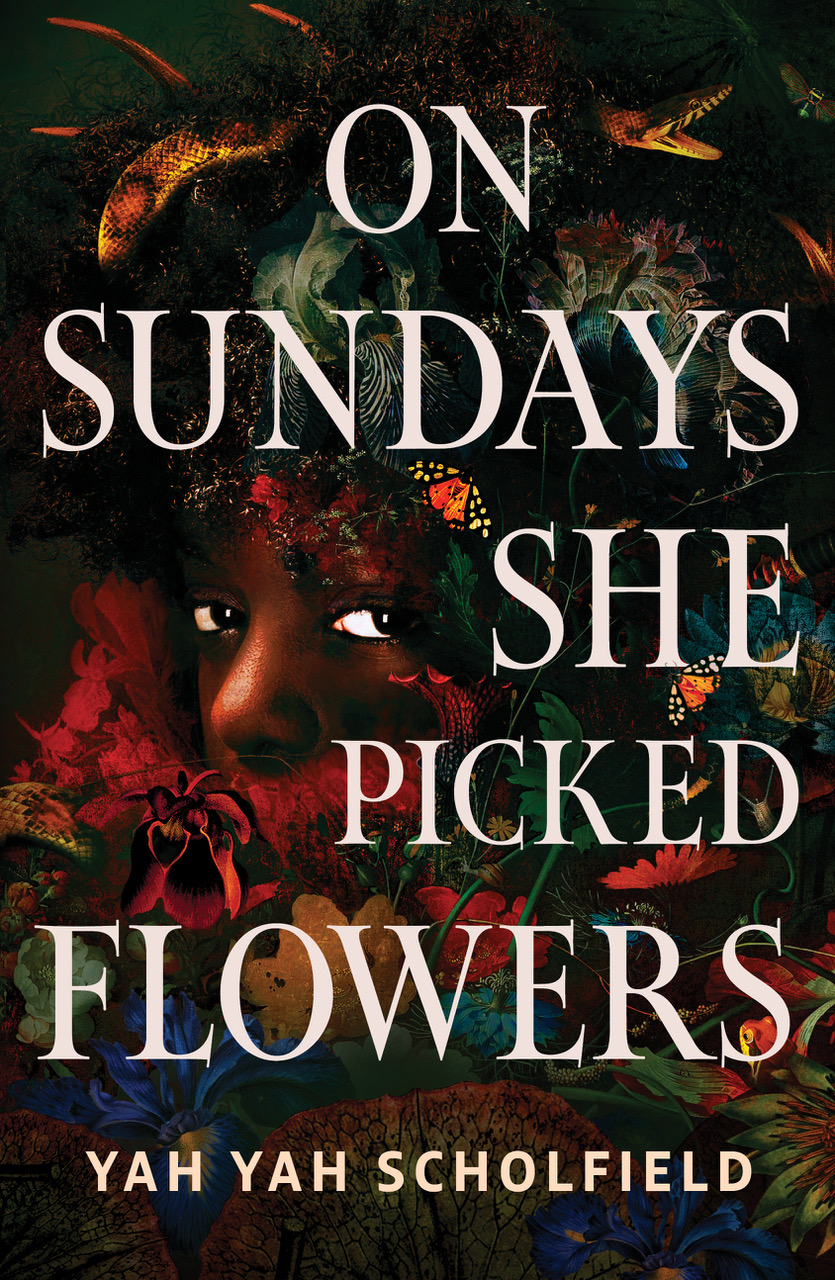
Yah Yah Scholfield writes horror-speculative fiction and their debut novel, On Sundays, She Picked Flowers, is a sinister and surreal Southern gothic where a woman escapes into the uncanny woods of southern Georgia. In today's feature, Scholfield explains how they came to discover the horror genre and the liberating feeling it offers, while considering the literary influences of Toni Morrison and Shirley Jackson.

The Writer's Life

Reading with... Yah Yah Scholfield

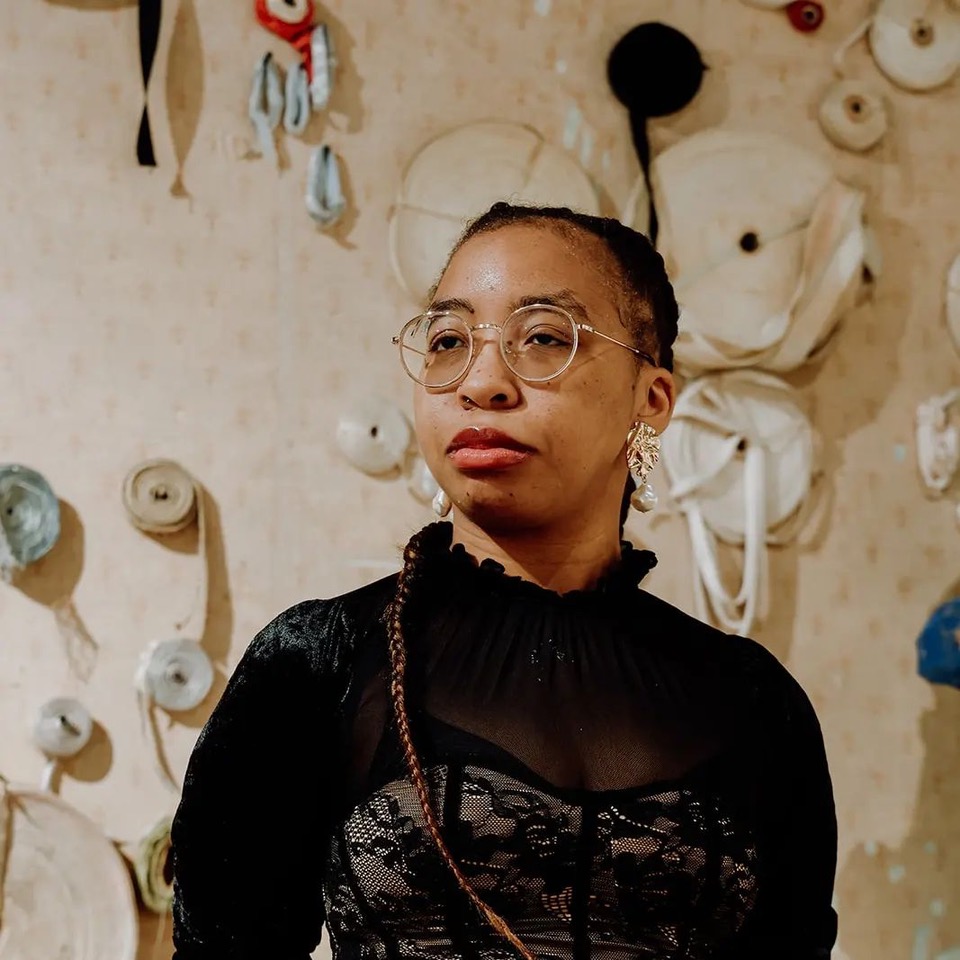
credit: Hunter Photography

Yah Yah Scholfield's work has been featured in a variety of horror-speculative fiction magazines and anthologies including Death in the Mouth, Peach Pit, Unspeakable Horror 3, and Fiyah Lit. Their short story "Strange Fruit" is an O. Henry Prize winner. Scholfield lives in Atlanta with their family and two cats. You can find their thoughts and personal essays on their Substack, Fluoresensitive. On Sundays, She Picked Flowers (Saga Press, January 27, 2026) is a sinister and surreal Southern gothic where a woman escapes into the uncanny woods of southern Georgia.

Handsell readers your book in 25 words or less:

A Black lesbian fighting generational trauma one violent, loving, and merciful act at a time.

On your nightstand now:

A scarf I purchased at a thrift store, the script books from A24's Moonlight by Barry Jenkins and Hereditary by Ari Aster, a coffee-table book about Black potters in South Carolina, my iPad, and a lamp that no longer works.

Favorite book when you were a child:

Flowers in the Attic by V.C. Andrews. I had no business reading that book, but I adored it--there's a certain beauty in reading a book that's too grown for you as a child, and I loved how angry and nauseous the entire Dollanganger series made me feel. For sure, Flowers in the Attic combined with Scary Stories to Tell in the Dark by Alvin Schwartz helped push my prepubescent love for the gothic and uncomfortable.

Your top five authors:

Toni Morrison, because she showed me that a Black woman's pen and voice were powerful and worthy. James Baldwin, because he showed me the complex beauty of being Black and gay and angry in America. Shirley Jackson, for filling me with so much dread and anxiety, the feeling of fear-excitement like a bruise you love to press. N.K. Jemisin, for absolutely blowing my mind with science fiction and fantasy that featured people who looked and acted like me. And last but certainly not least, Ursula K. Le Guin, whose mindfulness and thoughtfulness in writing inspires me daily.

Book you've faked reading:

To be really honest, I haven't faked reading anything. If I do not enjoy something, I will DNF it like that, no hesitation. I just can't fake the funk!
Book you're an evangelist for:

Beloved by Toni Morrison, and it's not even close. It is literary historical fiction, but it's also one of the best gothic horrors ever written. The ambience of this house haunted by slavery, by violence, by Sethe's choices, the way the characters' actions and behaviors all stem from this horrifically traumatic moment in history--and then the ghost! And then Beloved! Oh, I read the book once every two years, and it never gets old.

Book you've bought for the cover:

More Perfect by Temi Oh, and I'm so glad I did. An Orpheus and Eurydice retelling in a dystopian future reminiscent of a tech-obsessed present? Absolutely, yes!

Book you hid from your parents:

Uh-uh, y'all ain't getting me in trouble! Though, really, I didn't have to hide any of my books from my parents, because they were of the belief that as long as I was reading and not acting up, I was golden. A lot of, ahem, mature content slipped by them.

Book that changed your life:

This is a hard one. I don't think you can say one book or another changed your life, because there really are so many that move you at different points in your life. When I was a kid, it was books like Blue Tights by Rita Williams-Garcia and The Bluest Eye by Toni Morrison, The Skin I'm In by Sharon G. Flake--books that resounded with me and discussed topics that reflected aspects of my day-to-day reality. As an adult, I think the book that's really rattled and twisted me around is Parable of the Sower by Octavia Butler. Just that one iconic line "God is Change" really and deeply rearranged the terrain of my brain.

Favorite line from a book:

"No live organism can continue for long to exist sanely under conditions of absolute reality; even larks and katydids are supposed, by some, to dream. Hill House, not sane, stood by itself against its hills, holding darkness within; it had stood so for eighty years and might stand for eighty more. Within, walls continued upright, bricks met neatly, floors were firm, and doors were sensibly shut; silence lay steadily against the wood and stone of Hill House, and whatever walked there, walked alone." --Shirley Jackson, The Haunting of Hill House

Five books you'll never part with:

The Haunting of Hill House by Shirley Jackson, Beloved by Toni Morrison, The Bluest Eye by Toni Morrison, Just Above My Head by James Baldwin, and A Wizard of Earthsea by Ursula K. Le Guin.

Book you most want to read again for the first time:

Frankenstein by Mary Shelley. I read it for the first time ever in 2024, and though I knew it was a classic and very well written, I wasn't prepared for how hard it would hit me. It's a gorgeous, gorgeous gothic science-fiction novel, and I felt such love for the creature, and so much love for Victor. That line, "Alas, he is cold, he cannot answer me" picked me up, swung me around, and I just want to reexperience that ache all over again.

Why horror is your genre of choice:

I was a skittish and very anxious child, and I am a skittish and very anxious adult. I hate to claim this but fear does rule me--I suffer from pure OCD, my brain is a minefield of horrors and worries, and yet with horror, I am free. I am allowed to ruminate on the shadows in my bedroom and in alleys, I am permitted to scream at sudden noises. And, if I choose to be the monster, the thing that goes boo!, then the terror is my own special thing, and I can control it, one story at a time.


Book Candy
Rediscover

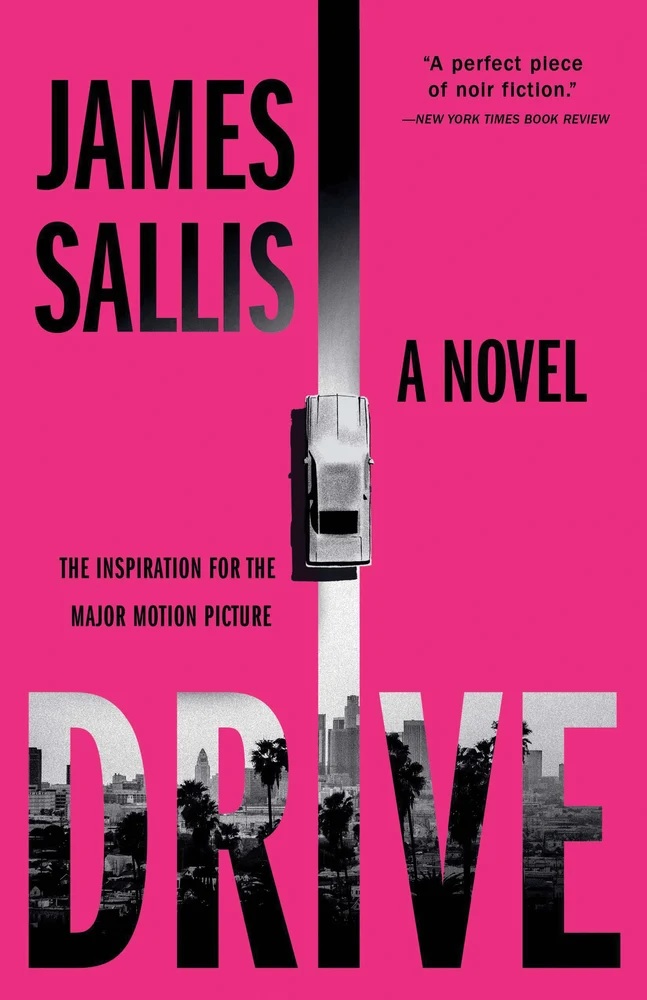
Author James Sallis, "who had the detectives and sheriffs of his stories investigate not merely crime but also the nature of memory and the possibility of self-knowledge," died January 27. The best known of his 18 novels was Drive (2005), about a Hollywood stunt driver who is also a wheelman for armed robberies. It was adapted into a 2011 movie, directed by Nicolas Winding Refn and starring Ryan Gosling, Carey Mulligan, and Bryan Cranston.

Rediscover

Rediscover: James Sallis

Author James Sallis, "who had the detectives and sheriffs of his stories investigate not merely crime but also the nature of memory and the possibility of self-knowledge," died January 27 at age 81, the New York Times reported. In addition to his 18 novels, he translated a novel from the French; wrote a biography; helped run a British sci-fi magazine; edited an anthology on jazz guitar; wrote criticism, poetry and short stories; and played banjo in a three-piece band.

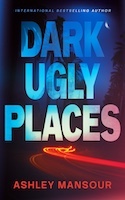
Sallis's best known novel was Drive (2005), about a Hollywood stunt driver who is also a wheelman for armed robberies. It was adapted into a 2011 movie, directed by Nicolas Winding Refn and starring Ryan Gosling, Carey Mulligan, and Bryan Cranston.
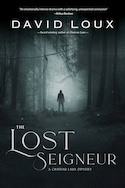
Sallis also wrote a six-novel series about New Orleans P.I. Lew Griffin, beginning with The Long-Legged Fly (1992) and ending with Ghost of a Flea (2001). "As time went on, Mr. Sallis's books grew more compact and more improvisational," the Times noted. "He allowed himself to be guided by random visions of his imagination, like a person standing by a cabin, woodland behind him, with the sound of a Jeep engine bouncing off a nearby body of water."

"You ask yourself: 'Who is this person?' " Sallis told Craig McDonald for his book of interviews, Rogue Males: Conversations & Confrontations About the Writing Life (2009). "Who is this person in the vehicle coming up around the water? Why is that person coming up there? Have they met before?' As you start asking yourself questions, the story starts forming."

McDonald posted on Facebook that Sallis "was a cherished acquaintance, and profound literary inspiration. His Lew Griffin series was the inspiration for my Hector Lassiter series.... Scholar, literary translator, teacher, novelist, nonfiction writer, singer-songwriter, and musician, I once described James Sallis, the novelist, as embodying his own genre, entirely unto himself. He was also a one-of-a-kind outstanding human being."

The Poisoned Pen Bookstore, Scottsdale, Ariz., which published some of Sallis's early novels through its Poisoned Pen Press, noted that Sallis "was a close friend and mentor to me (Patrick) for nearly 30 years. It's heartbreaking."

Sallis's other books include the John Turner series; Renderings (1995); Death Will Have Your Eyes (1997); The Killer Is Dying (2011); Others of My Kind (2013); Willnot (2016); and Sarah Jane (2019). His most recent book, World's Edge: A Mosaic Novel, is scheduled to be released on February 10 by Soho Press.

In a tribute, Soho Press wrote: "In many ways Jim was the platonic ideal of what a writer can be, though he probably would not like it put thus. As an artist the work was everything to Jim, and he worked without boundaries or careerism. Perhaps best known for his existentialist crime fiction and neo-noirs like Drive... Jim was also a poet, musicologist, literary historian, critic, editor, and teacher....

"As a reader and appreciator of culture, Jim was as curious and uninhibited as he was as a writer. It was a joy to talk about art in all forms with him, but his grand view of literature matched his personal approach to craft. To Jim it didn't matter where or how good work came into existence, or how it was shelved.... We mourn his passing deeply but find joy in the notion that his work will be read for as long as there are books."

Kids Buzz
Read what authors have to say about their upcoming books...

You and I Are Stars and Night

by Kate Hosford, illus. Richard Jones

KidsBuzz: Beach Lane Books: You and I Are Stars and Night by Kate Hosford, illus. by Richard Jones

Dear Reader,

As children contend with an increasing number of challenges in our uncertain world, I've become even more interested in writing about the bonds of steadfast love.

For this book, I imagined a story where the wind calls out to a grown-up and child, prompting them to go on a magical nighttime adventure. I used rhyme to heighten the sense of magic and lyricism, and metaphor to reaffirm the grown-up's unbreakable bond with the child: you and I are salt and sea/ boat and sail/ light and moon. Lastly, I wanted the return home to be not just the end of the story, but the beginning of a bigger adventure as the two of them drift into dreamland on an even bigger boat. I hope that children will disappear into Richard Jones' illustrated world, filled with hidden surprises which they will continue to discover upon repeated readings.

"The epitome of a bedtime book." --The Horn Book

"Dreamy… an anchoring bedtime send-off." --Publishers Weekly

--Kate Hosford

Buy Now

Publisher: Beach Lane Books • Ages 4-8 • List Price: $19.99 HC • ISBN: 9781665940382 • Pub Date: February 3, 2026

Powered by: Xtenit