Latest News
Get Lit at the Beach: A Gathering for Readers, April 17 - 19, 2026
WHAT TO READ NEXT: REVIEWS OF GREAT BOOKS

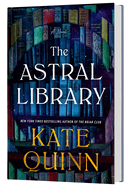
Novelist Kate Quinn presents an irresistible premise in her new literary fantasy, The Astral Library: there's an archive where bibliophiles can enter their favorite stories. Her characters leap into classics such as Jane Eyre and The Adventures of Sherlock Holmes, because the books must be in public domain--for ethical reasons. So that begged the question: Given the chance, where would I leap?

My first thought was Moby-Dick, adventure on the high seas! But then again, I'm certainly not rugged enough to last very long on the Pequod. Another idea was The Age of Innocence, but I'm much too uncouth to rub elbows with Newland Archer and the countess Ellen Olenska. At last, it struck me like a croquet mallet. Alice's Adventures in Wonderland might be the only setting in the public domain where I could imagine spending the day, wandering aimlessly, nibbling on suspicious snacks, and pondering life's essential questions, like, Why is a raven like a writing desk?

--Dave Wheeler, senior editor, Shelf Awareness
FEATURED TITLES
Cover

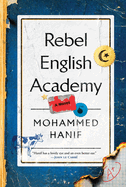
Rebel English Academy

Mohammed Hanif

Dangerous love and subversive politics collide in this cleverly plotted, darkly satirical, and wildly entertaining historical drama set in late 1970s Pakistan.
Cover

Rebel English Academy

Mohammed Hanif

Grove Press | $28 | 9780802165985

Elaborate conspiracy theories abound in Mohammed Hanif's darkly satirical Rebel English Academy, a high-stakes historical drama of "dangerous love" and subversive politics set in Pakistan.

Hanif's cleverly plotted fourth novel opens in 1979, at the inauspicious moment when Pakistan's former Prime Minister Zulfikar Ali Bhutto is executed on the orders of the military. The country erupts in protests and celebrations, depending on political affiliations. When a distressing trend emerges of people lighting themselves on fire to protest Bhutto's hanging, Captain Gul of the military's Field Intelligence Unit is dispatched to OK Town to investigate. A mustached heartthrob with "unruly" sideburns, he is captivated by Sabiha, a young woman on the run after her husband's herbal medicine clinic burns down under questionable circumstances. Sabiha, a champion athlete and daughter of imprisoned Bhutto loyalists, takes refuge at an English-language academy run by Baghi, a teacher and former revolutionary.

This is a wildly entertaining drama brimming with opportunists. Hanif's authority figures are only superficially interested in the travails of their constituents and only if it serves their own interests. The military execution of Bhutto, a devastating blow to democracy forever etched in Pakistan's psyche, is a provocative backdrop for Hanif (Red Birds; A Case of Exploding Mangoes) to explore power dynamics across society. Sabiha and Baghi are cogs in a system not designed for the ordinary person to succeed, while Captain Gul represents its overzealous core. Even as the authorities close in on their prey, Hanif--ever the satirist--recruits small-town heroes to administer their own absurdist version of justice in a finale superbly fitting for such an unsettling period in Pakistan's history. --Shahina Piyarali

Cover

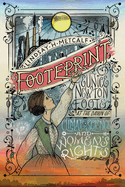
Footeprint: Eunice Newton Foote at the Dawn of Climate Science and Women's Rights

Lindsay H. Metcalf

A delightful YA novel-in-verse corrects the history books on climate science by spotlighting the incredible life of scientist and women's rights activist Eunice Newton Foote.
Cover

Footeprint: Eunice Newton Foote at the Dawn of Climate Science and Women's Rights

Lindsay H. Metcalf

Charlesbridge Teen | $18.99 | 9781623546335

Lindsay Metcalf (Tomatoes on Trial) draws climate science pioneer Eunice Newton Foote out of the shadows of history in the expressive, evocative fictionalized novel-in-verse, Footeprint. Through melodic third-person poetry, Metcalf describes both the scientific and women's rights advancements this little-known American inventor achieved. Metcalf based her work of fiction on historical fact, using minimal speculation and including images of various individuals noted in the book as well as reproductions of historical documents.

Eunice Newton, a descendent of Isaac Newton, is born in 1819 into a family that nurtures her curiosity and independence. Her parents send Eunice to Troy Female Seminary, the only school "in New York/ with a mission to teach science to girls." When Eunice marries lawyer Elisha Foote, she goes to work inventing. But "because of the law... Eunice decides/ her invention's best chance/ rests in Elisha's hands." Elisha "becomes the face" of Eunice's first patented invention--Regulating the Heat of Stoves--while "Eunice longs for the day/ when her face will be enough." Eventually, the work of the women's suffrage movement enables Eunice to publish her groundbreaking discovery of carbon dioxide's effects on the atmosphere under her own name in 1857. However, John Tyndale "discovered the greenhouse effect" in 1859, meaning Eunice was forgotten until 2010, when a "retired petroleum geologist" found Eunice's work and set the record straight.

Metcalf's excellent research and her artistic approach to presenting the information create a mesmerizing reading experience. The author's clever use of figurative language emphasizes the struggles Eunice endures due to gender bias--"Like the layers of her dress,/ [Eunice] must peel away misbeliefs/ one breakthrough at a time"--and her verse (often flowing into concrete poetry) displays Eunice Newton Foote as the breathtaking work of art that she is. --Jen Forbus, freelancer

Poisoned Pen Press: Impostor (Alexander Gregory Thrillers #1) by LJ Ross
Cover

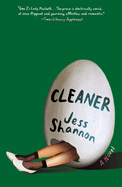
Cleaner

Jess Shannon

This debut novel is a dark, strange, but ultimately entertaining story of a woman's search for meaning and art through cleaning.
Cover

Cleaner

Jess Shannon

Scribner | $26 | 9781668223086

Jess Shannon's hypnotic, weird, and dark debut novel, Cleaner, charts the awkward journey of an unnamed narrator as she attempts to discover her artistic self through cleaning.

Overeducated, jobless, and "with an ungodly amount of student debt," the novel's 20-something protagonist moves back in with her laconic parents and discovers she has a passion for cleaning. This leads to a janitorial job at an art gallery, where she meets a cocaine-sniffing artist, Isabella, in the bathroom. When the two are discovered having sex in a stall, the narrator is fired. Obsessed with Isabella, who lives with her wealthy boyfriend, the narrator wheedles her way into Isabella's life, first as a cleaner, then as a lover to both Isabella and her boyfriend Paul. The throuple doesn't last long, however, as one day Isabella disappears. Without a ripple, the narrator slides into Isabella's life and attempts to make it her own with results that are decidedly mixed.

Written in one unbroken stream-of-consciousness paragraph, Cleaner is short on plot but replete with reflections on what it means to be an artist and the vague line between self-indulgence and supporting one's art. The narrator often makes disastrous and selfish decisions, but her sardonic sense of humor and ability to see the world as an evolving canvas make her an interesting character with whom to spend time. After envisioning a fried egg as a bleeding "carcass," she reflects, "No else at the table saw what I saw. I supposed this to be the curse of the artist." Provocative, unusual, and striking, Cleaner marks Shannon as a writer to watch. --Debra Ginsberg, author and freelance editor

Cover

The Astral Library

Kate Quinn

Kate Quinn's wry, gripping The Astral Library takes a flying leap into a magical library, complete with book portals, literary ghosts, a sinister foe, and--of course--dragons.
Cover

The Astral Library

Kate Quinn

Morrow | $30 | 9780063479753

With her gripping novel The Astral Library, historical novelist Kate Quinn (The Briar Club) takes a flying leap into literary fantasy, creating a world where desperate bibliophiles can find literal sanctuary--and, occasionally, dragons--in the pages of a book.

Tough-talking former foster kid Alix Watson is an expert at escaping into her favorite stories. But when her life falls apart on a single terrible day, she steps through a door at the Boston Public Library and finds herself in the Astral Library, which offers book lovers the chance to actually live inside the volumes. Alix, eager to learn, volunteers to assist the librarian as a page. But when the library comes under sinister attack, Alix must marshal her forces--including handsome costumier Beau and a ragtag band of fellow readers--to protect the library and its patrons.

Quinn's narrative combines a delightful collection of stories and settings (Adventures of Huckleberry Finn, The Great Gatsby, Jane Eyre, The Adventures of Sherlock Holmes) with wry asides about technology via a temperamental tablet that changes its own password and a passel of library ghosts still struggling to conquer their TBR lists. Both the novel's villains and its eventual ending skewer modern bureaucracy while asking important questions about the role of libraries in a free society. And, as in all good stories that go off the map, there are dragons.

Perceptive, compassionate, and bursting with literary catnip, The Astral Library is a highly entertaining magical caper and a moving tribute to the power of a good story. --Katie Noah Gibson, blogger at Cakes, Tea and Dreams

BOOK REVIEWS
Cover
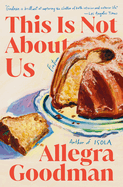
This Is Not About Us by Allegra Goodman is the story of the Rubinstein family and their myriad resentments, all of which come to the fore after a death and an argument over homemade apple cake.
Cover

This Is Not About Us

Allegra Goodman

The Dial Press | $29 | 9780593447840

Readers under the impression that a dessert couldn't possibly start a feud will see their error when they read Allegra Goodman's expansive, openhearted novel This Is Not About Us, a family saga that, like the apple cake that starts it all, is deceptively light and fluffy but more substantial than may at first appear. The tragedy that sets the plot in motion is anything but cheery. Jeanne, at 74 the youngest of three Rubinstein sisters, is dying of lung cancer at her Brookline, Mass., Tudor home. Over several days, family members visit, including Helen and Sylvia, Jeanne's older sisters. When Sylvia brings over a homemade apple cake, Helen is furious, as it's her recipe. Helen is also deeply religious, unlike atheist Jeanne, on whose behalf Sylvia fumes when Helen recites the Kaddish, a Jewish prayer. One can see where this is headed: Jeanne dies in the first chapter, but resentments linger for the next 300 pages.

What makes this work so entertaining is Goodman's breezy prose and the colorful family members she has invented. There's Sylvia's lawyer son, Richard, father of two young daughters, divorced from Debra, and dating a woman half his age. Jeanne's adult son Dan and his wife are parents to Phoebe, an eco-warrior student who notices during a visit home that "all composting had ceased the minute she had gone to college" but now wants to ditch university and rededicate herself to the violin. More follows, including a daughter dreading her bat mitzvah and painful memories from childhood seders. This is another toothsome creation from a reliably entertaining writer. --Michael Magras, freelance book reviewer

Cover
This funny, perceptive Swedish novel stars an irascible octogenarian woman and a grieving young man searching for connection.
Cover

The Secret of Snow

Tina Harnesk, trans. by Alice Menzies

Atria | $28 | 9781668028230

An irascible octogenarian woman and a young man with questions in his past face endings and beginnings in The Secret of Snow by Tina Harnesk, a novelist of Sámi descent, and translated from the Swedish by Alice Menzies. This funny, perceptive contemporary dramedy won the reader-selected Best Book of the Year in Sweden in 2023.

Máriddja Rijá, 80-something years old and preoccupied with goats, leads a reclusive life near the small northern village of Guovddo with her husband, a Sámi man named Biera. Máriddja reacts to receiving a terminal cancer diagnosis by firmly and (mostly) politely refusing help, going so far as to burn the mail and throw away her cell phone so her husband won't find out she is dying, because "this crap was between Máriddja and her creator." Máriddja and Biera have no one but each other, so she hatches a desperate scheme to find someone who will look after Biera. Her co-conspirator comes in the form of Siri, the virtual assistant she believes is a human operator speaking through Biera's iPhone.

Meanwhile Kaj, a young doctor struggling with grief after the death of his mother, has just moved to Guovddo. His discovery of a box of Sámi-crafted items from his mother's estate reignites lifelong questions about his childhood and leads to an unexpected breakthrough.

Harnesk's quiet wit and lovable characters make this exploration of community and cultural connection sing with joy and meaning. Fans of Shelby Van Pelt's Remarkably Bright Creatures will find comfortingly familiar bones in this story of a family fractured and healed. --Jaclyn Fulwood, blogger at Infinite Reads

Cover
A man who should have died discovers a hidden world of beauty and danger in a small Catskills community in this debut novel that pays equal love and attention to its cryptid and human characters.
Cover

Strange Animals

Jarod K. Anderson

Ballantine | $29 | 9798217092468

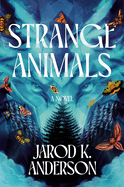
A brush with death leads a man to a new life and a new awareness of a beautiful, dangerous world hidden all around in Strange Animals, the first novel by poet Jarod K. Anderson (Something in the Woods Loves You).

Green twists his ankle and falls off the curb, then sees a bus coming toward him--then he's standing on the sidewalk again. Afterward, he feels called to the Catskills. During his first night at the campgrounds, he wakes before dawn to a translucent deer being chased by a horned, wolf-like creature that leaps onto the hood of his car and speaks to him telepathically. Green's neighbor, Valentina, tells him that that he is a cryptonaturalist, or someone "who studies hidden nature," and he accepts a position as her apprentice. There's been a series of possibly natural but unlikely deaths in the area, so understanding cryptids quickly becomes not only an academic matter but also vital to protecting the community Green is coming to love.

Anderson, creator of The CryptoNaturalist podcast, presents the vibrant, wonderous creatures that one would expect and depicts the quirks of humanity with equal love and attention. From the moment that Green asks the gas station attendants for directions to a campground, the residents of this little corner of the Catskills come across as a charming collection of misfits, ready to welcome the sort of person who feels called to them. The potentially world-altering threat of one of these cryptids is a bit too perilous to call Strange Animals a cozy fantasy, but it offers true heart and found family in a sometimes incomprehensible world. --Kristen Allen-Vogel, information services librarian at Dayton Metro Library

Cover
Jasmin Kirkbride's gorgeous debut novel, The Forest on the Edge of Time, follows two sisters cast into the future and ancient Greece to attempt to avert climate change.
Cover

The Forest on the Edge of Time

Jasmin Kirkbride

Tor Books | $29.99 | 9781250376831

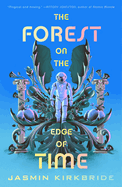
Jasmin Kirkbride's debut novel, The Forest on the Edge of Time, is an urgent composition of climate crisis and immersive time travel. In a postapocalyptic future, Hazel Brandt forms a fractious alliance with an irritable artificial intelligence and a flock of nonverbal robots whom she christens "the Tinys." Her goal is to communicate through an interdimensional dreamscape with her sister, Echo, who has traveled to ancient Greece to seed new philosophical ideas in an attempt to avert climate change.

Kirkbride tantalizes readers with questions about the hidden trauma that fuels the sisters in their high-stakes endeavor. Her novel is told from three perspectives: Hazel at the mysterious Station C in the far future, Echo in the past, and a young girl named Anna in the present. The arcs of these narratives come together in an incredibly satisfying way, with a few astonishing "aha!" moments.

The time travelers arrive with a kind of amnesia. Their memories return in bits and flashes, feeding into the mechanics of the time travel for a fascinating and thoroughly imagined dynamic. Kirkbride leaves a trail of clues that leads readers back to the sisters' shared trauma and gradually doles out information about the curious relationships between the characters in different timelines. It ratchets up the tension to irresistible, compulsive-read intensity.

Kirkbride's gorgeous writing weaves heavy topics with glimmers of hope, creating a delicate balance that nods to her PhD thesis on radical hope in climate fiction. The Forest on the Edge of Time melds sci-fi and literary traditions and is surprising, thoughtful, and artfully crafted. --Carol Caley, writer

Cover
This witty workplace romance pairs a sex-toy engineer with a software developer in a steamy, no-strings-attached arrangement that becomes something more.
Cover

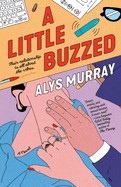
A Little Buzzed

Alys Murray

Berkley | $19 | 9780593819715

Historical romance's "sex deal" trope, in which one person offers another intimate "lessons" to benefit both parties, might seem anachronistic in a 21st century where less economic value is placed on virginity. However, Alys Murray (Sweet Pea Summer) updates this convention with wild success in A Little Buzzed.

Scout Porter is the brilliant head engineer at BuzzCorp, the sex toy startup where she landed after her last job--and relationship--went awry. Riddled with self-doubt from that experience and a lifelong lack of support from her ghastly parents, Scout is mortified when her coworkers learn that she is a virgin. A solution arrives in the form of Hudson Bailey, a software developer for the company's cutting-edge forthcoming product who has no personal experience with sex toys to draw on while coding the app.

As sparks fly across the office, they enter an arrangement: Scout will educate Hudson on BuzzCorp's product catalog, and Hudson will dispatch with her virginity in a no-strings-attached romp that will end when Hudson's contract expires and the product launches. But as their friendship grows into something more, they both realize that to grab this chance at love and hope for the future, they'll have to release their tightly held, self-limiting beliefs based on past hurts--including the betrayal responsible for Hudson's people-pleasing ways and Scout's desperation to prove her professional and personal worth. With plenty of steam and even more heart, this workplace romance brims with charm, wit, and reminders that love doesn't have to be earned. --Kristen Coates, editor and freelance reviewer

Cover
In Mark Haddon's moving, collage-like memoir, significant moments in the author's life add up to a wondrous whole and provocative worldview.
Cover

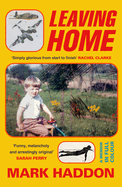
Leaving Home: A Memoir in Full Colour

Mark Haddon

Doubleday | $35 | 9780385551892

Mark Haddon (The Curious Incident of the Dog in the Night-Time; Dogs and Monsters) was always leaving home. That is the impression he gives readers in Leaving Home, his beautifully written, collage-like memoir of moments that shaped him as a person and as a writer.

Leaving Home consists of 87 nonlinear sections varying in length with family photos and drawings by the author--even footnotes. He speculates about what others call nostalgia, the nature of "longing, this echo of some remembered comfort." The delight of the memoir comes from his grappling with answers: "Is it that, as children, we live inside a bubble of focused attention which gives everything inside the bubble a memorable fierceness?"

Luckily, Haddon appears never to have lost his bubble of focused attention. He supplies uncanny details that place readers beside him at Brighton's Palace Pier, with its sounds, smells, and sights. He writes of the adults and children he worked with, who had a variety of disabilities both mental and physical, and their impact on him: "Our humanity is not an individual quality that can be measured and traded and celebrated and ignored, but an activity, a thing human beings do together."

Haddon's bracing, raw honesty reveals his struggle with mental illness, love for his wife and two children, views on spirituality, and the life-giving force of his writing. He notes for one of his writing groups, "As writers we... can simply lay one thing beside another and let readers do the rest." Haddon's recollections create a moving cumulative effect; he gives readers the space to savor his epiphanies and arrive at their own. --Jennifer M. Brown

Cover
Shelley Puhak uncovers the truth behind the scurrilous legend of Elizabeth Bathory, whose sole crime was being a powerful political woman during a time of religious strife and persecution.
Cover

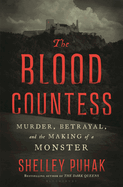
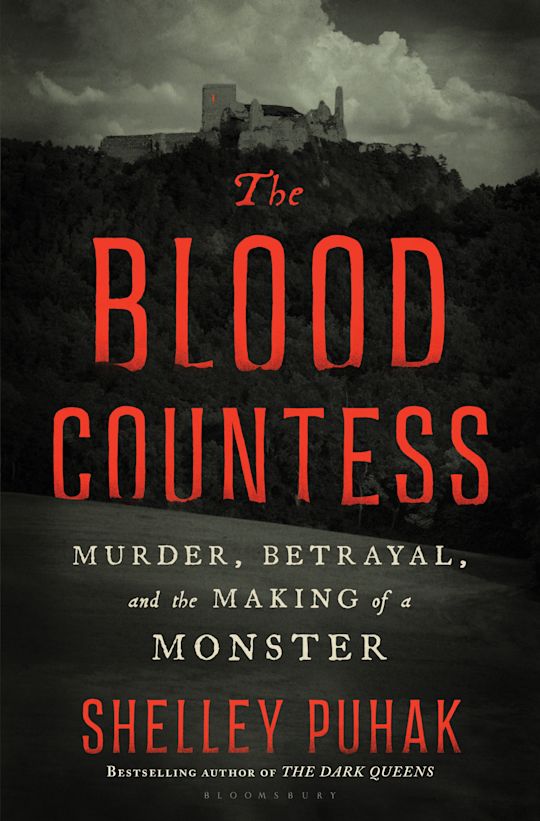
The Blood Countess: Murder, Betrayal, and the Making of a Monster

Shelley Puhak

Bloomsbury | $32.99 | 9781639732159

Separating myth from misogyny, The Blood Countess by Shelley Puhak (The Dark Queens) confronts the nefarious legend of a 16th-century noblewoman. Countess Elizabeth Bathory of Hungary is an object of dark fascination, a female serial killer allegedly responsible for murdering more than 600 girls in her Hungarian castle. This legend even earned her an entry in The Guiness Book of World Records as the "most prolific female murderer." But, as Puhak persuasively argues in this thrilling historical cold case, "nearly none of it is true."

Rather than catalog horrors, Puhak deftly examines the political conflicts between Hungary and Transylvania in the early 1600s, the religious wars that pitted Calvinists, Catholics, and Lutherans against each other, and the reigning Habsburg dynasty that targeted a widow for her wealth, influence, and land holdings. Using new evidence, Puhak dismantles the legend of Bathory as a vampiric ghoul who bathed in the blood of her victims to attain immortality. The countess was instead the target of a whisper campaign and "well-worn playbook" to impugn her moral character--all in the service of taking possession of her estate and removing her not insignificant influence in royal circles.

Commenting on the numerous portrayals of Bathory throughout centuries of popular culture, Puhak suggests that "our legends are all too often platforms for another era's extremists." The Blood Countess delivers a sharply argued, thoroughly researched feminist takedown of a libelous legend. --Peggy Kurkowski, book reviewer and copywriter in Denver

Cover
Charles Scribner III's skill as a storyteller infuses these charming essays on publishing, art history, and classical music.
Cover

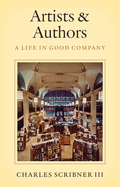
Artists & Authors: A Life in Good Company

Charles Scribner III

Lyons Press | $29.95 | 9781493093632

The charming collection Artists & Authors organizes 18 essays into a cohesive whole, with Charles Scribner III (Sacred Muse; Scribners) covering the gamut of publishing tales, art history musings (plus a heist!), and reflections on classical music.

Readers will savor the stories of Scribner's grandfather's relationship with Ernest Hemingway, who wrote that the man knew "a good deal about horses, as much as a man probably should be allowed to know about the publishing business, and surprisingly, something about books." Scribner also considers the early works of F. Scott Fitzgerald that he believes contributed to the artistry and longevity of The Great Gatsby. Fitzgerald even offered writing advice in a letter to his daughter, Scottie: "If you have anything to say... you have got to feel it so desperately that you will find some way to say it that nobody has ever found before."

Additionally, Scribner describes his admiration for and the expertise of Caravaggio, Peter Paul Rubens, Gian Lorenzo Bernini, and Michelangelo. In "Rubens Meets Miami Vice," he relates his entertaining role as a witness in a trial involving the 1985 heist of two Rubens paintings. He ventures into "The Vocal Arts," making Franz Joseph Haydn, Antonio Vivaldi, Johann Sebastian Bach, and Wolfgang Amadeus Mozart approachable. The highlight is a chapter devoted to Dame Elisabeth Schwarzkopf (based on his interviews for a piece for Opera News); she is both "the greatest singer of Mozart for the second half of the past century" and an old friend whom he meets near Hemingway's old Austrian stomping grounds. Their conversation is a veritable master class in singing and playing piano.

Altogether, these pieces impart Scribner's warmth, knowledge, and lifelong passion as an invitation to share his enthusiasm. --Jennifer M. Brown

Cover
In this daring, format-bending picture book, an older sister learns to navigate the frustrating dynamics of her relationship with her rambunctious siblings.
Cover

The Great Escape

Deborah Marcero

Putnam Books for Young Readers | $19.99 | 9780593857953

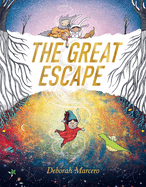
An older sister's attempts to flee her rowdy siblings lead to a grand family outing in The Great Escape, an imaginative, heartwarming picture book by author/illustrator Deborah Marcero (In a Jar).

Evie, a white girl with huge glasses and a wizard's hat, believes "in all things magic." Still, no spell can quell the "wild tornado" of her intrusive younger siblings, Wolfie, Bunnie, and Teddy (all wearing onesies that match their names). When Evie races outside, her siblings follow. She casts spells, then drops through the snow, falling "until upside down became right side up... and falling became flying." The siblings follow Evie into a painterly, magical realm of ocean and cosmos. The shadow of a large creature prompts Evie's protective instincts, but Teddy observes that it belongs to a mother whale whose calf is stuck in a net of constellations. Evie and siblings work together to untie and untangle, then grab rides home from the cetaceans.

Marcero's striking illustrations, playful use of form, and rhythmically onomatopoeic text elevate this picture book. The combination of watercolor paints and archival ink pens, interwoven with images of galaxies from the James Webb Space Telescope, creates a textured tapestry that blends worlds above and below. Graphic novel-style panels and vignettes in muted colors cleverly reinforce the ordinary; a drastic shift to an unrestrained palette along with a new reading experience (the reader must turn the book upside down and around) captures the extraordinary. Lastly, Marcero's lyrical yet lively text, with sound effects, particularly from the noisy siblings ("Howl! Growl! Eieioo!"), is sure to make for a stellar read-aloud. --Cristina Iannarino, children's book buyer, Books on the Square, Providence, RI.

Cover
Three middle schoolers forge an inspiring bond when they become stranded together during Hurricane Harvey in this touching novel about forgiveness, friendship, and resilience.
Cover

Some of Us Are Brave

Saadia Faruqi

Quill Tree Books | $19.99 | 9780063389533

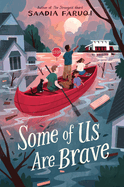
Three stranded middle schoolers brave a flooding Houston during Hurricane Harvey in Some of Us Are Brave by Saadia Faruqi (A Place at the Table), a stirring middle-grade portrayal of newfound friendship.

It's August 2017. Twelve-year-old Pakistani American Yasir wants to play soccer professionally so he can pull himself and his mom out of poverty. First step: become captain of his school team. But current captain, 13-year-old white American Cody, won't back down--not based on his "Go back to where you came from" slurs at summer camp. Cody learned this "be mean to everyone so you can look tough" tactic from his dad, who beats Cody and locks him in the shed overnight. Thirteen-year-old South Asian American Mona feels stuck; her parents travel constantly, leaving her responsible for her seven-year-old brother, Omar. Art frees her, particularly drawing mythological floods. When Hurricane Harvey inundates Houston, Yasir, Cody, Mona, Omar, and two strays (a Jack Russell in a BabyBjörn and an intrepid cat) are all forced together into a canoe as they seek shelter.

Set against the murky, thigh-high floodwater of Pakistani American Faruqi's own devastated hometown, the children must tackle long-held fears born of trauma that have now become imminent: of drowning, of the dark, of being alone and adrift. Cody gradually sheds his dad's racist vitriol as he supports the remarkably forgiving Yasir and Mona who, in turn, repeat the Prophet Noah's prayer from the Quran, "Anni Maghloobun Fantasir," as a mantra ("I am overcome, so come to my help"). Faruqi traces the children's uncertain odyssey and its direct aftermath with a grace and tenderness that is as radiant as her characters' burgeoning friendships. --Samantha Zaboski, freelance editor and reviewer

Cover
This endearingly comedic and heartwarming middle-grade graphic novel reminds readers it's okay to not be perfect--and even more okay to cheer on friends.
Cover

Serendipity

Gabbie Benda

Holiday House | $14.99 | 9780823462902

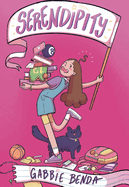
The luckiest girl in town must reverse a "curse" that has her messing up all her extracurriculars--and her best friendship--in Serendipity, a delightfully uplifting and funny middle-grade graphic novel by author/illustrator Gabbie Benda (A Family of Readers).

Serendipity, a peachy-skinned middle schooler, does it all. This month, she has the big theater production, a championship basketball game, and the student government debate (she's confident she'll be re-elected president). After winning free tickets to the carnival (lucky seventh caller!), she accidentally breaks a fortune teller machine, which then proclaims, "Bad luck will infect your soul. Eternally." Now, Serendipity is getting Bs, forgetting her lines, and tripping on the basketball court. Determined not to let anyone down, she tries everything to regain her luck (even meeting the school mystic in the janitor's closet). Her best friend, Basil, suggests Serendipity simply has too much on her plate, but being lucky is Serendipity's thing and she refuses to disappoint anyone.

Serendipity is charming in its buoyant realism. The pressure Serendipity feels to be perfect is exacerbated by some ("Just remember, Serendipity, that we're all counting on you!") and balanced by others ("Sometimes... an assist is just as good as making the basket yourself"). Benda also highlights the experience of Serendipity's friends, ultimately depicting the importance of cooperating with and uplifting others. A pink-centric palette brightens the visual tone, thick broken outlines create a sense of movement, and a feeling of constant activity is developed by text and characters breaking out of their panels. Expressive characters (Basil's deadpan deliveries, Serendipity's dramatics) and applause-worthy visual comedy bring wholehearted humor to an absolute gem of a debut. --Samantha Zaboski, freelance editor and reviewer

Cover
Sarabeth's Garage is an entertaining and inspiring picture book about a strong, independent child who is not afraid to pursue her dreams--spark plugs, carburetors, and all.
Cover

Sarabeth's Garage

Melanie Florence, illus. by Nadia Alam

Tundra Books | $18.99 | 9781774885956

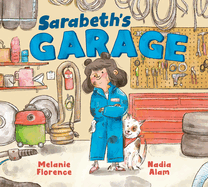
The driving force behind the upbeat, inspiring Sarabeth's Garage is a self-aware young car aficionado who's not afraid to pursue her dreams.

Sarabeth loves engines that "roar... like lions" and "purr... like kittens." She loves sports cars, "sleek and fast like cheetahs," and "boxy SUVs" that move more like elephants. Tires, motors, carburetors, and engines--Sarabeth loves them all. On Saturdays, she works with her dad in his garage, where they eat lunches that her mother packs and talk about all the cars that come in to be fixed. Sarabeth's grandmother grumbles, "In my day, little girls played with dolls, not cars and trucks." Sarabeth's feelings are hurt, but she loves every second she spends in her dad's garage. One evening, when her grandmother's car "grumble[s] and groan[s] like an unhappy walrus," Sarabeth checks under the hood. She takes a wrench, makes a "careful adjustment," and "just like that, the engine roar[s] like a lion," then "purr[s] like a kitten." Sarabeth's grandmother apologizes, explaining how in her day, "girls didn't know how to fix cars." Sarabeth forgives her: "In my day, girls can do anything they want."

Melanie Florence's Sarabeth is an independent spirit who knows what she wants and follows through. She's strong, opinionated, and puts her passion and knowledge to good use, changing the mind of her equally opinionated grandma along the way. Nadia Alam's dark pencil outlines use photo-edited color to fill the pages with hues as lively as Sarabeth herself, which brings the girl's imaginative impressions to life. Sarabeth's Garage is a fine spin on evading societal constrictions at any age. --Lynn Becker, reviewer, blogger, and children's book author

The Writer's Life

In The Blood Countess: Murder, Betrayal, and the Making of a Monster, Shelley Puhak delves into the lurid legend of Elizabeth Bathory, searching for a truth that has been buried under myth and misogyny for centuries. Here Puhak discusses the power of whisper campaigns, conspiracy theories, and the troubling ways ordinary people can be manipulated into believing the worst about their neighbors.

The Writer's Life

Shelley Puhak: Whispered Horrors
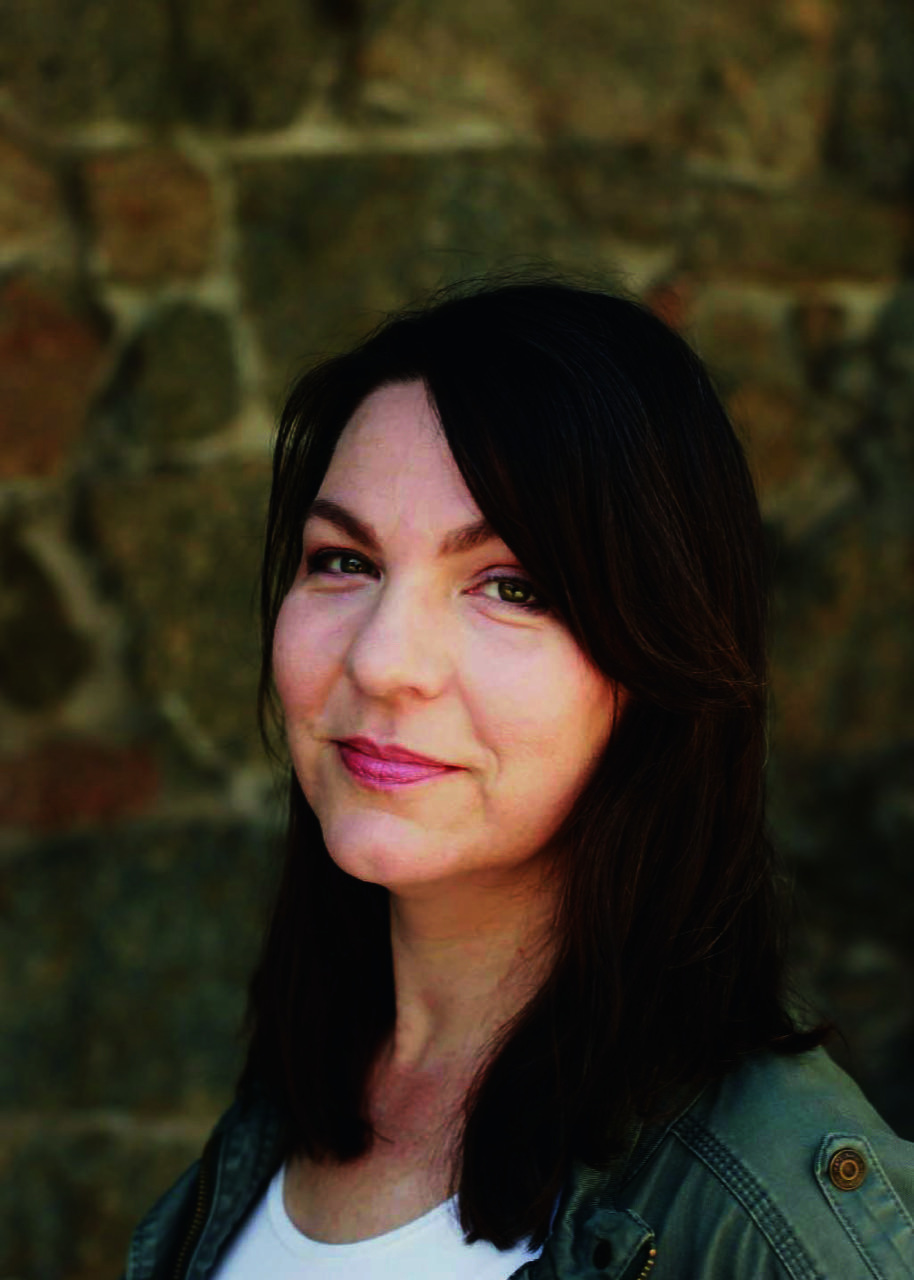
Shelley Puhak
(photo: P.B. Miles)

Shelley Puhak is the critically acclaimed author of The Dark Queens: The Bloody Rivalry That Forged the Medieval World. Her essays have been included in The Best American Travel Writing and selected as Notables in four consecutive editions of The Best American Essays. She is the author of two books of poetry, including Guinevere in Baltimore, winner of the Anthony Hecht Prize. The Blood Countess: Murder, Betrayal, and the Making of a Monster (Bloomsbury; reviewed in this issue) separates the myth and misogyny that fuels dark fascination surrounding one woman from the 16th century.

How and why did you come to Countess Elizabeth Bathory as the subject of your next book? What inspired you?

I first encountered the canonical Bathory legend in my 20s, while exploring the many castles of Slovakia. When, many years later, I learned that more Central European scholars and historians were questioning that legend, I took note. I've always been a sucker for a good unsolved mystery, but this case really began resonating with me as I watched conspiracy theories take hold and disinformation campaigns be waged in our own day and age.

My first book, The Dark Queens, took on two women who hardly anyone has heard of. It was fun to flip the script this time around and write about a woman who is very well-known and show how we've got her story all wrong.

What type of new evidence did you uncover to overturn the accepted myth/legend of Bathory as a diabolical serial woman-killer?

Letters between Elizabeth and her family, friends, and her servants, as well as additional correspondence about Elizabeth, such as between the king and the man prosecuting her case. There were also court cases and documents about other members of Elizabeth's family, as well as records about some of the people who testified against her.

Other evidence was hiding in plain sight. When I commissioned new transcriptions and translations of existing materials, I discovered quite a few errors that had led to mistaken assumptions and misreadings.

How did religious conflicts of the era add to Elizabeth's problems, specifically the allegations of murder?

As different denominations battled for power during the Reformation, their rhetoric became increasingly hyperbolic. People labeled their opponents not just agents of the Devil, but secular criminals. Bishops, priests, and town officials called one another thieves, fornicators, and, quite often, "murderers." So this accusation was already being bandied about very regularly.

The religious conflict also spurred debates over medical care. Was it permissible to still treat illnesses and injuries? Or should you only try to pray them away? And who, exactly, was supposed to be recording deaths and overseeing burials? In such a charged environment, when someone died unexpectedly on the Countess's estates, it was difficult to sort out what was misfortune, what was medical malpractice, and what might have been murder.
Seventeenth-century Hungary was a wildly multicultural place, and Elizabeth showed great toleration for differences in (Christian) belief and practices. Do you think her progressive stance threatened the male-dominated order of the Church, no matter whether it was Calvinist, Catholic, or Lutheran?

Yes, absolutely. It also was a threat to the Hapsburgs, the foreign dynasty ruling the country at the time, who needed to prevent Hungarians from uniting against them.

As a widow with married daughters who had large estates abutting her own, is it fair to surmise that Elizabeth's extensive land holdings triggered the whisper campaigns by her enemies?

Her land holdings definitely made her an attractive target, although they were not the only reason she was targeted. I approached this book as a whodunit: If Elizabeth Bathory was indeed framed, who was the plot's mastermind? A couple of possibilities presented themselves. The whisper campaign could have started because of local grudges: Was it fellow nobles, hoping to score her land? A few underlings who were embezzling funds and wanted to avoid being caught? A witch-hunting pastor hoping to advance his career? Or was the plot much bigger?

What is often overlooked is how embroiled Elizabeth was in the tumultuous politics of the time and how she was under suspicion of treason. First, her family was involved in a rebellion. Then, her young and charismatic nephew became the prince of neighboring Transylvania; there was genuine fear that this new prince would invade and overthrow the Hapsburgs. This political context explains one of the other accusations leveled against Elizabeth Bathory, that she was trying to assassinate the king.

Were people really convinced she was guilty of murdering young girls and bathing in their blood, or was this just an elaborate and effective attempt to gain control of her?

It was fascinating--and frustrating--to parse all of these different character's motives. Did all of the people spreading these rumors really believe them? There were a few people, like the witch-hunting pastor, who seem to have sincerely believed that Bathory was a child-snatching cannibal, just as they believed their neighbors were witches or werewolves or the minions of Satan. There were plenty of other people, however, who took advantage of a moral panic to benefit themselves.

One of the "best" ways to impugn the character of a powerful woman was to make allegations of witchcraft, which your book explores. Why was this tactic so successful?

Women were not supposed to be political creatures, which made it difficult, and sometimes legally impossible, to charge them with treason. You also couldn't challenge a female political opponent to a duel or face her on a battlefield. The best way to sideline her? Impugn her virtue or charge her with witchcraft. So many high-ranking women were accused of witchcraft in this era, ranging from queens to noblewomen, including other members of Elizabeth's family.

This was a time where anti-science and reactionary forces seemed to run amok. Can you explain how this theme should concern people in modern times?

I think we are generally not prepared for the speed with which things can fall apart. People who have put their faith in the rule of law, in logic and reason, sometimes end up unable to act in time because they are incredulous, frozen in disbelief.

There are two possible horror stories in the Bathory case. One is that an individual who publicly campaigned to protect the vulnerable was also the head of a criminal network that trafficked, tortured, and murdered children. The other possibility is that a peaceful and progressive community turned on itself. Ordinary people--educated, kind, good people--were manipulated into believing that their neighbors were literal monsters. For me, the second possibility is equally, if not more, chilling.

There are many representations of the countess in books, movies, and television. What is the biggest thing about her life these portrayals get wrong? And what do you hope your readers will come away with after reading your book?

The bloodbath! There are so many portrayals of the Countess bathing in virgin blood, usually in an attempt to stay eternally young. Elizabeth Bathory was accused of many things--witchcraft, cannibalism, treason, and murder--but none of her contemporaries ever mentioned her bathing in blood. That sensational detail was a much later addition, inserted by an odd little priest with an agenda of his own.

My goal for this book--beyond solving this historical cold case once and for all--was to help readers reflect upon how disinformation campaigns are waged, how myths get made, and what, exactly, historical justice might look like today. --Peggy Kurkowski, book reviewer and copywriter in Denver


Book Candy
Rediscover

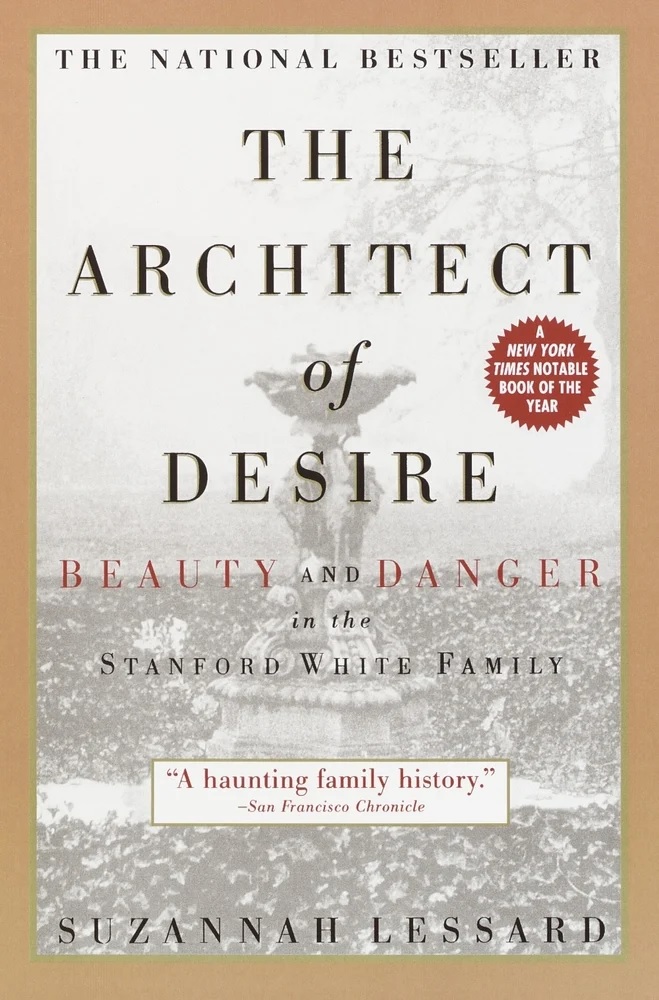
Suzannah Lessard, an author and writer for the New Yorker "who examined the ways in which people are marked by place--and the ways in which they, in turn, mark the landscape--and whose best-selling memoir, The Architect of Desire: Beauty and Danger in the Stanford White Family, explored the dark history of Mr. White, the Gilded Age architect who was her great-grandfather," died January 29.

Rediscover

Rediscover: Suzannah Lessard

Suzannah Lessard, an author and writer for the New Yorker "who examined the ways in which people are marked by place--and the ways in which they, in turn, mark the landscape--and whose best-selling memoir, The Architect of Desire: Beauty and Danger in the Stanford White Family [1996], explored the dark history of Mr. White, the Gilded Age architect who was her great-grandfather," died January 29 at age 81, the New York Times reported. Her other books include The View from a Small Mountain: Reading the American Landscape (2017) and The Absent Hand: Reimagining Our American Landscape (2019).

Lessard grew up in a compound that her family called "the Place"--largely created by White--in St. James, on the North Shore of Long Island. "The centerpiece of the compound was Box Hill, a gabled confection designed by Mr. White, who was famous for the Beaux-Arts palaces that he and his firm, McKim, Mead & White, created for America's newly minted merchant-royals in the late 19th century--and for the scandal of his death," the Times wrote. In 1906, he was fatally shot by Harry K. Thaw, whose 21-year-old wife had been sexually assaulted when she was 16 by White.

Lessard joined the New Yorker in the mid-1970s. "She was a true eccentric, in the best way," her friend Daphne Merkin, the author and essayist, said. "She thought originally and made connections that weren't immediately apparent. She roamed in her mind, always looking for a bigger context."

Her great-grandfather's story, along with those of Lessard's "eccentric and erratic family," were part of the environment she lived in, the Times noted, adding that her memoir "was decades in the making. It was the book she could not write and yet felt compelled to write, and the writer's block she suffered often compromised her other work."

"Underneath the entrancing Stanford White surface is predation," Lessard wrote. "Behind the aesthetic sophistication of a Stanford White interior is the blindly voracious, irresponsible force, both personal and that of a whole class, a whole nation out of control."

Powered by: Xtenit